Bitcoin suffered a sudden and deep drop in November, losing nearly a quarter of its value and wiping out over $1 trillion across the crypto market. Related Reading: Bitcoin’s Sudden Volatility Jump Signals Options Could Be Calling The Shots—Analyst Whales Trim Positions Before Crash According to on-chain data from CryptoQuant, large holders played a central role. Wallets holding between 1,000–10,000 BTC pared back their stakes in the weeks leading up to the fall. Those big sellers took profits after the October rally, and in many cases selling was steady rather than panicked. When large players step back like that, market depth can vanish quickly. A quick overview of Bitcoin’s price decline shows prices slid from record highs above $126,000 in October to roughly $81,000 at the lowest point, before a partial bounce to $87k was recorded. Traders and funds were caught off guard by the speed of the move. At the time of writing, Bitcoin was trading at $87,086, up 1.5% in the last 24 hours. Retail Selling Added To Pressure Based on reports, small wallets also leaned toward safety. Holders under 10 BTC and groups up to 1,000 BTC reduced positions, removing another layer of potential buyers. Has Bitcoin Found Its Bottom? Cohorts Tell the Whole Story “BTC may have formed a local bottom, supported by a strong rebound and accumulation from: 100–1k BTC holders. >10k BTC holders. However, the crucial 1k–10k BTC cohort is still distributing, preventing a full… pic.twitter.com/dGU4CBD1Bw — CryptoQuant.com (@cryptoquant_com) November 25, 2025 Buying interest from casual investors was weaker than expected. Mid-sized holders — those with 10–100 and 100–1,000 BTC — did buy during the correction, and their activity helped slow the slide. Still, their buying power was not enough to match the large outflows. Futures Liquidations Intensified The Drop Reports show that futures market dynamics turned a correction into a crash. Over a 13-day stretch, long positions were forcefully closed out. That cascade removed bids and created a chain reaction of selling that pushed Bitcoin from around $105K down to $81K. Liquidations were heavy, and the selling pressure was compounded as each forced sale fed into the next. A Tentative Rebound Shows Life After the lows were hit, Bitcoin climbed back to about $87,500. This rebound has been taken by some as a sign that a local bottom might be forming. According to CryptoQuant, however, the recovery cannot be considered secure while the 1,000–10,000 BTC group keeps reducing holdings. The market’s health was being tested by who chose to sell and who chose to buy. Bottom Status Hinges On Whale Activity Market watchers say a true reversal needs selling from large wallets to stop. If those whales pause, mid-sized buyers might build a firmer floor and confidence could return. If selling continues, lower levels may be explored once again. The coming sessions will be watched closely by traders who want to see whether large holders change course or keep cashing out. Related Reading: Bitcoin Creator Somehow Becomes ‘Poor’ By Losing $41 Billion Without Saying A Word For now, the situation is simple and tense at the same time: prices have recovered slightly, but the structural weakness that allowed a 25% fall was exposed. Bitcoin could face further losses after its recent crash, if CryptoQuant’s data is anything to go by. Large holders have been taking profits, while retail investors have also been selling, leaving fewer buyers to support the market. Analysts say the next move will depend on whether these big holders continue selling or if mid-sized buyers step in to stabilize prices. Featured image from Vecteezy, chart from TradingViewBitcoin suffered a sudden and deep drop in November, losing nearly a quarter of its value and wiping out over $1 trillion across the crypto market. Related Reading: Bitcoin’s Sudden Volatility Jump Signals Options Could Be Calling The Shots—Analyst Whales Trim Positions Before Crash According to on-chain data from CryptoQuant, large holders played a central role. Wallets holding between 1,000–10,000 BTC pared back their stakes in the weeks leading up to the fall. Those big sellers took profits after the October rally, and in many cases selling was steady rather than panicked. When large players step back like that, market depth can vanish quickly. A quick overview of Bitcoin’s price decline shows prices slid from record highs above $126,000 in October to roughly $81,000 at the lowest point, before a partial bounce to $87k was recorded. Traders and funds were caught off guard by the speed of the move. At the time of writing, Bitcoin was trading at $87,086, up 1.5% in the last 24 hours. Retail Selling Added To Pressure Based on reports, small wallets also leaned toward safety. Holders under 10 BTC and groups up to 1,000 BTC reduced positions, removing another layer of potential buyers. Has Bitcoin Found Its Bottom? Cohorts Tell the Whole Story “BTC may have formed a local bottom, supported by a strong rebound and accumulation from: 100–1k BTC holders. >10k BTC holders. However, the crucial 1k–10k BTC cohort is still distributing, preventing a full… pic.twitter.com/dGU4CBD1Bw — CryptoQuant.com (@cryptoquant_com) November 25, 2025 Buying interest from casual investors was weaker than expected. Mid-sized holders — those with 10–100 and 100–1,000 BTC — did buy during the correction, and their activity helped slow the slide. Still, their buying power was not enough to match the large outflows. Futures Liquidations Intensified The Drop Reports show that futures market dynamics turned a correction into a crash. Over a 13-day stretch, long positions were forcefully closed out. That cascade removed bids and created a chain reaction of selling that pushed Bitcoin from around $105K down to $81K. Liquidations were heavy, and the selling pressure was compounded as each forced sale fed into the next. A Tentative Rebound Shows Life After the lows were hit, Bitcoin climbed back to about $87,500. This rebound has been taken by some as a sign that a local bottom might be forming. According to CryptoQuant, however, the recovery cannot be considered secure while the 1,000–10,000 BTC group keeps reducing holdings. The market’s health was being tested by who chose to sell and who chose to buy. Bottom Status Hinges On Whale Activity Market watchers say a true reversal needs selling from large wallets to stop. If those whales pause, mid-sized buyers might build a firmer floor and confidence could return. If selling continues, lower levels may be explored once again. The coming sessions will be watched closely by traders who want to see whether large holders change course or keep cashing out. Related Reading: Bitcoin Creator Somehow Becomes ‘Poor’ By Losing $41 Billion Without Saying A Word For now, the situation is simple and tense at the same time: prices have recovered slightly, but the structural weakness that allowed a 25% fall was exposed. Bitcoin could face further losses after its recent crash, if CryptoQuant’s data is anything to go by. Large holders have been taking profits, while retail investors have also been selling, leaving fewer buyers to support the market. Analysts say the next move will depend on whether these big holders continue selling or if mid-sized buyers step in to stabilize prices. Featured image from Vecteezy, chart from TradingView

Bitcoin Faces More Downside After Recent Crash, Data Shows

2025/11/26 20:00
3 min di lettura
Per feedback o dubbi su questo contenuto, contattateci all'indirizzo crypto.news@mexc.com.

Bitcoin suffered a sudden and deep drop in November, losing nearly a quarter of its value and wiping out over $1 trillion across the crypto market.

Whales Trim Positions Before Crash

According to on-chain data from CryptoQuant, large holders played a central role. Wallets holding between 1,000–10,000 BTC pared back their stakes in the weeks leading up to the fall.

Those big sellers took profits after the October rally, and in many cases selling was steady rather than panicked. When large players step back like that, market depth can vanish quickly.

A quick overview of Bitcoin’s price decline shows prices slid from record highs above $126,000 in October to roughly $81,000 at the lowest point, before a partial bounce to $87k was recorded. Traders and funds were caught off guard by the speed of the move.

At the time of writing, Bitcoin was trading at $87,086, up 1.5% in the last 24 hours.

Retail Selling Added To Pressure

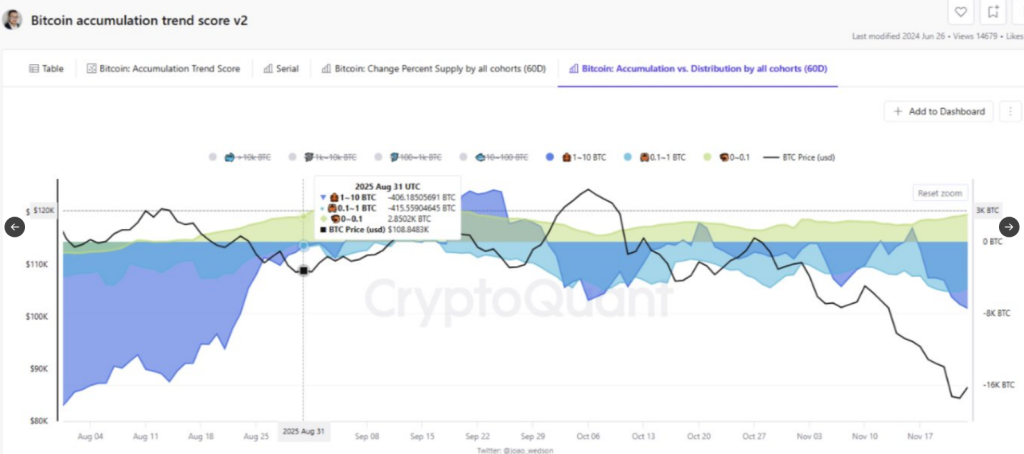
Based on reports, small wallets also leaned toward safety. Holders under 10 BTC and groups up to 1,000 BTC reduced positions, removing another layer of potential buyers.
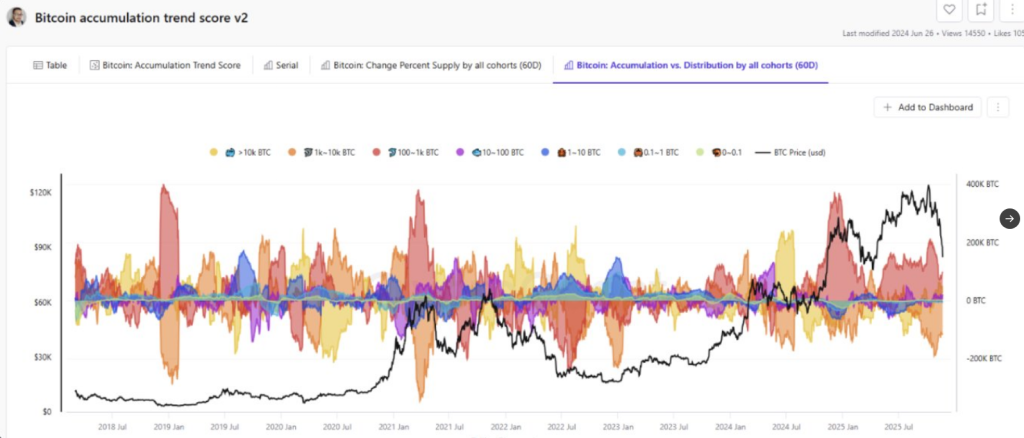
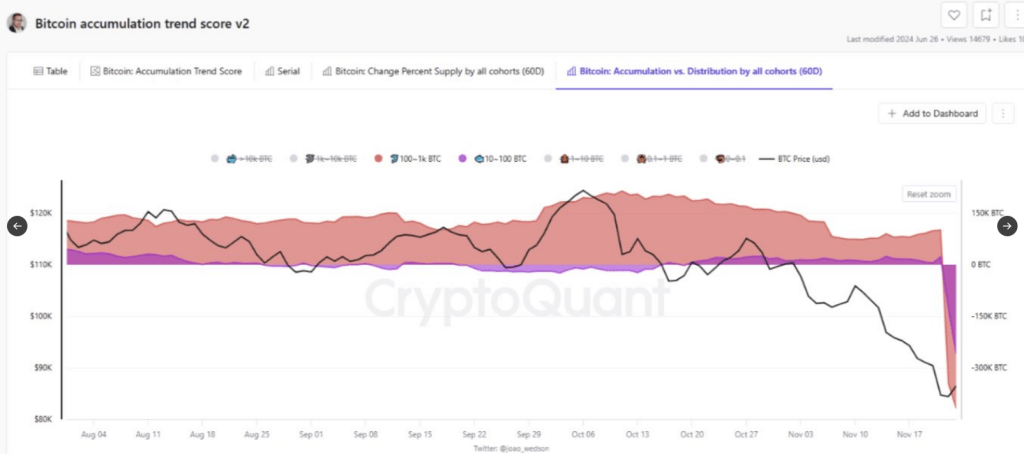
Buying interest from casual investors was weaker than expected. Mid-sized holders — those with 10–100 and 100–1,000 BTC — did buy during the correction, and their activity helped slow the slide. Still, their buying power was not enough to match the large outflows.
Futures Liquidations Intensified The Drop

Reports show that futures market dynamics turned a correction into a crash. Over a 13-day stretch, long positions were forcefully closed out.

That cascade removed bids and created a chain reaction of selling that pushed Bitcoin from around $105K down to $81K. Liquidations were heavy, and the selling pressure was compounded as each forced sale fed into the next.
A Tentative Rebound Shows Life

After the lows were hit, Bitcoin climbed back to about $87,500. This rebound has been taken by some as a sign that a local bottom might be forming.

According to CryptoQuant, however, the recovery cannot be considered secure while the 1,000–10,000 BTC group keeps reducing holdings. The market’s health was being tested by who chose to sell and who chose to buy.

Bottom Status Hinges On Whale Activity

Market watchers say a true reversal needs selling from large wallets to stop. If those whales pause, mid-sized buyers might build a firmer floor and confidence could return.

If selling continues, lower levels may be explored once again. The coming sessions will be watched closely by traders who want to see whether large holders change course or keep cashing out.

For now, the situation is simple and tense at the same time: prices have recovered slightly, but the structural weakness that allowed a 25% fall was exposed.

Bitcoin could face further losses after its recent crash, if CryptoQuant’s data is anything to go by. Large holders have been taking profits, while retail investors have also been selling, leaving fewer buyers to support the market.

Analysts say the next move will depend on whether these big holders continue selling or if mid-sized buyers step in to stabilize prices.

Featured image from Vecteezy, chart from TradingView

Opportunità di mercato
Logo Moonveil
Valore Moonveil (MORE)
$0.0001492
$0.0001492$0.0001492
-1.06%
USD
Grafico dei prezzi in tempo reale di Moonveil (MORE)
Disclaimer: gli articoli ripubblicati su questo sito provengono da piattaforme pubbliche e sono forniti esclusivamente a scopo informativo. Non riflettono necessariamente le opinioni di MEXC. Tutti i diritti rimangono agli autori originali. Se ritieni che un contenuto violi i diritti di terze parti, contatta crypto.news@mexc.com per la rimozione. MEXC non fornisce alcuna garanzia in merito all'accuratezza, completezza o tempestività del contenuto e non è responsabile per eventuali azioni intraprese sulla base delle informazioni fornite. Il contenuto non costituisce consulenza finanziaria, legale o professionale di altro tipo, né deve essere considerato una raccomandazione o un'approvazione da parte di MEXC.

Potrebbe anche piacerti

Aave CEO Breaks Silence on Game-changing Upgrade in Q4: Details

Aave CEO Breaks Silence on Game-changing Upgrade in Q4: Details

The post Aave CEO Breaks Silence on Game-changing Upgrade in Q4: Details appeared on BitcoinEthereumNews.com. Aave CEO and founder Stani Kulechov has broken his silence on a major upgrade coming to Aave in Q4, 2025. The Aave v4 upgrade is anticipated to be one of the major events in DeFi in 2025, including features such as a Hub-and-Spoke architecture, reinvestment module and others, boosting Aave liquidity and saving gas. The upgrade will also include UX improvements and a new liquidation engine. The Reinvestment Module would help Aave earn more from unused capital, utilizing idle liquidity. On Sept. 15, the Aave founder informed the crypto community of the Aave v4 upgrade roadmap, which highlights where the project is currently at in its development. Aave CEO reacts The Aave founder commented in reaction to a tweet highlighting the features of Aave V4, “very nice overview of the Aave V4 feature,” adding that the Reinvestment Module was not part of the initial design. Very nice overview of the Aave V4 features. Interestingly, the Reinvestment Module wasn’t part of our original design a couple of years ago when we laid down the protocol architecture. It actually emerged later as an unexpected, but exciting, “last-minute” addition. The… https://t.co/Zkp3bmrCAZ — Stani.eth (@StaniKulechov) September 17, 2025 “Interestingly, the Reinvestment Module wasn’t part of our original design a couple of years ago when we laid down the protocol architecture. It actually emerged later as an unexpected, but exciting, last-minute addition,” Kulechov added. The Aave CEO explained the reinvestment feature further as one that allows the protocol to deploy pool float into low-risk, highly liquid yield strategies, creating additional efficiency for LPs. The feature is somewhat inspired by Ethena’s rebalance to USDtb but applied natively within Aave. The Aave team shared the launch roadmap for the Aave upgrade on Sept. 15, revealing a recent V4 Development Update. Source: https://u.today/aave-ceo-breaks-silence-on-game-changing-upgrade-in-q4-details
Condividi
BitcoinEthereumNews2025/09/18 16:57
Iran threatens to target financial entities that finance US military budget

Iran threatens to target financial entities that finance US military budget

The post Iran threatens to target financial entities that finance US military budget appeared on BitcoinEthereumNews.com. In a social media post on Sunday, Mohammad
Condividi
BitcoinEthereumNews2026/03/23 07:05
SoFi’s $1.6 Billion EBITDA Target: The Path to Fintech Profitability

SoFi’s $1.6 Billion EBITDA Target: The Path to Fintech Profitability

SoFi Technologies achieved a significant milestone in Q4 2023: GAAP net income profitability. This was the first quarter in the company’s history that it generated
Condividi
Techbullion2026/03/23 07:09