Recently, the former PEPE boss has transformed into a contract whale, frequently opening contracts worth hundreds of millions of dollars in Hyperliquid, which has attracted the attention of the market.Recently, the former PEPE boss has transformed into a contract whale, frequently opening contracts worth hundreds of millions of dollars in Hyperliquid, which has attracted the attention of the market.

James Wynn: From the slums to a crypto giant, a crazy $1.2 billion gamble

2025/05/25 15:25
6 min di lettura
Per feedback o dubbi su questo contenuto, contattateci all'indirizzo crypto.news@mexc.com.

Author: Frank, PANews

Recently, the former PEPE boss has transformed into a contract giant, and has frequently opened contracts worth hundreds of millions of dollars on Hyperliquid, which has attracted the attention of the market. As one of the few giant whales who has publicly disclosed his identity on Hyperliquid and is active in the community, James Wynn's daily position changes have become a hot topic for many investors.

What is James Wynn's background, and how does he affect the entire market with his remarks and positions?

The "10U God of War" who started with PEPE

According to James Wynn's Twitter account, he was born in a "forgotten town" in the UK, which was full of crime, drugs, alcohol and poverty. James Wynn said that he lived in dire straits since he was a child and "barely made ends meet every week."

James Wynn: From the slums to a crypto giant, a crazy $1.2 billion gamble

In 2022, after being exposed to cryptocurrency, James Wynn became a member of the 10 U Warriors. He often wandered between several ultra-small-cap MEMEs until he later discovered PEPE on iToken. Subsequently, James Wynn chose to buy PEPE heavily and made tens of millions of dollars. Previously, PANews also verified this from the chain in another report on James Wynn. (Related reading: Legendary Meme coin hunter James: Earned $25 million with $7,000, but now the shouting effect has failed )

Judging from the information on social media, James Wynn started to join Twitter in 2023, and almost all of his initial content focused on the promotion and publicity of PEPE coins. In April 2023, James Wynn predicted that the market value of PEPE tokens would rise to 4.2 billion US dollars. The market value at that time was 4.2 million US dollars. A year later, this prediction not only came true, but even exceeded his expectations at the time. In October 2024, the market value of PEPE exceeded 10 billion US dollars, becoming one of the MEME coins with the highest market value.

James Wynn: From the slums to a crypto giant, a crazy $1.2 billion gamble

Of course, in this process, as one of the largest holders of PEPE coins, James Wynn also made huge profits. According to previous statistics from PANews, James Wynn's principal in PEPE transactions was only US$7,600, and his profits exceeded US$25 million by April 2024. Considering that PEPE later rose by about 3 times again, James Wynn's overall profits may exceed US$50 million.

Harvesting fans and transforming after reputation is damaged

By 2024, with the successful creation of PEPE's personality, James Wynn's posts began to involve more MEME coins (such as BIAO, ANDY, WOLF), and he often released CAs of some new tokens to shout orders. In April 2024, James Wynn recommended a token called ELON, and in the following days, he made crazy orders like he recommended PEPE. At the same time, James Wynn also quietly laid out this token using several wallets. Under the highly appealing recommendation, many community players began to follow up and buy ELON. When the token rose a hundred times, James Wynn claimed that there was a problem with the token and said that he had cleared the token. This wave of operations caused the price of ELON to fall by 70% in a short period of time, and many players were buried in James Wynn's liquidation landslide. Such operations also seriously damaged James Wynn's reputation in the community, and people began to realize that MEME gods are not reliable.

Subsequently, James Wynn's content gradually began to change, from a community promoter to an investor and analyst. In the second half of 2024, he began to gradually turn to Bitcoin trends and market analysis. He also changed his Twitter name from "James Wynn (The GOAT)" to the current "James Wynn Whale".

A high-leverage gamble worth $1.2 billion

In March 2025, James Wynn officially began to switch to Hyperliquid and deposited approximately US$6 million for contract trading. In just two months, through high-leverage operations on Hyperliquid, as of May 24, James Wynn increased his profits to approximately US$48 million.

Especially in the past month, through frequent high-leverage and large-position investments, James Wynn not only frequently sent his operations to the hot lists on social media, but also used the profit of 36 million US dollars in a single month to once again prove his trading talent or luck.

His trading targets on Hyperliquid are surprisingly simple, mainly focusing on Bitcoin and a few meme coins such as PEPE, TRUMP and FARTCOIN. For example, on April 6, 2025, he went long on Bitcoin at an average price of $94,292 and 40x leverage; when the price of Bitcoin rose from $94,000 to $100,000, his floating profit reached $5 million. And his 10x leveraged long position in PEPE had a floating profit of up to $23 million. Trading in TRUMP and FARTCOIN tokens also contributed profits of approximately $5 million to $5.57 million and $4.3 million to $5.15 million, respectively.
James Wynn: From the slums to a crypto giant, a crazy $1.2 billion gamble

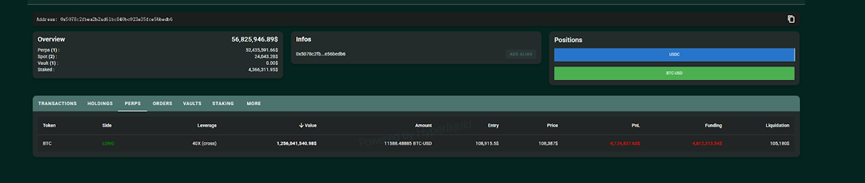
As of May 24, James Wynn's total funds in Hyperliquid were approximately $55.8 million, compared to the opening position of $1.25 billion. His overall leverage ratio is about 22 times. Under such a leverage ratio, once the market volatility exceeds 5%, he may face full liquidation. Therefore, his trading style is a high-risk, high-return route and is not suitable for ordinary traders. Of course, considering that James Wynn had already earned tens of millions of dollars in principal on MEMEs such as PEPE, his position is also within his controllable risk range. On May 24, James Wynn closed his $1.2 billion position, with a loss of approximately $13.39 million. Due to the huge loss of this transaction, his overall income also fell back to around $40 million.

James Wynn: From the slums to a crypto giant, a crazy $1.2 billion gamble

Looking back at James Wynn's crypto trading career, from being unknown to becoming the leader of MEME, and then transforming into a contract trading whale again. James Wynn's experience seems to best fit people's imagination of crypto wealth stories. And he himself seems unwilling to be a low-key person. Despite holding huge wealth, he is still active on social media. This exposure also brings him real benefits. During the MEME shouting period, he can use his influence to ensure that the MEME coins he invested in always have followers to carry the sedan chair. In the contract trading stage, as the market's attention increases, James Wynn's operations will also affect some traders' judgment of the market to a certain extent, and even form a copycat effect (but this effect may not be as obvious as during the MEME coin period).

In general, James Wynn's success seems to be a mixture of market timing, extraordinary courage (or extreme adventurism) and strong self-marketing ability. In the end, James Wynn's "history of success" may leave more questions than answers to the market. Is he a trading wizard with unique vision, or just a lucky guy who caught the trend of the times? Will he get rich or go bankrupt in the next stop?

All this is far from over. The crypto market has never lacked periodic "heroes", but becoming an "evergreen" still requires the test of time.


Opportunità di mercato
Logo Pepe
Valore Pepe (PEPE)
$0.000003324
$0.000003324$0.000003324
-0.41%
USD
Grafico dei prezzi in tempo reale di Pepe (PEPE)
Disclaimer: gli articoli ripubblicati su questo sito provengono da piattaforme pubbliche e sono forniti esclusivamente a scopo informativo. Non riflettono necessariamente le opinioni di MEXC. Tutti i diritti rimangono agli autori originali. Se ritieni che un contenuto violi i diritti di terze parti, contatta crypto.news@mexc.com per la rimozione. MEXC non fornisce alcuna garanzia in merito all'accuratezza, completezza o tempestività del contenuto e non è responsabile per eventuali azioni intraprese sulla base delle informazioni fornite. Il contenuto non costituisce consulenza finanziaria, legale o professionale di altro tipo, né deve essere considerato una raccomandazione o un'approvazione da parte di MEXC.

Potrebbe anche piacerti

UNI Price Prediction: Testing $4.17 Upper Band Resistance, Targets $4.50 by April 2026

UNI Price Prediction: Testing $4.17 Upper Band Resistance, Targets $4.50 by April 2026

Uniswap trades at $3.88 with neutral RSI at 51.98. Technical analysis suggests potential breakout to $4.17 upper Bollinger Band, with bullish targets reaching $
Condividi
BlockChain News2026/03/12 17:21
Speed, Cost, and Intelligence: How Kie.ai’s Gemini 3 Flash API Balances Performance and Budget for Developers

Speed, Cost, and Intelligence: How Kie.ai’s Gemini 3 Flash API Balances Performance and Budget for Developers

Integrating AI into applications is a balancing act between performance, cost, and intelligence. Traditionally, high-performance AI models come with steep costs
Condividi
Techbullion2026/03/12 16:55
Cash Flow Valuation HyperLiquid: Could $HYPE Reach $385 in Five Years?

Cash Flow Valuation HyperLiquid: Could $HYPE Reach $385 in Five Years?

Author: G3ronimo Compiled by: TechFlow HyperLiquid has grown into a mature crypto-native exchange, with the majority of its net fees programmatically distributed directly to token holders through an "Assistance Fund" (AF). This design makes $HYPE one of the few tokens capable of being valued based on cash flow. To date, most valuations of HyperLiquid have relied on traditional multiples, comparing it to established financial platforms like Coinbase and Robinhood, using EBITDA or revenue multiples as a reference. Unlike traditional corporate stocks, where management typically retains and reinvests earnings at their discretion, HyperLiquid systematically returns 93% of transaction fees directly to token holders through a support fund. This model creates predictable and quantifiable cash flows, making it well-suited for detailed discounted cash flow (DCF) analysis rather than static multiple comparisons. Our methodology begins by determining $HYPE's cost of capital. We then invert the current market price to determine the market-implied future earnings. Finally, we apply growth projections to these earnings streams and compare the resulting intrinsic value to today's market price, revealing the valuation gap between current pricing and fundamental value. Why choose discounted cash flow (DCF) over a multiple? While other valuation methods compare HyperLiquid to Coinbase and Robinhood via EBITDA multiples, these methods have the following limitations: The difference between the corporate and token structures: Coinbase and Robinhood are corporate stocks, whose capital allocation is guided by the board of directors, and profits are retained and reinvested by management; while HyperLiquid systematically returns 93% of trading fees directly to token holders through a relief fund. Direct Cash Flow: HyperLiquid's design generates predictable cash flows that are well-suited to DCF models, rather than static multiples. Growth and risk characteristics: DCFs are able to explicitly model different growth scenarios and risk adjustments, whereas multiples may not adequately capture growth and risk dynamics. Determining an appropriate discount rate To determine our cost of equity, we start with reference data from the public market and adjust for cryptocurrency-specific risks: Cost of equity (r) ≈ Risk-free rate + β × Market risk premium + Crypto/illiquidity premium Beta Analysis Based on regression analysis with the S&P 500: Robinhood (HOOD): Beta of 2.5, implied cost of equity of 15.6%; Coinbase (COIN): Beta of 2.0, implied cost of equity of 13.6%; HyperLiquid (HYPE): Beta is 1.38 and the implied cost of equity is 10.5%. At first glance, $HYPE appears to have a lower beta, and therefore a lower cost of equity than Robinhood and Coinbase. However, the R² value reveals an important limitation: HOOD: The S&P 500 explains 50% of its returns; COIN: The S&P 500 explains 34% of its return; HYPE: The S&P 500 only explains 5% of its returns. $HYPE’s low R² suggests that traditional stock market factors are insufficient to explain its price fluctuations, and crypto-native risk factors need to be considered. risk assessment Despite $HYPE’s lower beta, we still adjust its discount rate from 10.5% to 13% (which is more conservative compared to COIN’s 13.6% and HOOD’s 15.6%) for the following reasons: Lower governance risk: Direct programmatic distribution of 93% of fees reduces concerns about corporate governance. In contrast, COIN and HOOD do not return any earnings to shareholders, and their capital allocation is determined by management. Higher Market Risk: $HYPE is a crypto-native asset and is subject to additional regulatory and technological uncertainties. Liquidity considerations: Token markets are generally less liquid than established stock markets. Get the Market Implied Price (MIP) Using our 13% discount rate, we can reverse engineer the market’s implied earnings expectations at the current $HYPE token price of approximately $54: Current market expectations: 2025: Total revenue of $700 million 2026: Total revenue of $1.4 billion Terminal growth: 3% annual growth thereafter These assumptions yield an intrinsic value of approximately $54, which is consistent with current market prices. This suggests that the market is pricing in modest growth based on current fee levels. At this point we need to ask a question: Does the market-implied price (MIP) reflect future cash flows? Alternative growth scenarios @Keisan_Crypto presents an attractive 2-year and 5-year bull market scenario. Original tweet link: Click here Two-year bull market forecast According to @Keisan_Crypto’s analysis, if HyperLiquid achieves the following goals: Annualized fees: $3.6 billion Aid fund income: $3.35 billion (93% of fees) Result: HYPE's intrinsic value is $128 (140% undervalued at current price) Related links Five-year bull market scenario Under a five-year bull market scenario (link), he predicts that transaction fees will reach $10 billion annually, with $9.3 billion accruing to $HYPE. He assumes HyperLiquid's global market share will grow from its current 5% to 50% by 2030. Even if it doesn't reach 50% market share, these figures are still achievable with a smaller market share as global trading volumes continue to grow. Five-year bull market forecast Annualized fees: $10 billion Aid fund income: $9.3 billion Result: HYPE's intrinsic value is $385 (600% undervalued at current price) Related links While this valuation is lower than Keisan's $1,000 target, the difference stems from our assumption of normalized earnings growth at 3% annually thereafter, while Keisan's model uses a cash flow multiple. We believe using cash flow multiples to project long-term value is problematic, as market multiples are volatile and can vary significantly over time. Furthermore, the multiples themselves incorporate earnings growth assumptions, while using the same cash flow multiple five years from now as one or two years later implies that growth levels from 2030 onward will be consistent with those in 2026/2027. Therefore, the multiples are more appropriate for short-term asset pricing. However, regardless of which model is used, $HYPE remains undervalued; this is a subtle difference. Additional Value Driver: USDH Under the Native Market model, USDH will use 50% of its stablecoin revenue for buybacks similar to a bailout fund. As a result, $HYPE can increase its free cash flow by $100 million (50% of $200 million) annually. Looking ahead five years, if USDH's market capitalization reaches $25 billion (currently still one-third of USDC's, and an even smaller portion of the total stablecoin market five years from now), its annual revenue could reach $1 billion. Following the same 50% distribution model, this would generate an additional $500 million in free cash flow per year for the aid fund. This would value each token at over $400. Excluding Value Drivers: HIP-3 and HyperEVM This DCF analysis intentionally excludes two important potential value drivers that are not amenable to cash flow modeling. Clearly, these would provide additional incremental value and could therefore be evaluated separately using different valuation methodologies and then added to this valuation. Summarize Our DCF analysis indicates that if HyperLiquid can maintain its growth trajectory and market position, the $HYPE token is significantly undervalued. The token's unique feature of programmatic fee distribution makes it particularly suitable for cash flow-based valuation methodologies. Methodological Notes This analysis builds on research by @Keisan_Crypto and @GLC_Research. The DCF model is open source and can be modified at the following link: https://valypto.xyz/project/hyperliquid/oNQraQIg Market data and forecasts are subject to change, and models should be updated promptly based on the latest information.
Condividi
PANews2025/09/19 08:00