On October 12th, MetaDao, the Solana blockchain launchpad, launched its latest ICO round: AVICI, LOYAL, ZKSOL, and PAYSTREAM. Just a week prior, while the BSC blockchain was caught up in a meme coin frenzy, MetaDAO's popularity within the Solana ecosystem continued to climb. Its platform token, META, saw its value more than triple during the National Day holiday, becoming one of Solana's most prominent assets. Its ICO project, UMBRA, launched on October 6th, soared from a pre-sale price of $0.30 to $2.10, achieving a 700% return. This series of data not only reflects MetaDAO’s strong ability to generate revenue as an on-chain fundraising engine, but also indicates that the speculative enthusiasm for the Solana ecosystem is returning in full force. MetaDAO may become the core narrative of the Solana ecosystem in the next stage. From “Voting” to “Betting”: MetaDAO’s Market-Based Governance Experiment MetaDAO operates in a completely different way from previous launchpads or ICO platforms. Its logic is simple: let the market determine the fate of the project. When a project raises funds on MetaDAO, all USDC raised doesn't go directly into the team's accounts. Instead, it goes into an on-chain treasury governed by the market. If a team wishes to use funds, issue additional tokens, modify parameters, or even adjust product direction, they must submit a proposal. The approval of a proposal is determined not by voting but by transactions—this is MetaDAO's core governance mechanism, Futarchy. This mechanism is similar to a prediction market, where investors aren't "voting" but "betting." If they believe a proposal will increase token value, they buy into the "Approve" market; if they believe it's harmful, they buy into the "Reject" market. Ultimately, market price itself becomes the basis for judgment—the party with the higher value wins, and the proposal is implemented. This design completely breaks away from the "most votes, most decisions" structure of governance and directly ties every decision to token value. This mechanism has two significant advantages. First, it prevents project owners from "rugging." In the traditional ICO model, once a project successfully raises funds, investors have virtually no leverage, and funds could be misappropriated or disappear at any time. In MetaDAO, all USDC raised is held in an on-chain vault, and any spending or token minting is subject to market verification. If the project team leaves or the market value falls below the stated funds, anyone can initiate a proposal to redeem the funds. Governance no longer relies on "trusting the team" but on "trusting the mechanism." Secondly, incentives are tied to long-term value. MetaDAO's ICO model utilizes a highly volatile and transparent issuance method. Investors receive tokens proportional to their investment, while the founding team's earnings are locked into a "performance package" tied to price performance. The team unlocks corresponding incentives every time the token price reaches 2x, 4x, 8x, 16x, and 32x. All unlocks are subject to an 18-month lock-up period and a three-month time-weighted average price verification. This means that the team can only cash in on returns when the project continues to grow and the token truly gains market recognition. This "delayed gratification" structure redefines the boundary between short-term speculation and long-term development. What projects are worth paying attention to? @UmbraPrivacy UMBRA is Solana's privacy protocol, built on ArciumHQ. Its goal isn't simply to enable "private transactions," but rather to provide a compliant, auditable privacy infrastructure for the entire on-chain financial system. By building an auditable, anonymous transfer system, UMBRA enables transactions to be verified on-chain without exposing any critical details, enabling the coexistence of privacy and trust. UMBRA's governance is fully decentralized—fundraising, tokens, and the treasury are all controlled by the community. The team and early backers have allocated a total of 13.5 million tokens, which will be gradually unlocked after an 18-month lockup period, with returns linked to token performance. @AviciMoney Avici is a crypto neobank built on Solana, aiming to create a global internet banking system that is user-hosted and trustless. Users can open a stablecoin Visa card in minutes, spend directly with crypto assets, and deposit funds through a virtual account. Avici also plans to launch an on-chain credit score, replacing traditional credit reporting with zero-knowledge proofs, allowing users to obtain fairer credit services while protecting their privacy. The platform currently boasts over $1 million in spending, a 70% retention rate, and over 9,000 users. Avici will launch an ICO on MetaDAO on October 14th, issuing an Ownership Coin. @loyal_hq Loyal is a decentralized intelligent inference protocol built on Solana and MagicBlock infrastructure, aiming to rebuild a private and open-source intelligent network. It allows users to securely call AI models and conduct private conversations on-chain. The user's wallet generates a PDA (Program Derived Address), which both records conversations and serves as a payment settlement node. AI inference fees are automatically distributed to computing nodes, developers, and the protocol itself, creating a fully decentralized incentive loop. The project will launch an ICO on MetaDAO on October 18th, with a total supply of 10 million tokens and a minimum fundraising amount of $500,000. 28% of the team's tokens will be locked for 18 months and unlocked in batches based on price multiples (2x, 4x, 8x, 16x, and 32x). @ZKLSOL ZKLSOL is the first protocol on Solana to combine privacy protection with yield generation. Traditional mixers require long periods of locked funds to enhance anonymity, but this means assets sit idle. ZKLSOL, on the other hand, relies on liquidity staking, earning interest on deposited SOL, allowing users to earn income while waiting for privacy mixing. ZKLSOL's yield model has a clear flywheel logic: users deposit SOL → generate ZKLSOL → generate yield from staking → pay a small fee upon withdrawal and transfer → fees and yield are combined into a reward pool, driving up APY, attracting more depositors, and further enhancing anonymity and fund security. The project will launch its ICO on MetaDAO on October 19th, with all funds raised going toward security audits, expanding LPs, and implementing regulatory compliance. @Paystreamlabs Paystream is a DeFi lending protocol that combines peer-to-peer matching and liquidity aggregation, aiming to maximize the efficiency of on-chain capital utilization. It achieves efficient capital circulation and maximized returns through a two-tiered structure: a P2P matching engine and a smart liquidity pool (LLP). At its core, Paystream's matching engine directly matches lenders and borrowers, ensuring the best interest rate for both parties. When the market temporarily lacks a match, the system automatically routes idle funds to the underlying yield pool, allowing the funds to continue generating returns. Protocol revenue primarily comes from two sources: a share of the matching spread and lending interest; and fees collected from users when borrowing, making leveraged markets, or withdrawing funds. The project will launch its ICO on MetaDAO on October 23rd. Summarize The recent rise of MetaDAO bears resemblance to the once-popular Believe ecosystem. The former reshapes fundraising tools with its "anti-rug" ICO mechanism, while the latter ignites investor sentiment with its Launchpad platform. Together, these two initiatives have driven Solona's alignment with the ICM (Internet Capital Market) ecosystem, gradually transitioning from MEME to sustainable speculation. Against the backdrop of the emergence of hot sectors like privacy, payments, and AI, MetaDAO may be becoming a key pillar in Solana's ecosystem recovery.On October 12th, MetaDao, the Solana blockchain launchpad, launched its latest ICO round: AVICI, LOYAL, ZKSOL, and PAYSTREAM. Just a week prior, while the BSC blockchain was caught up in a meme coin frenzy, MetaDAO's popularity within the Solana ecosystem continued to climb. Its platform token, META, saw its value more than triple during the National Day holiday, becoming one of Solana's most prominent assets. Its ICO project, UMBRA, launched on October 6th, soared from a pre-sale price of $0.30 to $2.10, achieving a 700% return. This series of data not only reflects MetaDAO’s strong ability to generate revenue as an on-chain fundraising engine, but also indicates that the speculative enthusiasm for the Solana ecosystem is returning in full force. MetaDAO may become the core narrative of the Solana ecosystem in the next stage. From “Voting” to “Betting”: MetaDAO’s Market-Based Governance Experiment MetaDAO operates in a completely different way from previous launchpads or ICO platforms. Its logic is simple: let the market determine the fate of the project. When a project raises funds on MetaDAO, all USDC raised doesn't go directly into the team's accounts. Instead, it goes into an on-chain treasury governed by the market. If a team wishes to use funds, issue additional tokens, modify parameters, or even adjust product direction, they must submit a proposal. The approval of a proposal is determined not by voting but by transactions—this is MetaDAO's core governance mechanism, Futarchy. This mechanism is similar to a prediction market, where investors aren't "voting" but "betting." If they believe a proposal will increase token value, they buy into the "Approve" market; if they believe it's harmful, they buy into the "Reject" market. Ultimately, market price itself becomes the basis for judgment—the party with the higher value wins, and the proposal is implemented. This design completely breaks away from the "most votes, most decisions" structure of governance and directly ties every decision to token value. This mechanism has two significant advantages. First, it prevents project owners from "rugging." In the traditional ICO model, once a project successfully raises funds, investors have virtually no leverage, and funds could be misappropriated or disappear at any time. In MetaDAO, all USDC raised is held in an on-chain vault, and any spending or token minting is subject to market verification. If the project team leaves or the market value falls below the stated funds, anyone can initiate a proposal to redeem the funds. Governance no longer relies on "trusting the team" but on "trusting the mechanism." Secondly, incentives are tied to long-term value. MetaDAO's ICO model utilizes a highly volatile and transparent issuance method. Investors receive tokens proportional to their investment, while the founding team's earnings are locked into a "performance package" tied to price performance. The team unlocks corresponding incentives every time the token price reaches 2x, 4x, 8x, 16x, and 32x. All unlocks are subject to an 18-month lock-up period and a three-month time-weighted average price verification. This means that the team can only cash in on returns when the project continues to grow and the token truly gains market recognition. This "delayed gratification" structure redefines the boundary between short-term speculation and long-term development. What projects are worth paying attention to? @UmbraPrivacy UMBRA is Solana's privacy protocol, built on ArciumHQ. Its goal isn't simply to enable "private transactions," but rather to provide a compliant, auditable privacy infrastructure for the entire on-chain financial system. By building an auditable, anonymous transfer system, UMBRA enables transactions to be verified on-chain without exposing any critical details, enabling the coexistence of privacy and trust. UMBRA's governance is fully decentralized—fundraising, tokens, and the treasury are all controlled by the community. The team and early backers have allocated a total of 13.5 million tokens, which will be gradually unlocked after an 18-month lockup period, with returns linked to token performance. @AviciMoney Avici is a crypto neobank built on Solana, aiming to create a global internet banking system that is user-hosted and trustless. Users can open a stablecoin Visa card in minutes, spend directly with crypto assets, and deposit funds through a virtual account. Avici also plans to launch an on-chain credit score, replacing traditional credit reporting with zero-knowledge proofs, allowing users to obtain fairer credit services while protecting their privacy. The platform currently boasts over $1 million in spending, a 70% retention rate, and over 9,000 users. Avici will launch an ICO on MetaDAO on October 14th, issuing an Ownership Coin. @loyal_hq Loyal is a decentralized intelligent inference protocol built on Solana and MagicBlock infrastructure, aiming to rebuild a private and open-source intelligent network. It allows users to securely call AI models and conduct private conversations on-chain. The user's wallet generates a PDA (Program Derived Address), which both records conversations and serves as a payment settlement node. AI inference fees are automatically distributed to computing nodes, developers, and the protocol itself, creating a fully decentralized incentive loop. The project will launch an ICO on MetaDAO on October 18th, with a total supply of 10 million tokens and a minimum fundraising amount of $500,000. 28% of the team's tokens will be locked for 18 months and unlocked in batches based on price multiples (2x, 4x, 8x, 16x, and 32x). @ZKLSOL ZKLSOL is the first protocol on Solana to combine privacy protection with yield generation. Traditional mixers require long periods of locked funds to enhance anonymity, but this means assets sit idle. ZKLSOL, on the other hand, relies on liquidity staking, earning interest on deposited SOL, allowing users to earn income while waiting for privacy mixing. ZKLSOL's yield model has a clear flywheel logic: users deposit SOL → generate ZKLSOL → generate yield from staking → pay a small fee upon withdrawal and transfer → fees and yield are combined into a reward pool, driving up APY, attracting more depositors, and further enhancing anonymity and fund security. The project will launch its ICO on MetaDAO on October 19th, with all funds raised going toward security audits, expanding LPs, and implementing regulatory compliance. @Paystreamlabs Paystream is a DeFi lending protocol that combines peer-to-peer matching and liquidity aggregation, aiming to maximize the efficiency of on-chain capital utilization. It achieves efficient capital circulation and maximized returns through a two-tiered structure: a P2P matching engine and a smart liquidity pool (LLP). At its core, Paystream's matching engine directly matches lenders and borrowers, ensuring the best interest rate for both parties. When the market temporarily lacks a match, the system automatically routes idle funds to the underlying yield pool, allowing the funds to continue generating returns. Protocol revenue primarily comes from two sources: a share of the matching spread and lending interest; and fees collected from users when borrowing, making leveraged markets, or withdrawing funds. The project will launch its ICO on MetaDAO on October 23rd. Summarize The recent rise of MetaDAO bears resemblance to the once-popular Believe ecosystem. The former reshapes fundraising tools with its "anti-rug" ICO mechanism, while the latter ignites investor sentiment with its Launchpad platform. Together, these two initiatives have driven Solona's alignment with the ICM (Internet Capital Market) ecosystem, gradually transitioning from MEME to sustainable speculation. Against the backdrop of the emergence of hot sectors like privacy, payments, and AI, MetaDAO may be becoming a key pillar in Solana's ecosystem recovery.
On October 12th, MetaDao, the Solana blockchain launchpad, launched its latest ICO round: AVICI, LOYAL, ZKSOL, and PAYSTREAM. Just a week prior, while the BSC blockchain was caught up in a meme coin frenzy, MetaDAO's popularity within the Solana ecosystem continued to climb. Its platform token, META, saw its value more than triple during the National Day holiday, becoming one of Solana's most prominent assets. Its ICO project, UMBRA, launched on October 6th, soared from a pre-sale price of $0.30 to $2.10, achieving a 700% return.
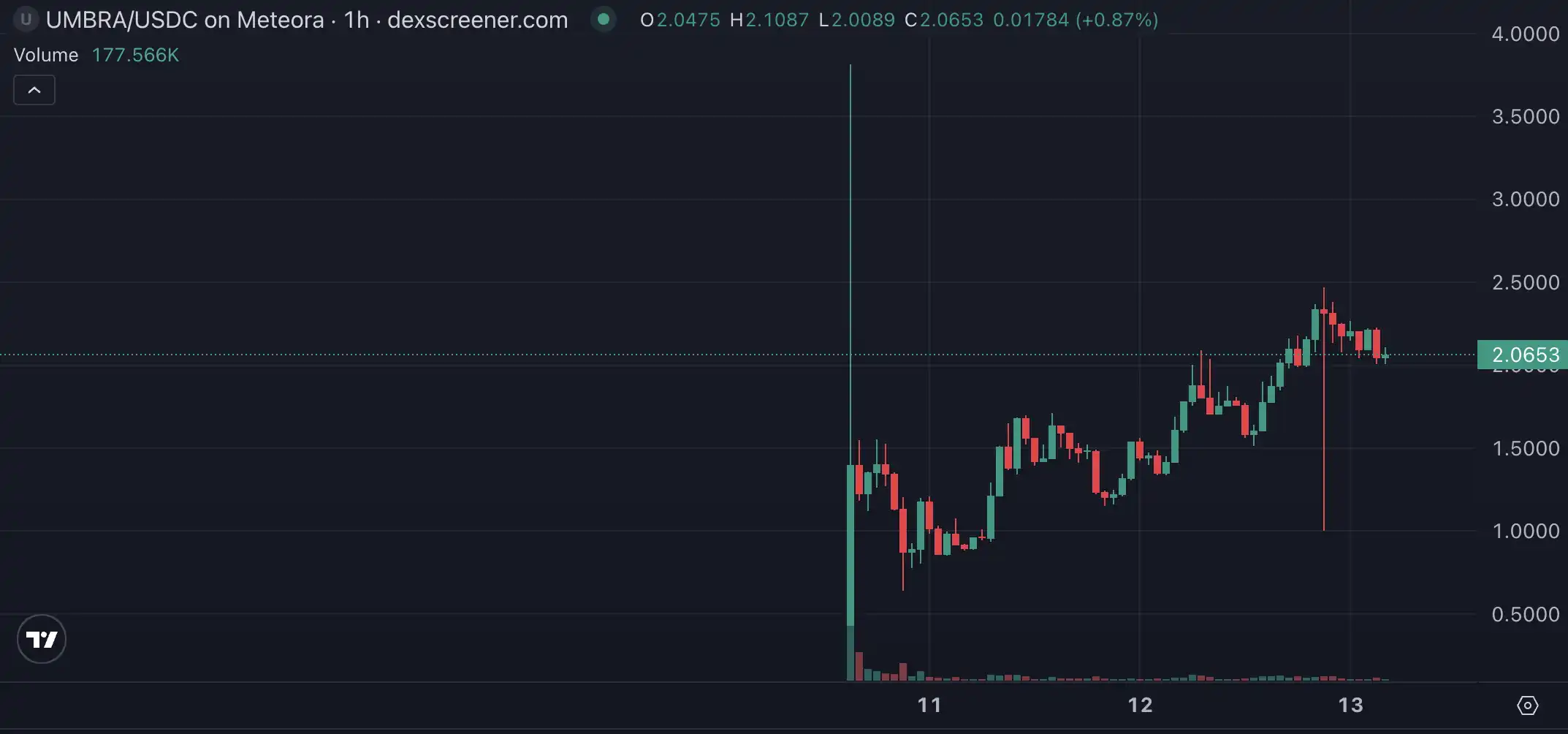
This series of data not only reflects MetaDAO’s strong ability to generate revenue as an on-chain fundraising engine, but also indicates that the speculative enthusiasm for the Solana ecosystem is returning in full force. MetaDAO may become the core narrative of the Solana ecosystem in the next stage.
From “Voting” to “Betting”: MetaDAO’s Market-Based Governance Experiment
MetaDAO operates in a completely different way from previous launchpads or ICO platforms. Its logic is simple: let the market determine the fate of the project.
When a project raises funds on MetaDAO, all USDC raised doesn't go directly into the team's accounts. Instead, it goes into an on-chain treasury governed by the market. If a team wishes to use funds, issue additional tokens, modify parameters, or even adjust product direction, they must submit a proposal. The approval of a proposal is determined not by voting but by transactions—this is MetaDAO's core governance mechanism, Futarchy.
This mechanism is similar to a prediction market, where investors aren't "voting" but "betting." If they believe a proposal will increase token value, they buy into the "Approve" market; if they believe it's harmful, they buy into the "Reject" market. Ultimately, market price itself becomes the basis for judgment—the party with the higher value wins, and the proposal is implemented. This design completely breaks away from the "most votes, most decisions" structure of governance and directly ties every decision to token value.
This mechanism has two significant advantages.
First, it prevents project owners from "rugging." In the traditional ICO model, once a project successfully raises funds, investors have virtually no leverage, and funds could be misappropriated or disappear at any time. In MetaDAO, all USDC raised is held in an on-chain vault, and any spending or token minting is subject to market verification. If the project team leaves or the market value falls below the stated funds, anyone can initiate a proposal to redeem the funds. Governance no longer relies on "trusting the team" but on "trusting the mechanism."
Secondly, incentives are tied to long-term value. MetaDAO's ICO model utilizes a highly volatile and transparent issuance method. Investors receive tokens proportional to their investment, while the founding team's earnings are locked into a "performance package" tied to price performance. The team unlocks corresponding incentives every time the token price reaches 2x, 4x, 8x, 16x, and 32x. All unlocks are subject to an 18-month lock-up period and a three-month time-weighted average price verification.
This means that the team can only cash in on returns when the project continues to grow and the token truly gains market recognition. This "delayed gratification" structure redefines the boundary between short-term speculation and long-term development.
What projects are worth paying attention to?
@UmbraPrivacy
UMBRA is Solana's privacy protocol, built on ArciumHQ. Its goal isn't simply to enable "private transactions," but rather to provide a compliant, auditable privacy infrastructure for the entire on-chain financial system. By building an auditable, anonymous transfer system, UMBRA enables transactions to be verified on-chain without exposing any critical details, enabling the coexistence of privacy and trust. UMBRA's governance is fully decentralized—fundraising, tokens, and the treasury are all controlled by the community. The team and early backers have allocated a total of 13.5 million tokens, which will be gradually unlocked after an 18-month lockup period, with returns linked to token performance.
@AviciMoney
Avici is a crypto neobank built on Solana, aiming to create a global internet banking system that is user-hosted and trustless. Users can open a stablecoin Visa card in minutes, spend directly with crypto assets, and deposit funds through a virtual account. Avici also plans to launch an on-chain credit score, replacing traditional credit reporting with zero-knowledge proofs, allowing users to obtain fairer credit services while protecting their privacy. The platform currently boasts over $1 million in spending, a 70% retention rate, and over 9,000 users. Avici will launch an ICO on MetaDAO on October 14th, issuing an Ownership Coin.
@loyal_hq
Loyal is a decentralized intelligent inference protocol built on Solana and MagicBlock infrastructure, aiming to rebuild a private and open-source intelligent network. It allows users to securely call AI models and conduct private conversations on-chain. The user's wallet generates a PDA (Program Derived Address), which both records conversations and serves as a payment settlement node. AI inference fees are automatically distributed to computing nodes, developers, and the protocol itself, creating a fully decentralized incentive loop. The project will launch an ICO on MetaDAO on October 18th, with a total supply of 10 million tokens and a minimum fundraising amount of $500,000. 28% of the team's tokens will be locked for 18 months and unlocked in batches based on price multiples (2x, 4x, 8x, 16x, and 32x).
@ZKLSOL
ZKLSOL is the first protocol on Solana to combine privacy protection with yield generation. Traditional mixers require long periods of locked funds to enhance anonymity, but this means assets sit idle. ZKLSOL, on the other hand, relies on liquidity staking, earning interest on deposited SOL, allowing users to earn income while waiting for privacy mixing. ZKLSOL's yield model has a clear flywheel logic: users deposit SOL → generate ZKLSOL → generate yield from staking → pay a small fee upon withdrawal and transfer → fees and yield are combined into a reward pool, driving up APY, attracting more depositors, and further enhancing anonymity and fund security. The project will launch its ICO on MetaDAO on October 19th, with all funds raised going toward security audits, expanding LPs, and implementing regulatory compliance.
@Paystreamlabs
Paystream is a DeFi lending protocol that combines peer-to-peer matching and liquidity aggregation, aiming to maximize the efficiency of on-chain capital utilization. It achieves efficient capital circulation and maximized returns through a two-tiered structure: a P2P matching engine and a smart liquidity pool (LLP). At its core, Paystream's matching engine directly matches lenders and borrowers, ensuring the best interest rate for both parties. When the market temporarily lacks a match, the system automatically routes idle funds to the underlying yield pool, allowing the funds to continue generating returns. Protocol revenue primarily comes from two sources: a share of the matching spread and lending interest; and fees collected from users when borrowing, making leveraged markets, or withdrawing funds. The project will launch its ICO on MetaDAO on October 23rd.
Summarize
The recent rise of MetaDAO bears resemblance to the once-popular Believe ecosystem. The former reshapes fundraising tools with its "anti-rug" ICO mechanism, while the latter ignites investor sentiment with its Launchpad platform. Together, these two initiatives have driven Solona's alignment with the ICM (Internet Capital Market) ecosystem, gradually transitioning from MEME to sustainable speculation. Against the backdrop of the emergence of hot sectors like privacy, payments, and AI, MetaDAO may be becoming a key pillar in Solana's ecosystem recovery.
Opportunità di mercato
$0.0005303$0.0005303$0.0005303
Grafico dei prezzi in tempo reale di Memecoin (MEME)
Disclaimer: gli articoli ripubblicati su questo sito provengono da piattaforme pubbliche e sono forniti esclusivamente a scopo informativo. Non riflettono necessariamente le opinioni di MEXC. Tutti i diritti rimangono agli autori originali. Se ritieni che un contenuto violi i diritti di terze parti, contatta
crypto.news@mexc.com per la rimozione. MEXC non fornisce alcuna garanzia in merito all'accuratezza, completezza o tempestività del contenuto e non è responsabile per eventuali azioni intraprese sulla base delle informazioni fornite. Il contenuto non costituisce consulenza finanziaria, legale o professionale di altro tipo, né deve essere considerato una raccomandazione o un'approvazione da parte di MEXC.
Potrebbe anche piacerti
New Hampshire to Issue $100M Bitcoin-Backed Bond With Speculative Moody’s Rating
The post New Hampshire to Issue $100M Bitcoin-Backed Bond With Speculative Moody’s Rating appeared on BitcoinEthereumNews.com. The New Hampshire Business Finance
BitcoinEthereumNews2026/04/02 00:21 
Edges higher ahead of BoC-Fed policy outcome
The post Edges higher ahead of BoC-Fed policy outcome appeared on BitcoinEthereumNews.com. USD/CAD gains marginally to near 1.3760 ahead of monetary policy announcements by the Fed and the BoC. Both the Fed and the BoC are expected to lower interest rates. USD/CAD forms a Head and Shoulder chart pattern. The USD/CAD pair ticks up to near 1.3760 during the late European session on Wednesday. The Loonie pair gains marginally ahead of monetary policy outcomes by the Bank of Canada (BoC) and the Federal Reserve (Fed) during New York trading hours. Both the BoC and the Fed are expected to cut interest rates amid mounting labor market conditions in their respective economies. Inflationary pressures in the Canadian economy have cooled down, emerging as another reason behind the BoC’s dovish expectations. However, the Fed is expected to start the monetary-easing campaign despite the United States (US) inflation remaining higher. Investors will closely monitor press conferences from both Fed Chair Jerome Powell and BoC Governor Tiff Macklem to get cues about whether there will be more interest rate cuts in the remainder of the year. According to analysts from Barclays, the Fed’s latest median projections for interest rates are likely to call for three interest rate cuts by 2025. Ahead of the Fed’s monetary policy, the US Dollar Index (DXY), which tracks the Greenback’s value against six major currencies, holds onto Tuesday’s losses near 96.60. USD/CAD forms a Head and Shoulder chart pattern, which indicates a bearish reversal. The neckline of the above-mentioned chart pattern is plotted near 1.3715. The near-term trend of the pair remains bearish as it stays below the 20-day Exponential Moving Average (EMA), which trades around 1.3800. The 14-day Relative Strength Index (RSI) slides to near 40.00. A fresh bearish momentum would emerge if the RSI falls below that level. Going forward, the asset could slide towards the round level of…
BitcoinEthereumNews2025/09/18 01:23 Bitcoin at Crucial Pivot Point, Here's Why Fed Can Tilt Balance
Bitcoin volatility might peak as market awaits major FOMC rate cut decision
Coinstats2025/09/17 23:28 Prezzi delle criptovalute