According to a recent report, the world’s largest stablecoin company, Tether, and a partner firm are looking to raise capital for a digital asset treasury company that would accumulate its tokenized gold. Tether To Launch Digital Asset Treasury Firm With XAUT: Report On Friday, October 3rd, Bloomberg reported that Tether and financial services firm Antalpha […]According to a recent report, the world’s largest stablecoin company, Tether, and a partner firm are looking to raise capital for a digital asset treasury company that would accumulate its tokenized gold. Tether To Launch Digital Asset Treasury Firm With XAUT: Report On Friday, October 3rd, Bloomberg reported that Tether and financial services firm Antalpha […]

Tether Seeks To Raise $200 Million For Tokenized Gold Treasury – Report

2025/10/05 05:00
2 min di lettura
Per feedback o dubbi su questo contenuto, contattateci all'indirizzo crypto.news@mexc.com.

According to a recent report, the world’s largest stablecoin company, Tether, and a partner firm are looking to raise capital for a digital asset treasury company that would accumulate its tokenized gold.

Tether To Launch Digital Asset Treasury Firm With XAUT: Report

On Friday, October 3rd, Bloomberg reported that Tether and financial services firm Antalpha Platform Holding are leading an effort to raise at least $200 million to set up a digital asset treasury company. Citing unnamed sources close to the matter, this public vehicle would use the capital to purchase XAUT, Tether’s gold token.

Bloomberg revealed that Antalpha Platform Holding has close ties to Bitmain Technologies, the world’s largest Bitcoin hardware supplier based in China. According to a report from the University of Cambridge Judge Business School, the Bitcoin hardware manufacturer supplies about 82% of the world’s crypto mining machines.

Bloomberg posited that this capital-raising effort would further strengthen the relationship between two of the largest companies in the global crypto industry. Meanwhile, this venture would represent a continuation in digital asset treasury companies’ craze happening this year, with more than 80 firms set up so far in 2025.

Furthermore, the report revealed that asset manager Cohen & Company is the lead advisor on the deal, with further talks kept private. While most parties declined to comment, Tether reportedly pointed out a post on the social media platform X about its recent announcement with Antalpha.
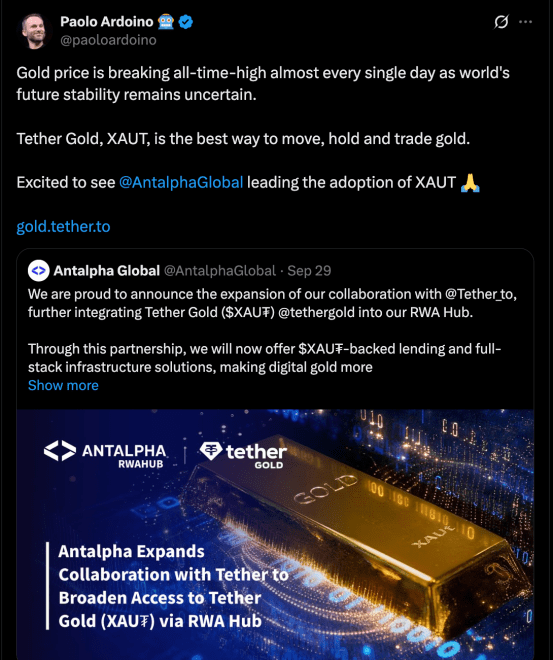
Tether

As per the post on X, Antalpha revealed that it would be integrating Tether Gold into its Real-World Assets (RWA) Hub, offering tokenized gold-backed lending and infrastructure solutions. The financial services firm also announced that it would set up physical vaults in major financial centers around the world to allow holders to exchange the tokens for gold bars.

This move to offer XAUT-backed lending came after Tether had purchased an 8.1% stake in Antalpha during its initial public offering (IPO) earlier in May 2025. 

Tether Gold, launched in 2020, offers investors an exposure to gold without physically owning the metal. With a market capitalization of about $1.5 billion, Tether claims that the almost 250,000 XAUT tokens in circulation are backed by an equivalent of more than 7.66 tons of gold.

USDT Market Cap At $175 Billion

At the same time, Tether owns the largest dollar-backed stablecoin and the fourth-largest digital asset in the cryptocurrency market, with a market cap of more than $175 billion.


Tether

Opportunità di mercato
Logo null
Valore null (null)
--
----
USD
Grafico dei prezzi in tempo reale di null (null)
Disclaimer: gli articoli ripubblicati su questo sito provengono da piattaforme pubbliche e sono forniti esclusivamente a scopo informativo. Non riflettono necessariamente le opinioni di MEXC. Tutti i diritti rimangono agli autori originali. Se ritieni che un contenuto violi i diritti di terze parti, contatta crypto.news@mexc.com per la rimozione. MEXC non fornisce alcuna garanzia in merito all'accuratezza, completezza o tempestività del contenuto e non è responsabile per eventuali azioni intraprese sulla base delle informazioni fornite. Il contenuto non costituisce consulenza finanziaria, legale o professionale di altro tipo, né deve essere considerato una raccomandazione o un'approvazione da parte di MEXC.

Potrebbe anche piacerti

Crucial ETH Unstaking Period: Vitalik Buterin’s Unwavering Defense for Network Security

Crucial ETH Unstaking Period: Vitalik Buterin’s Unwavering Defense for Network Security

BitcoinWorld Crucial ETH Unstaking Period: Vitalik Buterin’s Unwavering Defense for Network Security Ever wondered why withdrawing your staked Ethereum (ETH) isn’t an instant process? It’s a question that often sparks debate within the crypto community. Ethereum founder Vitalik Buterin recently stepped forward to defend the network’s approximately 45-day ETH unstaking period, asserting its crucial role in safeguarding the network’s integrity. This lengthy waiting time, while sometimes seen as an inconvenience, is a deliberate design choice with profound implications for security. Why is the ETH Unstaking Period a Vital Security Measure? Vitalik Buterin’s defense comes amidst comparisons to other networks, like Solana, which boast significantly shorter unstaking times. He drew a compelling parallel to military operations, explaining that an army cannot function effectively if its soldiers can simply abandon their posts at a moment’s notice. Similarly, a blockchain network requires a stable and committed validator set to maintain its security. The current ETH unstaking period isn’t merely an arbitrary delay. It acts as a critical buffer, providing the network with sufficient time to detect and respond to potential malicious activities. If validators could instantly exit, it would open doors for sophisticated attacks, jeopardizing the entire system. Currently, Ethereum boasts over one million active validators, collectively staking approximately 35.6 million ETH, representing about 30% of the total supply. This massive commitment underpins the network’s robust security model, and the unstaking period helps preserve this stability. Network Security: Ethereum’s Paramount Concern A shorter ETH unstaking period might seem appealing for liquidity, but it introduces significant risks. Imagine a scenario where a large number of validators, potentially colluding, could quickly withdraw their stake after committing a malicious act. Without a substantial delay, the network would have limited time to penalize them or mitigate the damage. This “exit queue” mechanism is designed to prevent sudden validator exodus, which could lead to: Reduced decentralization: A rapid drop in active validators could concentrate power among fewer participants. Increased vulnerability to attacks: A smaller, less stable validator set is easier to compromise. Network instability: Frequent and unpredictable changes in validator numbers can lead to performance issues and consensus failures. Therefore, the extended period is not a bug; it’s a feature. It’s a calculated trade-off between immediate liquidity for stakers and the foundational security of the entire Ethereum ecosystem. Ethereum vs. Solana: Different Approaches to Unstaking When discussing the ETH unstaking period, many point to networks like Solana, which offers a much quicker two-day unstaking process. While this might seem like an advantage for stakers seeking rapid access to their funds, it reflects fundamental differences in network architecture and security philosophies. Solana’s design prioritizes speed and immediate liquidity, often relying on different consensus mechanisms and validator economics to manage security risks. Ethereum, on the other hand, with its proof-of-stake evolution from proof-of-work, has adopted a more cautious approach to ensure its transition and long-term stability are uncompromised. Each network makes design choices based on its unique goals and threat models. Ethereum’s substantial value and its role as a foundational layer for countless dApps necessitate an extremely robust security posture, making the current unstaking duration a deliberate and necessary component. What Does the ETH Unstaking Period Mean for Stakers? For individuals and institutions staking ETH, understanding the ETH unstaking period is crucial for managing expectations and investment strategies. It means that while staking offers attractive rewards, it also comes with a commitment to the network’s long-term health. Here are key considerations for stakers: Liquidity Planning: Stakers should view their staked ETH as a longer-term commitment, not immediately liquid capital. Risk Management: The delay inherently reduces the ability to react quickly to market volatility with staked assets. Network Contribution: By participating, stakers contribute directly to the security and decentralization of Ethereum, reinforcing its value proposition. While the current waiting period may not be “optimal” in every sense, as Buterin acknowledged, simply shortening it without addressing the underlying security implications would be a dangerous gamble for the network’s reliability. In conclusion, Vitalik Buterin’s defense of the lengthy ETH unstaking period underscores a fundamental principle: network security cannot be compromised for the sake of convenience. It is a vital mechanism that protects Ethereum’s integrity, ensuring its stability and trustworthiness as a leading blockchain platform. This deliberate design choice, while requiring patience from stakers, ultimately fortifies the entire ecosystem against potential threats, paving the way for a more secure and reliable decentralized future. Frequently Asked Questions (FAQs) Q1: What is the main reason for Ethereum’s long unstaking period? A1: The primary reason is network security. A lengthy ETH unstaking period prevents malicious actors from quickly withdrawing their stake after an attack, giving the network time to detect and penalize them, thus maintaining stability and integrity. Q2: How long is the current ETH unstaking period? A2: The current ETH unstaking period is approximately 45 days. This duration can fluctuate based on network conditions and the number of validators in the exit queue. Q3: How does Ethereum’s unstaking period compare to other blockchains? A3: Ethereum’s unstaking period is notably longer than some other networks, such as Solana, which has a two-day period. This difference reflects varying network architectures and security priorities. Q4: Does the unstaking period affect ETH stakers? A4: Yes, it means stakers need to plan their liquidity carefully, as their staked ETH is not immediately accessible. It encourages a longer-term commitment to the network, aligning staker interests with Ethereum’s stability. Q5: Could the ETH unstaking period be shortened in the future? A5: While Vitalik Buterin acknowledged the current period might not be “optimal,” any significant shortening would likely require extensive research and network upgrades to ensure security isn’t compromised. For now, the focus remains on maintaining robust network defenses. Found this article insightful? Share it with your friends and fellow crypto enthusiasts on social media to spread awareness about the critical role of the ETH unstaking period in Ethereum’s security! To learn more about the latest Ethereum trends, explore our article on key developments shaping Ethereum’s institutional adoption. This post Crucial ETH Unstaking Period: Vitalik Buterin’s Unwavering Defense for Network Security first appeared on BitcoinWorld.
Condividi
Coinstats2025/09/18 15:30
White House adviser: Cryptocurrency bill is "very close" to passage

White House adviser: Cryptocurrency bill is "very close" to passage

PANews reported on June 18 that according to Jinshi, a US White House adviser said that the cryptocurrency bill is "very close" to passage, which will create demand for the
Condividi
PANews2025/06/18 23:52
SEC approves Grayscale’s multi-crypto fund with XRP, SOL and ADA

SEC approves Grayscale’s multi-crypto fund with XRP, SOL and ADA

GDLC's approval coincides with SEC adopting generic listing standards for crypto ETFs, which would expedite the launch process.
Condividi
Coinstats2025/09/18 10:26