This ablation study on AdaMix highlights the factors driving its efficiency in parameter-efficient fine-tuning. Results show that adaptation merging consistently outperforms random or fixed routing, while consistency regularization proves essential to maintaining strong performance. Module sharing is particularly effective in low-resource tasks, boosting convergence speed and lowering training loss compared to models without sharing. Experiments with adaptation module count and bottleneck dimension reveal diminishing returns, stressing the importance of balance over brute force scaling. Overall, AdaMix demonstrates how thoughtful design choices yield superior results to full model tuning.This ablation study on AdaMix highlights the factors driving its efficiency in parameter-efficient fine-tuning. Results show that adaptation merging consistently outperforms random or fixed routing, while consistency regularization proves essential to maintaining strong performance. Module sharing is particularly effective in low-resource tasks, boosting convergence speed and lowering training loss compared to models without sharing. Experiments with adaptation module count and bottleneck dimension reveal diminishing returns, stressing the importance of balance over brute force scaling. Overall, AdaMix demonstrates how thoughtful design choices yield superior results to full model tuning.

The Role of Consistency and Sharing in Efficient Fine-Tuning

2025/10/01 21:00
3 min di lettura
Per feedback o dubbi su questo contenuto, contattateci all'indirizzo crypto.news@mexc.com.

Abstract and 1. Introduction

  1. Background

    2.1 Mixture-of-Experts

    2.2 Adapters

  2. Mixture-of-Adaptations

    3.1 Routing Policy

    3.2 Consistency regularization

    3.3 Adaptation module merging and 3.4 Adaptation module sharing

    3.5 Connection to Bayesian Neural Networks and Model Ensembling

  3. Experiments

    4.1 Experimental Setup

    4.2 Key Results

    4.3 Ablation Study

  4. Related Work

  5. Conclusions

  6. Limitations

  7. Acknowledgment and References

Appendix

A. Few-shot NLU Datasets B. Ablation Study C. Detailed Results on NLU Tasks D. Hyper-parameter

4.3 Ablation Study

We perform all the ablation analysis on AdaMix with adapters for parameter-efficient fine-tuning.

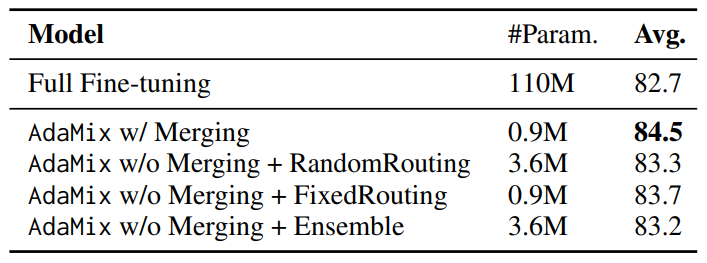
\ Analysis of adaptation merging. In this ablation study, we do not merge adaptation modules and consider two different routing strategies at inference time: (a) randomly routing input to any adaptation module, and (b) fixed routing where we route all the input to the first adaptation module in AdaMix. From Table 7, we observe AdaMix with adaptation merging to perform better than any of the other variants without the merging mechanism. Notably, all of the AdaMix variants outperform full model tuning.

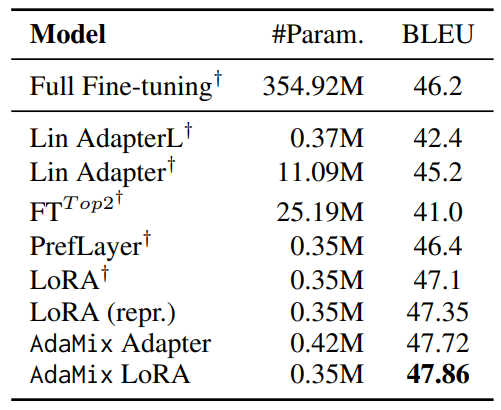
\ Table 3: Results on E2E NLG Challenge with GPT-2 medium backbone. Best result on each task is in bold. We report AdaMix results with both adapters and LoRA as underlying PEFT method. AdaMix outperforms all competing methods as well as fully fine-tuned large model with only 0.1% tunable parameters.† denotes results reported from (Hu et al., 2021) and repr. denotes reproduced results. #Param. denotes the number of tunable adaptation parameters used during inference. Results on DART and WebNLG presented in Tables 4 and 5 in Appendix
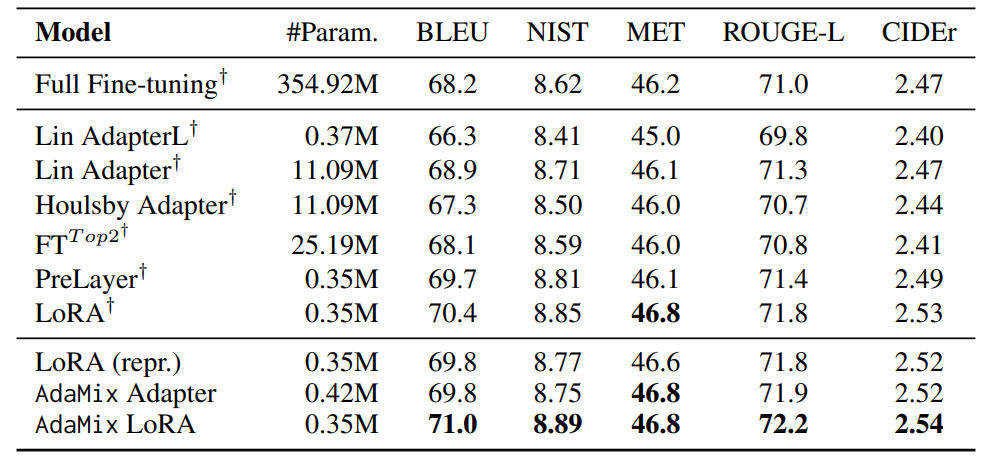
\ Table 4: Results on DART with GPT-2 backbone encoder. Best result on each task is in bold. We report AdaMix results with both adapters and LoRA as underlying PEFT method. AdaMix outperforms all competing methods as well as fully fine-tuned large model with only 0.1% tunable parameters.† denotes results reported from (Hu et al., 2021) and repr. denotes reproduced results. #Param. denotes the number of tunable adaptation parameters used during inference.

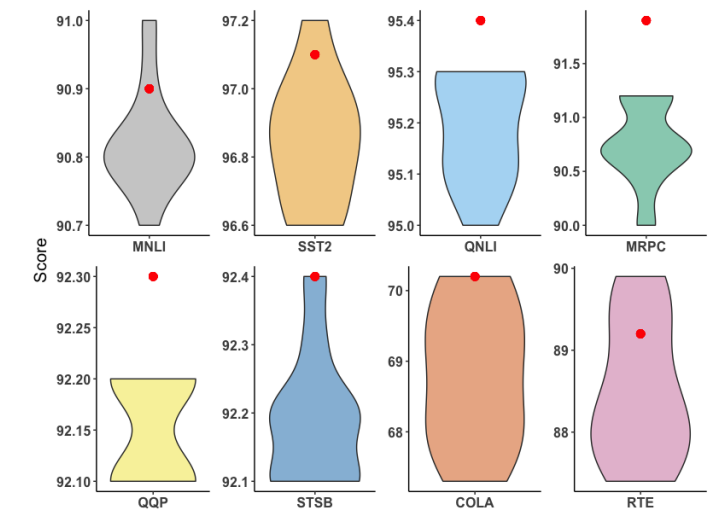
\ Moreover, Figure 5 shows that the performance of merging mechanism is consistently better than the average performance of random routing and comparable to the best performance of random routing.

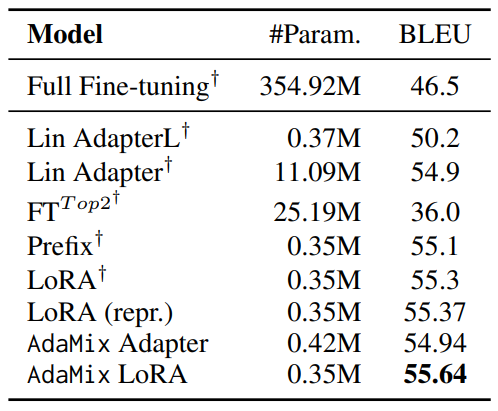
\ \ \ Table 5: Results on WebNLG with GPT-2 medium backbone. The results are based on all categories in the test set of WebNLG. Best result on each task is in bold. We report AdaMix results with both adapters and LoRA as underlying PEFT method. AdaMix outperforms all competing methods as well as fully fine-tuned large model with only 0.1% tunable parameters.† denotes results reported from (Hu et al., 2021) and repr. denotes reproduced results. #Param. denotes the number of tunable adaptation parameters used during inference.
\

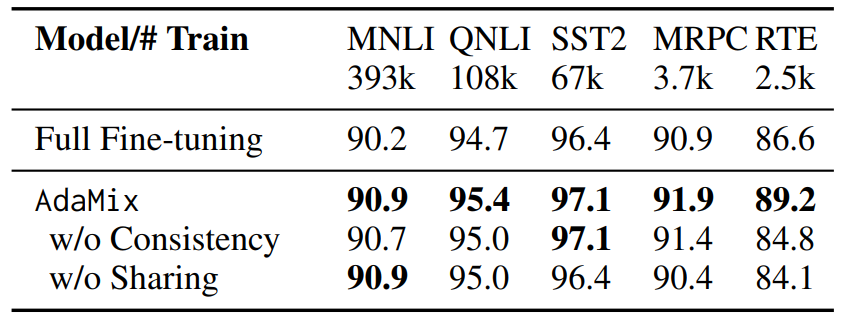
\ Analysis of consistency regularization. We drop consistency regularization during training for ablation and demonstrate significant performance degradation in Table 8.

\ Analysis of adaptation module sharing. We remove adaptation module sharing in AdaMix for ablation and keep four different copies of projectdown and four project-up FFN layers. From Table 8 we observe the performance gap between AdaMix and AdaMix w/o sharing to increase with decrease in the dataset size demonstrating the importance of parameter sharing for low-resource tasks (e.g.,

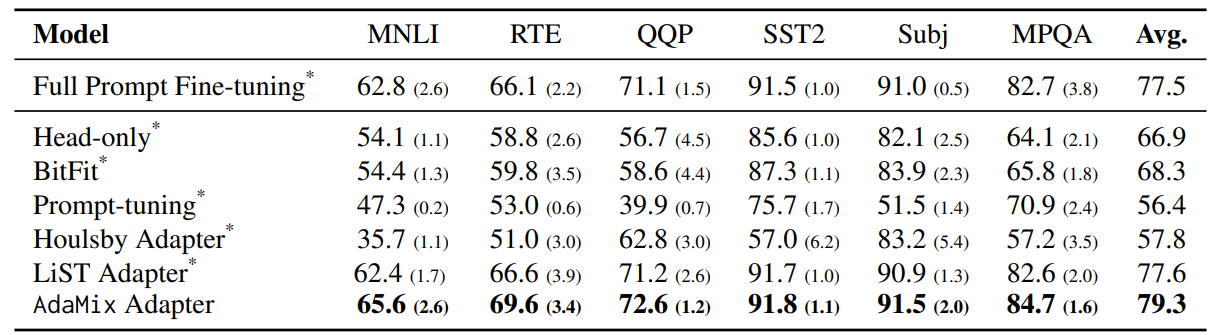
\ Table 6: Average performance and standard deviation of several parameter-efficient fine-tuning strategies based on RoBERTa-large with |K| = 30 training labels. The best performance is shown in bold. Prompt-tuning, Head-only and BitFit tune 1M model parameters during inference. Houlsby Adapter, LiST Adapter and AdaMix Adapter tune 14M model parameters. * denotes that the results are taken from (Wang et al., 2021).
\ Table 7: AdaMix without adaptation merging and different routing and ensembling strategies. Average results are presented on GLUE development set with BERTbase encoder. Detailed task results in Table 14 of Appendix for BERT-base and RoBERTa-large encoders.

\ Figure 5: Violin plot of AdaMix-RandomRouting performance distribution with RoBERTa-large encoders. Red dot denotes the performance of AdaMix.

\ Table 8: Ablation study demonstrating the impact of consistency regularization and sharing in AdaMix.

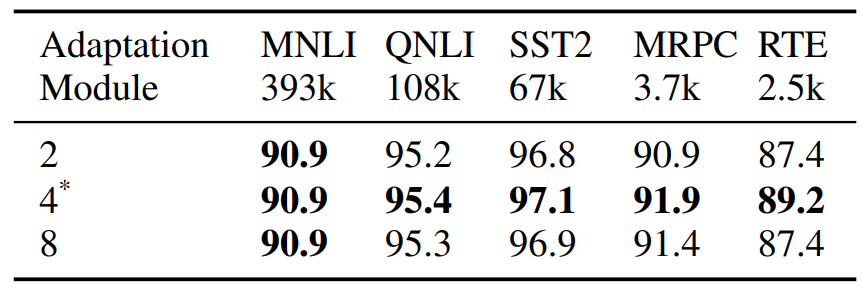
\ RTE, MRPC). This is further demonstrated in Figure 7 in Appendix which shows a faster convergence and lower training loss of AdaMix with sharing compared to that without given the same number of training steps. We explore which adaptation module to share (project-up v.s. project-down) in Table 11 in Appendix that depict similar results. Impact of the number of adaptation modules. In this study, we vary the number of adaptation modules in AdaMix as 2, 4 and 8 during training. Table 9 shows diminishing returns on aggregate task performance with increasing number of modules. As we increase sparsity and the number of tunable parameters by increasing the number of adaptation modules, low-resource tasks like RTE and SST-2 – with limited amount of labeled data for fine-tuning – degrade in performance compared to high-resource tasks like MNLI and QNLI.

\ Table 9: Varying the number of adaptation modules in AdaMix with RoBERTa-large encoder. * denotes the number of modules used in AdaMix with adapters.
\ Impact of adapter bottleneck dimension. Table 10 shows the impact of bottleneck dimension of adapters with different encoders in AdaMix. The model performance improves with increase in the number of trainable parameters by increasing the bottleneck dimension with diminishing returns after a certain point.

\

:::info Authors:

(1) Yaqing Wang, Purdue University (wang5075@purdue.edu);

(2) Sahaj Agarwal, Microsoft (sahagar@microsoft.com);

(3) Subhabrata Mukherjee, Microsoft Research (submukhe@microsoft.com);

(4) Xiaodong Liu, Microsoft Research (xiaodl@microsoft.com);

(5) Jing Gao, Purdue University (jinggao@purdue.edu);

(6) Ahmed Hassan Awadallah, Microsoft Research (hassanam@microsoft.com);

(7) Jianfeng Gao, Microsoft Research (jfgao@microsoft.com).

:::


:::info This paper is available on arxiv under CC BY 4.0 DEED license.

:::

\

Disclaimer: gli articoli ripubblicati su questo sito provengono da piattaforme pubbliche e sono forniti esclusivamente a scopo informativo. Non riflettono necessariamente le opinioni di MEXC. Tutti i diritti rimangono agli autori originali. Se ritieni che un contenuto violi i diritti di terze parti, contatta crypto.news@mexc.com per la rimozione. MEXC non fornisce alcuna garanzia in merito all'accuratezza, completezza o tempestività del contenuto e non è responsabile per eventuali azioni intraprese sulla base delle informazioni fornite. Il contenuto non costituisce consulenza finanziaria, legale o professionale di altro tipo, né deve essere considerato una raccomandazione o un'approvazione da parte di MEXC.

Potrebbe anche piacerti

Analyst Ignores Bitcoin (BTC) Price Crash Narratives, Points to Hidden Bull Signals That May Matter More

Analyst Ignores Bitcoin (BTC) Price Crash Narratives, Points to Hidden Bull Signals That May Matter More

Bitcoin price keeps struggling, and panic around crypto has started climbing with every fresh dip. BTC has lost its footing near recent highs, and that has pushed
Condividi
Captainaltcoin2026/03/07 17:30
UK and US Seal $42 Billion Tech Pact Driving AI and Energy Future

UK and US Seal $42 Billion Tech Pact Driving AI and Energy Future

The post UK and US Seal $42 Billion Tech Pact Driving AI and Energy Future appeared on BitcoinEthereumNews.com. Key Highlights Microsoft and Google pledge billions as part of UK US tech partnership Nvidia to deploy 120,000 GPUs with British firm Nscale in Project Stargate Deal positions UK as an innovation hub rivaling global tech powers UK and US Seal $42 Billion Tech Pact Driving AI and Energy Future The UK and the US have signed a “Technological Prosperity Agreement” that paves the way for joint projects in artificial intelligence, quantum computing, and nuclear energy, according to Reuters. Donald Trump and King Charles review the guard of honour at Windsor Castle, 17 September 2025. Image: Kirsty Wigglesworth/Reuters The agreement was unveiled ahead of U.S. President Donald Trump’s second state visit to the UK, marking a historic moment in transatlantic technology cooperation. Billions Flow Into the UK Tech Sector As part of the deal, major American corporations pledged to invest $42 billion in the UK. Microsoft leads with a $30 billion investment to expand cloud and AI infrastructure, including the construction of a new supercomputer in Loughton. Nvidia will deploy 120,000 GPUs, including up to 60,000 Grace Blackwell Ultra chips—in partnership with the British company Nscale as part of Project Stargate. Google is contributing $6.8 billion to build a data center in Waltham Cross and expand DeepMind research. Other companies are joining as well. CoreWeave announced a $3.4 billion investment in data centers, while Salesforce, Scale AI, BlackRock, Oracle, and AWS confirmed additional investments ranging from hundreds of millions to several billion dollars. UK Positions Itself as a Global Innovation Hub British Prime Minister Keir Starmer said the deal could impact millions of lives across the Atlantic. He stressed that the UK aims to position itself as an investment hub with lighter regulations than the European Union. Nvidia spokesman David Hogan noted the significance of the agreement, saying it would…
Condividi
BitcoinEthereumNews2025/09/18 02:22
Pundit Describes How $10,000 In XRP Could Become $1,000,000

Pundit Describes How $10,000 In XRP Could Become $1,000,000

Interest in the long-term potential of XRP continues to center on a common investor question: what level of growth would be required for a modest position to reach
Condividi
Timestabloid2026/03/07 17:02