Polkadot (DOT) is preparing to launch a new stablecoin, pUSD, through the RFC-155 proposal. The Polkadot community is championing pUSD as a key solution to unleash its DeFi potential, cut dependence on USDT/USDC, and boost ecosystem autonomy. However, some are concerned that they might repeat past mistakes. pUSD is an over-collateralized stablecoin fully backed by DOT, deployed on Asset Hub, and using the Honzon protocol developed by Acala. Acala is the former issuer of aUSD, a stablecoin project that failed disastrously. Can pUSD Stablecoin Avoid the Same Fate as aUSD? Reusing Honzon – the framework Acala previously relied on to issue aUSD is raising concerns. That incident eroded trust in the Acala team, with some even accusing them of “blaming a hack” while failing to compensate users adequately. “Acala’s stablecoin (aUSD) launch was a complete disaster and it really killed my trust in the team. I don’t see myself supporting their project anymore. What I’d love to see is a proper, reliable, native solution. Honestly, it’s frustrating that with all the talent in the Polkadot/Substrate space, nobody has managed to build something better yet.” – A community member shared. Approval rate of the proposal at the time of writing. Source: Polkadot Even those who support Polkadot launching its native stablecoin still see Honzon and Acala as lessons that cannot be ignored. They propose the project should “move forward independently from the Acala team.” In addition, they call for the Technical Council to take clear responsibility for governance. “With these assurances, I would be prepared to vote AYE. Without them, the risk of repeating past mistakes is too great.” Another member noted. Too Many Risks Setting aside concerns about Honzon and the Acala team, Polkadot’s pUSD also faces skepticism within the community. One primary reason is the structure that DOT solely backs it. While the exact overcollateralization ratio remains unclear, this could trigger liquidation cascades and add selling pressure on the token. Although the pUSD model is safer than Terra’s UST because it is overcollateralized, relying only on DOT as collateral introduces significant risks. Previously, MakerDAO’s DAI also started as ETH-only collateral. But today, MakerDAO supports Multi-Collateral DAI (MCD). They allow users to back DAI with crypto assets such as ETH, WBTC, LINK, UNI, stETH, and even Real World Assets (RWAs) like US Treasuries. “Backed only by DOT, which could trigger liquidation cascades and add additional selling pressure on the token. Remember the notorious DAI depeg in 2020, which forced MakerDAO to diversify its collateral.” A user on X commented. Additionally, another X user pointed out that the Polkadot ecosystem already has more advanced native solutions like HOLLAR. The Hydration runtime builds this stablecoin, optimizes it for appchains, and positions it as superior to the legacy aUSD architecture. Therefore, many argue that instead of repeating a “regular” EVM model, Polkadot should leverage its unique strengths. This would enable the creation of a stable, secure solution worthy of its ecosystem’s potential. pUSD is undoubtedly a strategic move by Polkadot to unlock DeFi potential. It could bring significant benefits if it proves secure and sees widespread adoption in the ecosystem. However, the ghost of aUSD’s failure continues to cast doubt within the community. To avoid repeating the same mistakes, Polkadot must work to dispel those lingering concerns. The fact that the DOT supply is capped at 2.1 billion, as reported by BeInCrypto, could help fuel the ecosystem’s growth.Polkadot (DOT) is preparing to launch a new stablecoin, pUSD, through the RFC-155 proposal. The Polkadot community is championing pUSD as a key solution to unleash its DeFi potential, cut dependence on USDT/USDC, and boost ecosystem autonomy. However, some are concerned that they might repeat past mistakes. pUSD is an over-collateralized stablecoin fully backed by DOT, deployed on Asset Hub, and using the Honzon protocol developed by Acala. Acala is the former issuer of aUSD, a stablecoin project that failed disastrously. Can pUSD Stablecoin Avoid the Same Fate as aUSD? Reusing Honzon – the framework Acala previously relied on to issue aUSD is raising concerns. That incident eroded trust in the Acala team, with some even accusing them of “blaming a hack” while failing to compensate users adequately. “Acala’s stablecoin (aUSD) launch was a complete disaster and it really killed my trust in the team. I don’t see myself supporting their project anymore. What I’d love to see is a proper, reliable, native solution. Honestly, it’s frustrating that with all the talent in the Polkadot/Substrate space, nobody has managed to build something better yet.” – A community member shared. Approval rate of the proposal at the time of writing. Source: Polkadot Even those who support Polkadot launching its native stablecoin still see Honzon and Acala as lessons that cannot be ignored. They propose the project should “move forward independently from the Acala team.” In addition, they call for the Technical Council to take clear responsibility for governance. “With these assurances, I would be prepared to vote AYE. Without them, the risk of repeating past mistakes is too great.” Another member noted. Too Many Risks Setting aside concerns about Honzon and the Acala team, Polkadot’s pUSD also faces skepticism within the community. One primary reason is the structure that DOT solely backs it. While the exact overcollateralization ratio remains unclear, this could trigger liquidation cascades and add selling pressure on the token. Although the pUSD model is safer than Terra’s UST because it is overcollateralized, relying only on DOT as collateral introduces significant risks. Previously, MakerDAO’s DAI also started as ETH-only collateral. But today, MakerDAO supports Multi-Collateral DAI (MCD). They allow users to back DAI with crypto assets such as ETH, WBTC, LINK, UNI, stETH, and even Real World Assets (RWAs) like US Treasuries. “Backed only by DOT, which could trigger liquidation cascades and add additional selling pressure on the token. Remember the notorious DAI depeg in 2020, which forced MakerDAO to diversify its collateral.” A user on X commented. Additionally, another X user pointed out that the Polkadot ecosystem already has more advanced native solutions like HOLLAR. The Hydration runtime builds this stablecoin, optimizes it for appchains, and positions it as superior to the legacy aUSD architecture. Therefore, many argue that instead of repeating a “regular” EVM model, Polkadot should leverage its unique strengths. This would enable the creation of a stable, secure solution worthy of its ecosystem’s potential. pUSD is undoubtedly a strategic move by Polkadot to unlock DeFi potential. It could bring significant benefits if it proves secure and sees widespread adoption in the ecosystem. However, the ghost of aUSD’s failure continues to cast doubt within the community. To avoid repeating the same mistakes, Polkadot must work to dispel those lingering concerns. The fact that the DOT supply is capped at 2.1 billion, as reported by BeInCrypto, could help fuel the ecosystem’s growth.

Polkadot Bets on pUSD Stablecoin — But Can It Escape aUSD’s Shadow?

2025/09/29 11:00
3 min di lettura
Per feedback o dubbi su questo contenuto, contattateci all'indirizzo crypto.news@mexc.com.

Polkadot (DOT) is preparing to launch a new stablecoin, pUSD, through the RFC-155 proposal. The Polkadot community is championing pUSD as a key solution to unleash its DeFi potential, cut dependence on USDT/USDC, and boost ecosystem autonomy.

However, some are concerned that they might repeat past mistakes. pUSD is an over-collateralized stablecoin fully backed by DOT, deployed on Asset Hub, and using the Honzon protocol developed by Acala. Acala is the former issuer of aUSD, a stablecoin project that failed disastrously.

Can pUSD Stablecoin Avoid the Same Fate as aUSD?

Reusing Honzon – the framework Acala previously relied on to issue aUSD is raising concerns. That incident eroded trust in the Acala team, with some even accusing them of “blaming a hack” while failing to compensate users adequately.
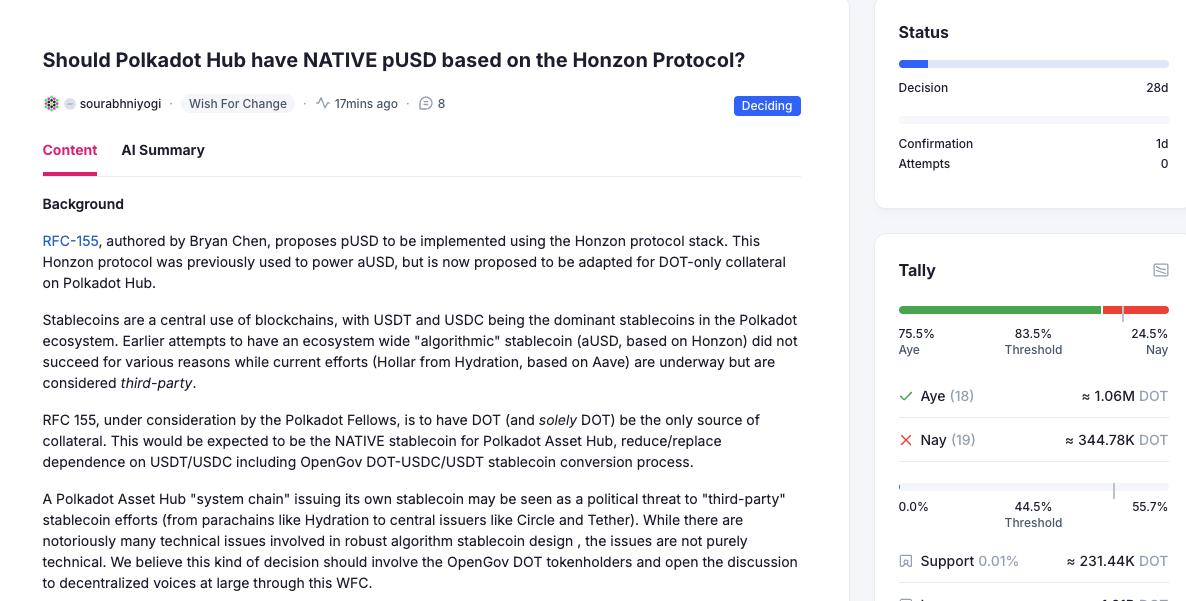
Approval rate of the proposal at the time of writing. Source: PolkadotApproval rate of the proposal at the time of writing. Source: Polkadot

Even those who support Polkadot launching its native stablecoin still see Honzon and Acala as lessons that cannot be ignored. They propose the project should “move forward independently from the Acala team.” In addition, they call for the Technical Council to take clear responsibility for governance.

Too Many Risks

Setting aside concerns about Honzon and the Acala team, Polkadot’s pUSD also faces skepticism within the community. One primary reason is the structure that DOT solely backs it.

While the exact overcollateralization ratio remains unclear, this could trigger liquidation cascades and add selling pressure on the token. Although the pUSD model is safer than Terra’s UST because it is overcollateralized, relying only on DOT as collateral introduces significant risks.

Previously, MakerDAO’s DAI also started as ETH-only collateral. But today, MakerDAO supports Multi-Collateral DAI (MCD). They allow users to back DAI with crypto assets such as ETH, WBTC, LINK, UNI, stETH, and even Real World Assets (RWAs) like US Treasuries.

Additionally, another X user pointed out that the Polkadot ecosystem already has more advanced native solutions like HOLLAR. The Hydration runtime builds this stablecoin, optimizes it for appchains, and positions it as superior to the legacy aUSD architecture. Therefore, many argue that instead of repeating a “regular” EVM model, Polkadot should leverage its unique strengths. This would enable the creation of a stable, secure solution worthy of its ecosystem’s potential.

pUSD is undoubtedly a strategic move by Polkadot to unlock DeFi potential. It could bring significant benefits if it proves secure and sees widespread adoption in the ecosystem. However, the ghost of aUSD’s failure continues to cast doubt within the community.

To avoid repeating the same mistakes, Polkadot must work to dispel those lingering concerns. The fact that the DOT supply is capped at 2.1 billion, as reported by BeInCrypto, could help fuel the ecosystem’s growth.


Opportunità di mercato
Logo Shadow
Valore Shadow (SHADOW)
$0.7387
$0.7387$0.7387
-3.21%
USD
Grafico dei prezzi in tempo reale di Shadow (SHADOW)
Disclaimer: gli articoli ripubblicati su questo sito provengono da piattaforme pubbliche e sono forniti esclusivamente a scopo informativo. Non riflettono necessariamente le opinioni di MEXC. Tutti i diritti rimangono agli autori originali. Se ritieni che un contenuto violi i diritti di terze parti, contatta crypto.news@mexc.com per la rimozione. MEXC non fornisce alcuna garanzia in merito all'accuratezza, completezza o tempestività del contenuto e non è responsabile per eventuali azioni intraprese sulla base delle informazioni fornite. Il contenuto non costituisce consulenza finanziaria, legale o professionale di altro tipo, né deve essere considerato una raccomandazione o un'approvazione da parte di MEXC.

Potrebbe anche piacerti

Is Doge Still The Best Crypto Investment, Or Will Pepeto Make You Rich In 2025

Is Doge Still The Best Crypto Investment, Or Will Pepeto Make You Rich In 2025

The post Is Doge Still The Best Crypto Investment, Or Will Pepeto Make You Rich In 2025 appeared on BitcoinEthereumNews.com. Crypto News 18 September 2025 | 13:39 Is Dogecoin actually running out of gas, after making people millionaires overnight? As investors hunt for the best crypto to buy now and the best crypto to invest in 2025, Dogecoin still owns the meme spotlight, yet its upside looks capped according to today’s Dogecoin price prediction. Focus is shifting toward projects that marry community with real on chain utility. People searching best crypto to buy now want shipped products, audits, and transparent tokenomics. That frames the honest matchup for this cycle, Dogecoin versus Pepeto. Meet Pepeto, an Ethereum based meme coin built with live rails, PepetoSwap for zero fee trading and Pepeto Bridge for smooth cross chain moves. By blending story with tools people can touch today, and speaking directly to crypto presale 2025 demand, Pepeto puts utility, clarity, and distribution first. In a market where older meme coins risk drifting on sentiment, Pepeto’s delivery gives it a credible seat in the best crypto investment debate. First, here is why Dogecoin may be fading. Dogecoin Price Prediction Is Dogecoin Losing Momentum Remember when Dogecoin made crypto feel effortless. In 2013, Doge turned an internet joke into money and a movement that welcomed everyone. A decade later the market is tougher and the relentless tailwind is gone, sentiment is choppier and patience matters. With Doge near $0.268, the setup reads bearish to neutral for the next few weeks. If the $0.26 shelf holds on daily closes, expect choppy range trading toward $0.29 to $0.30 where rallies keep stalling. Lose $0.26 and momentum often slides into $0.245 with risk of a deeper probe toward $0.22 to $0.21. Close back above $0.30 and the downside bias is likely neutralized, opening room for a squeeze into the low $0.30s. Beyond the price view, Dogecoin still centers…
Condividi
BitcoinEthereumNews2025/09/18 18:56
WLD Price Prediction: Worldcoin Eyes $0.42 Recovery Amid Technical Consolidation

WLD Price Prediction: Worldcoin Eyes $0.42 Recovery Amid Technical Consolidation

Worldcoin (WLD) trades at $0.39 with neutral RSI at 46, targeting $0.42 resistance. Technical indicators suggest consolidation before potential breakout. (Read
Condividi
BlockChain News2026/03/07 20:35
White House Scrambles for New Crypto CFTC Pick After Winklevoss Backlash

White House Scrambles for New Crypto CFTC Pick After Winklevoss Backlash

The White House has reconsidered its CFTC leadership pick after Brian Quintenz’s stalled nomination and Winklevoss backlash, reviewing new candidates with experience in crypto and digital asset regulation.
Condividi
Coinstats2025/09/19 08:39