To the uninitiated, Bitcoin and crypto are synonymous – and it’s only fair, given that the granddaddy of all crypto has been the face of the industry ever since it burst onto the scene a few years back. Since 2020, Bitcoin has generated over 1,500% in returns. Basically, crypto is so much about Bitcoin. All […]To the uninitiated, Bitcoin and crypto are synonymous – and it’s only fair, given that the granddaddy of all crypto has been the face of the industry ever since it burst onto the scene a few years back. Since 2020, Bitcoin has generated over 1,500% in returns. Basically, crypto is so much about Bitcoin. All […]

Bitcoin Hyper Not Far from $20M, Whales Keep Buying: See What This $BTC Layer-2 Plans

2025/09/22 16:37
6 min di lettura
Per feedback o dubbi su questo contenuto, contattateci all'indirizzo crypto.news@mexc.com.

To the uninitiated, Bitcoin and crypto are synonymous – and it’s only fair, given that the granddaddy of all crypto has been the face of the industry ever since it burst onto the scene a few years back.

Since 2020, Bitcoin has generated over 1,500% in returns. Basically, crypto is so much about Bitcoin.

All the chatter in crypto, since forever, has been around Bitcoin, from stories of people misplacing their cold wallets with $BTC bought at $10, now worth over $110K, to headlines about its dominance.

Until now, Bitcoin has really only been looked at as an investment vehicle, but a new contender is aiming to redefine what the Bitcoin blockchain can do. Enter Bitcoin Hyper ($HYPER).

$HYPER is a new cryptocurrency project that aims to turbocharge Bitcoin with Solana-like speed, scalability, and Web3 support. It’s about finally bringing digital gold up to true gold blockchain standards.

Currently in presale, $HYPER has already accumulated over $17.5M from early investors, including $30.5K from crypto whales just yesterday.

Read on as we unpack $HYPER in detail, explaining why it’s arguably the best crypto to buy in 2025.

Bitcoin’s Place in Crypto & Prevalent Problems

The total public Bitcoin holdings are now $116B, whereas other top altcoins like Ethereum and Solana only have around $14B and $3B in public company treasuries, respectively.

That’s a huge gap and a clear indicator of Bitcoin’s place in the industry.
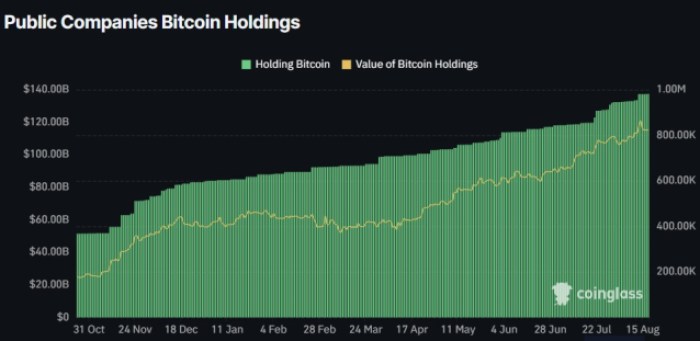
Public Companies Bitcoin Holdings

Think of it like creating a fruit market. It would only be fair that mango, the king of all fruits, be put as the face of the market and given the largest proportion in any index fund for that fruit-based market.

That said, mango isn’t the be-all and end-all of the fruit economy, and other fruits are just as vital.

Similarly, while Bitcoin dominates the space in terms of popularity and online chatter, other blockchains like Ethereum and Solana are actually doing the work to form the basis of the crypto infrastructure.

It’s very important to separate crypto from just a returns perspective or investment avenue, and to also see what it truly stands for: a hedge against macroeconomic instability, decentralization, anonymity, and simply offering users a much better alternative to today’s handicapped traditional fiat banking system.

In that regard, Ethereum and Solana dominate the DeFi space, the Web3 ecosystem, and the altcoin launchpad sector. It’s easy to argue they’re just as important to the core blockchain fundamentals of the industry as Bitcoin is.

However, Bitcoin will remain the granddaddy, and it’s understandable (but maybe not) that with so many returns and its mainstream presence, it has fallen off in terms of innovation.

Bitcoin’s Technical Stagnation: The Problem Waiting to Be Solved

Bitcoin is currently the 29th fastest blockchain in the world, with the ability to process just 7 transactions per second.

Compare that with Solana, which can theoretically process 65K transactions per second, and you can see why Bitcoin is nowhere in developer conversations.
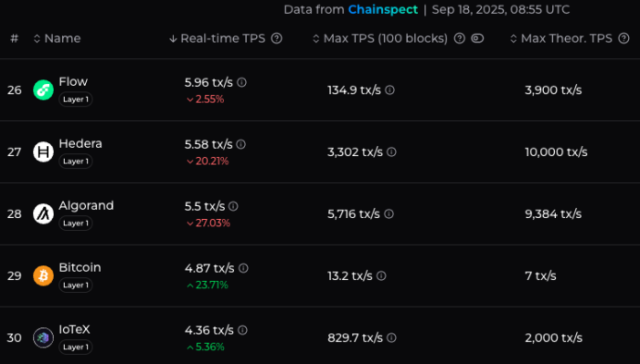
Blockchain speeds compared.

Its scripting language is deliberately restrictive, making it nearly impossible to build complex applications directly.

As a result, almost every talented developer has pivoted toward Ethereum, Solana, and other smart contract platforms where they can build and experiment freely.

In short, Bitcoin is financially dominant but technically stagnant.

Now, here’s the kicker: In any business, if you can identify a true, industry-wide problem and solve it, success is all but guaranteed. That’s why it’s important we have a conversation around Bitcoin Hyper ($HYPER).

Bitcoin Hyper Brings Solana’s Performance & Programmability to Bitcoin

Bitcoin Hyper is building a brand-new Layer 2 solution for Bitcoin that will integrate with the Solana Virtual Machine (SVM).

Unlike the very popular Ethereum Virtual Machine (EVM), the SVM is capable of executing thousands of transactions in parallel – the only condition being they’re not related to each other.

This becomes $HYPER’s core problem-solving bottom line, as it essentially cranks up Bitcoin’s sluggish speeds to modern blockchain standards.

Most importantly, despite this being a Layer 2 solution – with transactions happening off-chain, almost like on a sidechain – there’s no compromise in security, which Bitcoin’s Layer 1 is widely regarded for.

Bitcoin Hyper simply batches the results of its transactions and submits a summary to the Bitcoin mainchain, ensuring both lightning-fast execution and Bitcoin’s native security.

$HYPER’s Canonical Bridge Ensuring Seamless Interaction with New BTC Web3

Hyper’s SVM integration will also allow developers to build smart contracts and decentralized applications on the network.

This brings in an entirely new layer of use cases for developers and users on Bitcoin: think high-speed DeFi trading, NFTs, DAOs and governance, lending, staking, swapping, and blockchain gaming.

Bitcoin Hyper's layer-2 ecosystem explained, step by step.

Even better, Bitcoin Hyper makes it incredibly seamless for users to interact with this SVM-powered Web3 environment.

  • All you have to do is submit your Layer 1 Bitcoin into Hyper’s non-custodial, decentralized, canonical bridge.
  • It will then verify the transaction, lock your original Layer 1 BTC, and then mint an equivalent amount of BTC tokens on Hyper’s Layer 2.
  • These tokens are compatible with Layer 2 and can be used to interact with the newly unlocked Bitcoin Web3 ecosystem.

Don’t Miss the $HYPER Presale: Early Investors Reap the Biggest Rewards

Let’s fully understand Bitcoin Hyper’s potential. Consider why people buy different altcoins.

People buy Ethereum, Solana, and XRP for what they mean to the crypto infrastructure, not solely because they could 10x or 100x in the next five or ten years.

However, people buy Bitcoin because of what they believe crypto as a whole could become in the next five to ten years.

While this is a positive, since Bitcoin is the face of the industry, it also shows that there’s very little native reasoning to buy Bitcoin itself from a utility standpoint.

That is what Bitcoin Hyper is changing. It can actually crank up Bitcoin’s real-world utility, essentially igniting a fire under its belly, while also potentially becoming one of the next cryptos to explode.

Currently in presale, $HYPER has already raised over $17.5M in early investor funding, with each token priced at just $0.012955.

This is a golden opportunity, as you might never see Hyper at such a low price again, with a listing just around the corner.
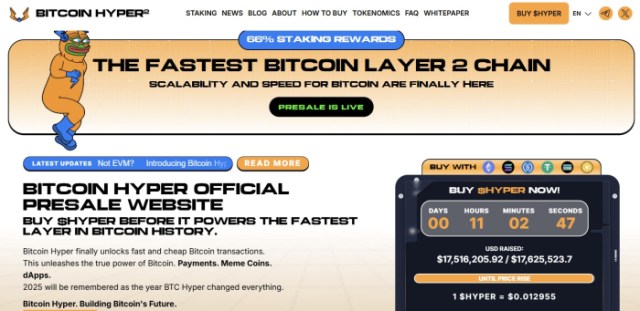
$HYPER live presale info

According to our Bitcoin Hyper price prediction, the token could reach $0.32 by the end of 2025, which would represent a staggering 2,300% return on your investment if you get in now.

If you need help with the purchase process, check out our step-by-step guide on how to buy Bitcoin Hyper.

Visit Bitcoin Hyper’s official website to learn more about what it could truly mean for Bitcoin and the broader crypto economy.

Disclaimer: Crypto investments are highly risky. This article is not financial advice, so kindly always do your own research before investing.

Authored by Krishi Chowdhary, Bitcoinist — https://bitcoinist.com/bitcoin-hyper-not-far-from-20m-as-whales-keep-accumulating

Opportunità di mercato
Logo Bitcoin
Valore Bitcoin (BTC)
$70,343.06
$70,343.06$70,343.06
+1.35%
USD
Grafico dei prezzi in tempo reale di Bitcoin (BTC)
Disclaimer: gli articoli ripubblicati su questo sito provengono da piattaforme pubbliche e sono forniti esclusivamente a scopo informativo. Non riflettono necessariamente le opinioni di MEXC. Tutti i diritti rimangono agli autori originali. Se ritieni che un contenuto violi i diritti di terze parti, contatta crypto.news@mexc.com per la rimozione. MEXC non fornisce alcuna garanzia in merito all'accuratezza, completezza o tempestività del contenuto e non è responsabile per eventuali azioni intraprese sulla base delle informazioni fornite. Il contenuto non costituisce consulenza finanziaria, legale o professionale di altro tipo, né deve essere considerato una raccomandazione o un'approvazione da parte di MEXC.

Potrebbe anche piacerti

Trump-backed WLFI  launches AgentPay SDK open-source payment toolkit for AI agents

Trump-backed WLFI  launches AgentPay SDK open-source payment toolkit for AI agents

The Trump family has expanded its presence in the crypto community with a major development for artificial intelligence (AI) agents. According to reports, World
Condividi
Cryptopolitan2026/03/20 19:03
Summarize Any Stock’s Earnings Call in Seconds Using FMP API

Summarize Any Stock’s Earnings Call in Seconds Using FMP API

Turn lengthy earnings call transcripts into one-page insights using the Financial Modeling Prep APIPhoto by Bich Tran Earnings calls are packed with insights. They tell you how a company performed, what management expects in the future, and what analysts are worried about. The challenge is that these transcripts often stretch across dozens of pages, making it tough to separate the key takeaways from the noise. With the right tools, you don’t need to spend hours reading every line. By combining the Financial Modeling Prep (FMP) API with Groq’s lightning-fast LLMs, you can transform any earnings call into a concise summary in seconds. The FMP API provides reliable access to complete transcripts, while Groq handles the heavy lifting of distilling them into clear, actionable highlights. In this article, we’ll build a Python workflow that brings these two together. You’ll see how to fetch transcripts for any stock, prepare the text, and instantly generate a one-page summary. Whether you’re tracking Apple, NVIDIA, or your favorite growth stock, the process works the same — fast, accurate, and ready whenever you are. Fetching Earnings Transcripts with FMP API The first step is to pull the raw transcript data. FMP makes this simple with dedicated endpoints for earnings calls. If you want the latest transcripts across the market, you can use the stable endpoint /stable/earning-call-transcript-latest. For a specific stock, the v3 endpoint lets you request transcripts by symbol, quarter, and year using the pattern: https://financialmodelingprep.com/api/v3/earning_call_transcript/{symbol}?quarter={q}&year={y}&apikey=YOUR_API_KEY here’s how you can fetch NVIDIA’s transcript for a given quarter: import requestsAPI_KEY = "your_api_key"symbol = "NVDA"quarter = 2year = 2024url = f"https://financialmodelingprep.com/api/v3/earning_call_transcript/{symbol}?quarter={quarter}&year={year}&apikey={API_KEY}"response = requests.get(url)data = response.json()# Inspect the keysprint(data.keys())# Access transcript contentif "content" in data[0]: transcript_text = data[0]["content"] print(transcript_text[:500]) # preview first 500 characters The response typically includes details like the company symbol, quarter, year, and the full transcript text. If you aren’t sure which quarter to query, the “latest transcripts” endpoint is the quickest way to always stay up to date. Cleaning and Preparing Transcript Data Raw transcripts from the API often include long paragraphs, speaker tags, and formatting artifacts. Before sending them to an LLM, it helps to organize the text into a cleaner structure. Most transcripts follow a pattern: prepared remarks from executives first, followed by a Q&A session with analysts. Separating these sections gives better control when prompting the model. In Python, you can parse the transcript and strip out unnecessary characters. A simple way is to split by markers such as “Operator” or “Question-and-Answer.” Once separated, you can create two blocks — Prepared Remarks and Q&A — that will later be summarized independently. This ensures the model handles each section within context and avoids missing important details. Here’s a small example of how you might start preparing the data: import re# Example: using the transcript_text we fetched earliertext = transcript_text# Remove extra spaces and line breaksclean_text = re.sub(r'\s+', ' ', text).strip()# Split sections (this is a heuristic; real-world transcripts vary slightly)if "Question-and-Answer" in clean_text: prepared, qna = clean_text.split("Question-and-Answer", 1)else: prepared, qna = clean_text, ""print("Prepared Remarks Preview:\n", prepared[:500])print("\nQ&A Preview:\n", qna[:500]) With the transcript cleaned and divided, you’re ready to feed it into Groq’s LLM. Chunking may be necessary if the text is very long. A good approach is to break it into segments of a few thousand tokens, summarize each part, and then merge the summaries in a final pass. Summarizing with Groq LLM Now that the transcript is clean and split into Prepared Remarks and Q&A, we’ll use Groq to generate a crisp one-pager. The idea is simple: summarize each section separately (for focus and accuracy), then synthesize a final brief. Prompt design (concise and factual) Use a short, repeatable template that pushes for neutral, investor-ready language: You are an equity research analyst. Summarize the following earnings call sectionfor {symbol} ({quarter} {year}). Be factual and concise.Return:1) TL;DR (3–5 bullets)2) Results vs. guidance (what improved/worsened)3) Forward outlook (specific statements)4) Risks / watch-outs5) Q&A takeaways (if present)Text:<<<{section_text}>>> Python: calling Groq and getting a clean summary Groq provides an OpenAI-compatible API. Set your GROQ_API_KEY and pick a fast, high-quality model (e.g., a Llama-3.1 70B variant). We’ll write a helper to summarize any text block, then run it for both sections and merge. import osimport textwrapimport requestsGROQ_API_KEY = os.environ.get("GROQ_API_KEY") or "your_groq_api_key"GROQ_BASE_URL = "https://api.groq.com/openai/v1" # OpenAI-compatibleMODEL = "llama-3.1-70b" # choose your preferred Groq modeldef call_groq(prompt, temperature=0.2, max_tokens=1200): url = f"{GROQ_BASE_URL}/chat/completions" headers = { "Authorization": f"Bearer {GROQ_API_KEY}", "Content-Type": "application/json", } payload = { "model": MODEL, "messages": [ {"role": "system", "content": "You are a precise, neutral equity research analyst."}, {"role": "user", "content": prompt}, ], "temperature": temperature, "max_tokens": max_tokens, } r = requests.post(url, headers=headers, json=payload, timeout=60) r.raise_for_status() return r.json()["choices"][0]["message"]["content"].strip()def build_prompt(section_text, symbol, quarter, year): template = """ You are an equity research analyst. Summarize the following earnings call section for {symbol} ({quarter} {year}). Be factual and concise. Return: 1) TL;DR (3–5 bullets) 2) Results vs. guidance (what improved/worsened) 3) Forward outlook (specific statements) 4) Risks / watch-outs 5) Q&A takeaways (if present) Text: <<< {section_text} >>> """ return textwrap.dedent(template).format( symbol=symbol, quarter=quarter, year=year, section_text=section_text )def summarize_section(section_text, symbol="NVDA", quarter="Q2", year="2024"): if not section_text or section_text.strip() == "": return "(No content found for this section.)" prompt = build_prompt(section_text, symbol, quarter, year) return call_groq(prompt)# Example usage with the cleaned splits from Section 3prepared_summary = summarize_section(prepared, symbol="NVDA", quarter="Q2", year="2024")qna_summary = summarize_section(qna, symbol="NVDA", quarter="Q2", year="2024")final_one_pager = f"""# {symbol} Earnings One-Pager — {quarter} {year}## Prepared Remarks — Key Points{prepared_summary}## Q&A Highlights{qna_summary}""".strip()print(final_one_pager[:1200]) # preview Tips that keep quality high: Keep temperature low (≈0.2) for factual tone. If a section is extremely long, chunk at ~5–8k tokens, summarize each chunk with the same prompt, then ask the model to merge chunk summaries into one section summary before producing the final one-pager. If you also fetched headline numbers (EPS/revenue, guidance) earlier, prepend them to the prompt as brief context to help the model anchor on the right outcomes. Building the End-to-End Pipeline At this point, we have all the building blocks: the FMP API to fetch transcripts, a cleaning step to structure the data, and Groq LLM to generate concise summaries. The final step is to connect everything into a single workflow that can take any ticker and return a one-page earnings call summary. The flow looks like this: Input a stock ticker (for example, NVDA). Use FMP to fetch the latest transcript. Clean and split the text into Prepared Remarks and Q&A. Send each section to Groq for summarization. Merge the outputs into a neatly formatted earnings one-pager. Here’s how it comes together in Python: def summarize_earnings_call(symbol, quarter, year, api_key, groq_key): # Step 1: Fetch transcript from FMP url = f"https://financialmodelingprep.com/api/v3/earning_call_transcript/{symbol}?quarter={quarter}&year={year}&apikey={api_key}" resp = requests.get(url) resp.raise_for_status() data = resp.json() if not data or "content" not in data[0]: return f"No transcript found for {symbol} {quarter} {year}" text = data[0]["content"] # Step 2: Clean and split clean_text = re.sub(r'\s+', ' ', text).strip() if "Question-and-Answer" in clean_text: prepared, qna = clean_text.split("Question-and-Answer", 1) else: prepared, qna = clean_text, "" # Step 3: Summarize with Groq prepared_summary = summarize_section(prepared, symbol, quarter, year) qna_summary = summarize_section(qna, symbol, quarter, year) # Step 4: Merge into final one-pager return f"""# {symbol} Earnings One-Pager — {quarter} {year}## Prepared Remarks{prepared_summary}## Q&A Highlights{qna_summary}""".strip()# Example runprint(summarize_earnings_call("NVDA", 2, 2024, API_KEY, GROQ_API_KEY)) With this setup, generating a summary becomes as simple as calling one function with a ticker and date. You can run it inside a notebook, integrate it into a research workflow, or even schedule it to trigger after each new earnings release. Free Stock Market API and Financial Statements API... Conclusion Earnings calls no longer need to feel overwhelming. With the Financial Modeling Prep API, you can instantly access any company’s transcript, and with Groq LLM, you can turn that raw text into a sharp, actionable summary in seconds. This pipeline saves hours of reading and ensures you never miss the key results, guidance, or risks hidden in lengthy remarks. Whether you track tech giants like NVIDIA or smaller growth stocks, the process is the same — fast, reliable, and powered by the flexibility of FMP’s data. Summarize Any Stock’s Earnings Call in Seconds Using FMP API was originally published in Coinmonks on Medium, where people are continuing the conversation by highlighting and responding to this story
Condividi
Medium2025/09/18 14:40
Tom Lee Declares That Ethereum Has Bottomed Out

Tom Lee Declares That Ethereum Has Bottomed Out

Experienced analyst Tom Lee conducted an in-depth analysis of the Ethereum price. Here are some of the highlights from Lee's findings. Continue Reading: Tom Lee
Condividi
Bitcoinsistemi2026/03/20 19:05