IMF: Asset Tokenization Boosts Efficiency but Brings New Risks
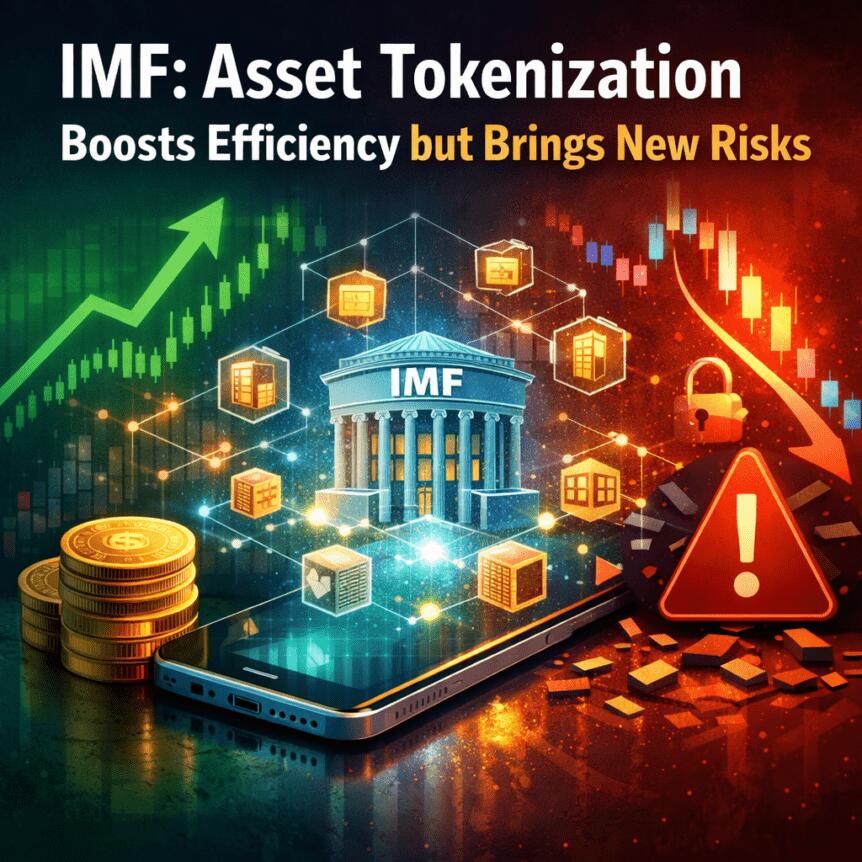
The International Monetary Fund has highlighted both the promise and the peril of tokenization in finance. In a 23-page assessment released this week, the IMF said tokenization could reduce friction and increase transparency across issuance, trading, settlement and asset management. Yet it warned that the same technology could also introduce risks that might affect financial stability, especially as speed and automation enable rapid, automated flows that leave less room for traditional oversight.
The IMF’s analysis stresses that while atomic settlement and enhanced visibility can mitigate some longstanding dangers, the accelerated pace of tokenized markets could give rise to new systemic stress if controls aren’t aligned with legal and supervisory clarity. A central finding remains: “The net effect of tokenization on financial stability is uncertain,” the IMF wrote, underscoring the delicate balance between improved efficiency and new risk vectors.
Key takeaways
- Tokenization reduces some traditional risks through faster settlement and greater transparency, but speed and automation introduce new financial-stability challenges.
- On-chain tokenization of real-world assets has surpassed $27.6 billion, excluding stablecoins, according to RWA.xyz data, highlighting growing industry activity.
- Long-run forecasts for the tokenization market vary widely—BCG in 2022 projected up to $16 trillion by 2030, while McKinsey in 2024 offered a more conservative $2 trillion—the gap reflecting differing assumptions about liquidity, regulation and adoption.
- Legal clarity over ownership records and settlement finality remains a bottleneck; the IMF notes fragmented markets could hamper widespread use unless governance keeps pace with technology.
The economic arc of tokenized real-world assets
The IMF’s report acknowledges that tokenization expands how securities and other financial products are issued, traded, settled and managed. But it also cautions that the technology effectively shifts some systemic risk from traditional banking rails to shared ledgers and smart contract code. In a phrase that captures the urgency for policymakers, the IMF warned that “stress events in tokenized markets are likely to unfold faster than in traditional systems, leaving less time for discretionary intervention.”
On the demand side, tokenization is being seen as a means to accelerate cross-border payments, broaden financial inclusion and unlock new channels for capital flow in emerging markets. Yet, the IMF also flags potential downsides: greater volatility in capital moves, rapid currency substitution and a perceived erosion of monetary sovereignty if participants rely on programmable money without adequate supervisory guardrails.
While the IMF is cautious, market participants are moving ahead. Real-world asset (RWA) tokenization has already drawn substantial traction. As of early April, data from RWA.xyz show more than $27.6 billion of real-world assets tokenized on-chain, excluding stablecoins. The scale of this segment points to a broader appetite among institutions to digitize assets like receivables, property interests and other non-tokenized holdings.
In the broader market outlook, the debate centers on scalability and liquidity. Industry studies have delivered mixed signals about the ultimate size of the opportunity. Boston Consulting Group estimated in 2022 that the tokenization market could swell to as much as $16 trillion by 2030, while McKinsey & Co. offered a notably more cautious projection of around $2 trillion for the same horizon. The IMF’s assessment sits between these bounds, emphasizing potential but underscoring the need for robust risk management as the ecosystem grows.
Industry momentum and notable players
Interest from Wall Street has been a key driver. High-profile figures such as BlackRock CEO Larry Fink have signaled support for tokenizing a broad spectrum of assets—from equities and bonds to money market funds and real estate—marking a shift in institutional attitudes toward on-chain representations of traditional instruments.
Within the on-chain asset category, Securitize has emerged as a leading platform by total value locked (TVL) in real-world asset tokenization. Securitize powers the BlackRock USD Institutional Digital Liquidity Fund, a major RWA project with reported TVL around $3.38 billion, per CryptoDep’s April data. Closely following are Tether Gold and Ondo Finance, with roughly $3.35 billion and $3.21 billion in TVL, respectively, underscoring a crowded field of tokenized wealth vehicles aimed at institutional investors.
Source: CryptoDep (April data) showing Securitize at about $3.38B TVL, with Tether Gold and Ondo Finance nearby.Beyond tokenized assets themselves, the traditional exchanges are signaling their intent to bring tokenization into mainstream trading and settlement. Intercontinental Exchange, the parent company of the New York Stock Exchange, announced in January that it would launch a tokenization platform designed for 24/7 trading and instant settlement of stocks and exchange-traded funds via a blockchain-based post-trade system. The move indicates a direction where tokenized securities could become an integrated, continuous-source of liquidity rather than a niche, off-hours exercise.
Standards, regulation and practical controls
One of the IMF’s pointed critiques centers on legal and regulatory clarity. Without well-defined ownership records and settlement finality, tokenized markets risk becoming fragmented and peripheral to the broader financial system. In response, the industry has begun embracing standards and access controls to align technology with regulatory expectations.
Among the notable technical developments is the Ethereum ecosystem’s ERC-3643 standard, which enables permissioned access to tokenized assets and imposes identity and eligibility checks for holders. In practice, this standard is already being applied by some tokenized products to ensure compliance with investor requirements. A concrete example cited in the industry press is Coinbase Asset Management’s tokenized shares for the Coinbase Bitcoin Yield Fund, issued on the Base network (an Ethereum Layer 2). The fund leverages ERC-3643 to verify holder identity and eligibility during tokenization and post-trade processes.
The IMF also points to the broader regulatory architecture around stablecoins, cross-border flows and monetary sovereignty as areas that require ongoing attention as tokenized markets scale. The balance between enabling innovation and preserving monetary policy effectiveness will be a central theme for policymakers over the coming years.
What to watch next
As tokenization marches from pilot projects to greater market participation, investors and builders will be watching several key dynamics. First, whether legal frameworks and settlement finality standards crystallize in a way that reduces fragmentation and reassures traditional market participants. Second, whether liquidity continues to grow in real‑world asset tokens to the point where they rival or surpass traditional offline channels. Third, which infrastructure—clearing, custody, identity verification, and cross-border rails—will emerge as the de facto backbone for scalable tokenized markets. And finally, whether central banks and regulators adopt a calibrated stance that supports innovation without sacrificing financial stability.
In the near term, a handful of large players and platforms—creators of RWA markets, major asset managers experimenting with tokenized funds, and exchange operators expanding tokenized trading—will likely shape the pace and direction of adoption. The IMF’s findings suggest this is not a one-off tech experiment but a continental shift in how assets are created, traded and settled—one that demands careful risk governance as the ecosystem matures.
Readers should monitor developments around legal clarifications for tokenized ownership, concrete liquidity metrics for tokenized assets, and the progression of compliant standards like ERC-3643 as the market seeks a balance between efficiency and resilience.
This article was originally published as IMF: Asset Tokenization Boosts Efficiency but Brings New Risks on Crypto Breaking News – your trusted source for crypto news, Bitcoin news, and blockchain updates.


Potrebbe anche piacerti

Why Banks Restrict Accounts (And What Happens Next)
Trump's new AG immediately put on notice by GOP rep — and warned of 'criminal' liability