Author: Zhou, ChainCatcher Over the past year, beneath the surface of the volatile crypto market and rapidly changing narratives, only a handful of projects have truly proven their value. However, when we put together the names of some of the most talked-about projects recently, whether it's the high-performance public chains MegaETH and Monad, the popular stable-yield protocol Ethena, or the prediction market pioneer Polymarket, Dragonfly is almost always present in their early or key investment lists. As one seasoned investor in the industry put it, Dragonfly is the biggest winner in this cycle. Dragonfly's Investment Profile and Background: Driven by Trading Instinct Dragonfly is a venture capital fund focused on the crypto space, founded by Feng Bo. As an early investor, Feng Bo possesses a deep understanding of exchange operations, liquidity needs, and trading scenarios, giving Dragonfly a financial perspective from the outset. He has repeatedly stated that blockchain should not be simply understood as "a faster internet," but rather as a set of tools for rebuilding the financial stack. Haseeb Qureshi, Managing Partner of Dragonfly, has repeatedly emphasized the issue of navigating economic cycles. He believes the real challenge lies not in the rotation of sectors or narratives, but in the systemic pain points that recur throughout bull and bear markets: How can performance bottlenecks be overcome? Can on-chain clearing mechanisms withstand extreme pressure? Is the revenue structure sustainable in the long term? How can data be transformed into tradable financial assets? In the absence of systemic risk hedging, how can institutional funds safely enter the market? These issues are easily obscured by the frenzied narrative of a bull market, and only come to the forefront again when the market cools down. In his recent article, "In Defense of Exponential Growth," Haseeb Qureshi points out that the market often misjudges the value of Ethereum, Solana, and next-generation L1 blockchains (such as Monad and MegaETH) because it falls into the "error of linear thinking": it uses traditional models such as P/E ratios and revenue metrics to judge blockchains, and treats companies with exponential growth as steady-state businesses. He firmly believes that the pricing logic of L1 projects is similar to that of biotechnology: a mere 1% to 5% probability of becoming the next Ethereum or Solana is enough to rationally justify their multi-billion dollar valuation (i.e., the "probability premium"). Therefore, long-term conviction is the real advantage in crypto investing that is often forgotten by most. Looking back at Dragonfly's investment portfolio over the past three years, a complete chain from underlying infrastructure to upper-layer applications can be clearly outlined: Public blockchains and scaling: Monad (seed round 2023), MegaETH (2024), Prodia (2024), Caldera (2023), etc.; Trading infrastructure: Lighter (2024), Level (2024), Orderly (2023 expansion), Bitget (2023 strategic round), etc.; Stable assets and returns: Ethena (multiple rounds in 2023-2024), Pendle (2023), etc.; Data and tools: Kaito (Series A, 2023), Polymarket (Two rounds, 2024-2025), etc. This is not a strategy of casting a wide net, but a clear preference: prioritize betting on long-term gaps in key links, and then look for key pieces of the puzzle in each link. This deep understanding is directly reflected in Dragonfly's investment preferences. They seem to rarely pursue whether a project can achieve several times growth in the short term, but rather care more about whether the mechanism or product can still be valued by the industry five or even ten years later. Core Differentiated Advantages and Challenges The underlying logic of Dragonfly's success lies in two mutually supportive differentiated pillars. First, Dragonfly boasts a strong secondary market trading team, a fundamental difference from many purely primary market VCs. This strategic move, established as early as 2019, manages over $1 billion in liquidity, creating a strong competitive advantage for its investment decisions. The L2 team can capture real market sentiment, fund flows, and narrative shifts much earlier. Their sensitivity to indicators such as liquidity and liquidation pressure far surpasses that of traditional primary VCs, allowing them to feed real-world data into primary market decisions. Haseeb Qureshi has publicly stated that the secondary market is not an exit strategy, but rather an outpost for investment. Secondly, Dragonfly's investment in multiple trading platforms such as Bitget and Bybit aims not only to increase the equity value of the exchanges themselves, but also to transform them into distribution amplifiers and liquidity channels for stable assets. Dragonfly has successfully integrated its supported stable assets (such as Ethena's USDe) into the exchange system through strategic deployment on trading platforms. Once stable assets can be used as collateral or the underlying assets of trading pairs on exchanges, it will greatly stimulate user demand and purchases, thereby rapidly expanding the issuance scale of stablecoins. Admittedly, the best time to evaluate a VC isn't during a bull market, but rather when everyone is less inclined to invest. The primary crypto market has cooled significantly over the past year. According to RootData statistics, there have been 1058 funding events recorded so far in 2025, a 46% decrease from the peak of 1962 in 2022. In this waning sentiment, most funds have proactively slowed down, with some capital simply shifting towards AI or traditional technologies. Against this backdrop, competition for high-quality projects has intensified. Dragonfly not only needs to compete with well-funded established VCs like Paradigm for early-stage star projects, but also faces the impact on liquidity from the entry of traditional financial investment giants. In addition, leading exchanges are also deploying their investment and incubation departments to develop vertical sectors. This poses a severe challenge to Dragonfly's project acquisition, ecosystem control, and long-term holding capabilities. Furthermore, as cutting-edge technologies such as AI become deeply integrated with encryption, a key challenge for investment institutions like Dragonfly, with a pure encryption background, is whether their expertise will be recognized by the founders when acquiring high-quality cross-industry projects. Conclusion ChainCatcher previously interviewed several early Crypto investors, mentioning in their article "The New Cycle and Old Rules of Crypto VCs" that many native crypto VCs, indulging in narrative-driven and short-term speculation, face a mismatch between value capture and risk-taking. Dragonfly's demonstrated trading instincts, secondary market hedging capabilities, and emphasis on stablecoin cash flow precisely return to the old rules of long-term USD funds: meticulous management of systemic risk and the search for sustainable revenue models with endogenous growth momentum. From this perspective, Dragonfly's emergence as a winner in this cycle is a microcosm of fund managers returning to traditional rules in the new crypto cycle. However, facing competition from traditional giants, traditional financial investment giants, and leading exchanges, as well as the professional challenges brought about by the integration of crypto and cutting-edge technologies, Dragonfly must consider how to extend this trading instinct to cross-domain technological infrastructure to maintain its long-term competitive advantage if it wants to break through its existing growth boundaries.Author: Zhou, ChainCatcher Over the past year, beneath the surface of the volatile crypto market and rapidly changing narratives, only a handful of projects have truly proven their value. However, when we put together the names of some of the most talked-about projects recently, whether it's the high-performance public chains MegaETH and Monad, the popular stable-yield protocol Ethena, or the prediction market pioneer Polymarket, Dragonfly is almost always present in their early or key investment lists. As one seasoned investor in the industry put it, Dragonfly is the biggest winner in this cycle. Dragonfly's Investment Profile and Background: Driven by Trading Instinct Dragonfly is a venture capital fund focused on the crypto space, founded by Feng Bo. As an early investor, Feng Bo possesses a deep understanding of exchange operations, liquidity needs, and trading scenarios, giving Dragonfly a financial perspective from the outset. He has repeatedly stated that blockchain should not be simply understood as "a faster internet," but rather as a set of tools for rebuilding the financial stack. Haseeb Qureshi, Managing Partner of Dragonfly, has repeatedly emphasized the issue of navigating economic cycles. He believes the real challenge lies not in the rotation of sectors or narratives, but in the systemic pain points that recur throughout bull and bear markets: How can performance bottlenecks be overcome? Can on-chain clearing mechanisms withstand extreme pressure? Is the revenue structure sustainable in the long term? How can data be transformed into tradable financial assets? In the absence of systemic risk hedging, how can institutional funds safely enter the market? These issues are easily obscured by the frenzied narrative of a bull market, and only come to the forefront again when the market cools down. In his recent article, "In Defense of Exponential Growth," Haseeb Qureshi points out that the market often misjudges the value of Ethereum, Solana, and next-generation L1 blockchains (such as Monad and MegaETH) because it falls into the "error of linear thinking": it uses traditional models such as P/E ratios and revenue metrics to judge blockchains, and treats companies with exponential growth as steady-state businesses. He firmly believes that the pricing logic of L1 projects is similar to that of biotechnology: a mere 1% to 5% probability of becoming the next Ethereum or Solana is enough to rationally justify their multi-billion dollar valuation (i.e., the "probability premium"). Therefore, long-term conviction is the real advantage in crypto investing that is often forgotten by most. Looking back at Dragonfly's investment portfolio over the past three years, a complete chain from underlying infrastructure to upper-layer applications can be clearly outlined: Public blockchains and scaling: Monad (seed round 2023), MegaETH (2024), Prodia (2024), Caldera (2023), etc.; Trading infrastructure: Lighter (2024), Level (2024), Orderly (2023 expansion), Bitget (2023 strategic round), etc.; Stable assets and returns: Ethena (multiple rounds in 2023-2024), Pendle (2023), etc.; Data and tools: Kaito (Series A, 2023), Polymarket (Two rounds, 2024-2025), etc. This is not a strategy of casting a wide net, but a clear preference: prioritize betting on long-term gaps in key links, and then look for key pieces of the puzzle in each link. This deep understanding is directly reflected in Dragonfly's investment preferences. They seem to rarely pursue whether a project can achieve several times growth in the short term, but rather care more about whether the mechanism or product can still be valued by the industry five or even ten years later. Core Differentiated Advantages and Challenges The underlying logic of Dragonfly's success lies in two mutually supportive differentiated pillars. First, Dragonfly boasts a strong secondary market trading team, a fundamental difference from many purely primary market VCs. This strategic move, established as early as 2019, manages over $1 billion in liquidity, creating a strong competitive advantage for its investment decisions. The L2 team can capture real market sentiment, fund flows, and narrative shifts much earlier. Their sensitivity to indicators such as liquidity and liquidation pressure far surpasses that of traditional primary VCs, allowing them to feed real-world data into primary market decisions. Haseeb Qureshi has publicly stated that the secondary market is not an exit strategy, but rather an outpost for investment. Secondly, Dragonfly's investment in multiple trading platforms such as Bitget and Bybit aims not only to increase the equity value of the exchanges themselves, but also to transform them into distribution amplifiers and liquidity channels for stable assets. Dragonfly has successfully integrated its supported stable assets (such as Ethena's USDe) into the exchange system through strategic deployment on trading platforms. Once stable assets can be used as collateral or the underlying assets of trading pairs on exchanges, it will greatly stimulate user demand and purchases, thereby rapidly expanding the issuance scale of stablecoins. Admittedly, the best time to evaluate a VC isn't during a bull market, but rather when everyone is less inclined to invest. The primary crypto market has cooled significantly over the past year. According to RootData statistics, there have been 1058 funding events recorded so far in 2025, a 46% decrease from the peak of 1962 in 2022. In this waning sentiment, most funds have proactively slowed down, with some capital simply shifting towards AI or traditional technologies. Against this backdrop, competition for high-quality projects has intensified. Dragonfly not only needs to compete with well-funded established VCs like Paradigm for early-stage star projects, but also faces the impact on liquidity from the entry of traditional financial investment giants. In addition, leading exchanges are also deploying their investment and incubation departments to develop vertical sectors. This poses a severe challenge to Dragonfly's project acquisition, ecosystem control, and long-term holding capabilities. Furthermore, as cutting-edge technologies such as AI become deeply integrated with encryption, a key challenge for investment institutions like Dragonfly, with a pure encryption background, is whether their expertise will be recognized by the founders when acquiring high-quality cross-industry projects. Conclusion ChainCatcher previously interviewed several early Crypto investors, mentioning in their article "The New Cycle and Old Rules of Crypto VCs" that many native crypto VCs, indulging in narrative-driven and short-term speculation, face a mismatch between value capture and risk-taking. Dragonfly's demonstrated trading instincts, secondary market hedging capabilities, and emphasis on stablecoin cash flow precisely return to the old rules of long-term USD funds: meticulous management of systemic risk and the search for sustainable revenue models with endogenous growth momentum. From this perspective, Dragonfly's emergence as a winner in this cycle is a microcosm of fund managers returning to traditional rules in the new crypto cycle. However, facing competition from traditional giants, traditional financial investment giants, and leading exchanges, as well as the professional challenges brought about by the integration of crypto and cutting-edge technologies, Dragonfly must consider how to extend this trading instinct to cross-domain technological infrastructure to maintain its long-term competitive advantage if it wants to break through its existing growth boundaries.

Why is Dragonfly the biggest winner in this cycle?

2025/12/07 08:00

Author: Zhou, ChainCatcher

Over the past year, beneath the surface of the volatile crypto market and rapidly changing narratives, only a handful of projects have truly proven their value.

However, when we put together the names of some of the most talked-about projects recently, whether it's the high-performance public chains MegaETH and Monad, the popular stable-yield protocol Ethena, or the prediction market pioneer Polymarket, Dragonfly is almost always present in their early or key investment lists.

As one seasoned investor in the industry put it, Dragonfly is the biggest winner in this cycle.

Dragonfly's Investment Profile and Background: Driven by Trading Instinct

Dragonfly is a venture capital fund focused on the crypto space, founded by Feng Bo. As an early investor, Feng Bo possesses a deep understanding of exchange operations, liquidity needs, and trading scenarios, giving Dragonfly a financial perspective from the outset. He has repeatedly stated that blockchain should not be simply understood as "a faster internet," but rather as a set of tools for rebuilding the financial stack.

Haseeb Qureshi, Managing Partner of Dragonfly, has repeatedly emphasized the issue of navigating economic cycles. He believes the real challenge lies not in the rotation of sectors or narratives, but in the systemic pain points that recur throughout bull and bear markets:

How can performance bottlenecks be overcome? Can on-chain clearing mechanisms withstand extreme pressure? Is the revenue structure sustainable in the long term? How can data be transformed into tradable financial assets? In the absence of systemic risk hedging, how can institutional funds safely enter the market?

These issues are easily obscured by the frenzied narrative of a bull market, and only come to the forefront again when the market cools down.

In his recent article, "In Defense of Exponential Growth," Haseeb Qureshi points out that the market often misjudges the value of Ethereum, Solana, and next-generation L1 blockchains (such as Monad and MegaETH) because it falls into the "error of linear thinking": it uses traditional models such as P/E ratios and revenue metrics to judge blockchains, and treats companies with exponential growth as steady-state businesses.

He firmly believes that the pricing logic of L1 projects is similar to that of biotechnology: a mere 1% to 5% probability of becoming the next Ethereum or Solana is enough to rationally justify their multi-billion dollar valuation (i.e., the "probability premium"). Therefore, long-term conviction is the real advantage in crypto investing that is often forgotten by most.

Looking back at Dragonfly's investment portfolio over the past three years, a complete chain from underlying infrastructure to upper-layer applications can be clearly outlined:

  • Public blockchains and scaling: Monad (seed round 2023), MegaETH (2024), Prodia (2024), Caldera (2023), etc.;
  • Trading infrastructure: Lighter (2024), Level (2024), Orderly (2023 expansion), Bitget (2023 strategic round), etc.;
  • Stable assets and returns: Ethena (multiple rounds in 2023-2024), Pendle (2023), etc.;
  • Data and tools: Kaito (Series A, 2023), Polymarket (Two rounds, 2024-2025), etc.

This is not a strategy of casting a wide net, but a clear preference: prioritize betting on long-term gaps in key links, and then look for key pieces of the puzzle in each link.

This deep understanding is directly reflected in Dragonfly's investment preferences. They seem to rarely pursue whether a project can achieve several times growth in the short term, but rather care more about whether the mechanism or product can still be valued by the industry five or even ten years later.

Core Differentiated Advantages and Challenges

The underlying logic of Dragonfly's success lies in two mutually supportive differentiated pillars.

First, Dragonfly boasts a strong secondary market trading team, a fundamental difference from many purely primary market VCs. This strategic move, established as early as 2019, manages over $1 billion in liquidity, creating a strong competitive advantage for its investment decisions. The L2 team can capture real market sentiment, fund flows, and narrative shifts much earlier. Their sensitivity to indicators such as liquidity and liquidation pressure far surpasses that of traditional primary VCs, allowing them to feed real-world data into primary market decisions. Haseeb Qureshi has publicly stated that the secondary market is not an exit strategy, but rather an outpost for investment.

Secondly, Dragonfly's investment in multiple trading platforms such as Bitget and Bybit aims not only to increase the equity value of the exchanges themselves, but also to transform them into distribution amplifiers and liquidity channels for stable assets.

Dragonfly has successfully integrated its supported stable assets (such as Ethena's USDe) into the exchange system through strategic deployment on trading platforms. Once stable assets can be used as collateral or the underlying assets of trading pairs on exchanges, it will greatly stimulate user demand and purchases, thereby rapidly expanding the issuance scale of stablecoins.

Admittedly, the best time to evaluate a VC isn't during a bull market, but rather when everyone is less inclined to invest. The primary crypto market has cooled significantly over the past year. According to RootData statistics, there have been 1058 funding events recorded so far in 2025, a 46% decrease from the peak of 1962 in 2022. In this waning sentiment, most funds have proactively slowed down, with some capital simply shifting towards AI or traditional technologies.

Against this backdrop, competition for high-quality projects has intensified. Dragonfly not only needs to compete with well-funded established VCs like Paradigm for early-stage star projects, but also faces the impact on liquidity from the entry of traditional financial investment giants. In addition, leading exchanges are also deploying their investment and incubation departments to develop vertical sectors. This poses a severe challenge to Dragonfly's project acquisition, ecosystem control, and long-term holding capabilities.

Furthermore, as cutting-edge technologies such as AI become deeply integrated with encryption, a key challenge for investment institutions like Dragonfly, with a pure encryption background, is whether their expertise will be recognized by the founders when acquiring high-quality cross-industry projects.

Conclusion

ChainCatcher previously interviewed several early Crypto investors, mentioning in their article "The New Cycle and Old Rules of Crypto VCs" that many native crypto VCs, indulging in narrative-driven and short-term speculation, face a mismatch between value capture and risk-taking. Dragonfly's demonstrated trading instincts, secondary market hedging capabilities, and emphasis on stablecoin cash flow precisely return to the old rules of long-term USD funds: meticulous management of systemic risk and the search for sustainable revenue models with endogenous growth momentum.

From this perspective, Dragonfly's emergence as a winner in this cycle is a microcosm of fund managers returning to traditional rules in the new crypto cycle. However, facing competition from traditional giants, traditional financial investment giants, and leading exchanges, as well as the professional challenges brought about by the integration of crypto and cutting-edge technologies, Dragonfly must consider how to extend this trading instinct to cross-domain technological infrastructure to maintain its long-term competitive advantage if it wants to break through its existing growth boundaries.

Disclaimer: The articles reposted on this site are sourced from public platforms and are provided for informational purposes only. They do not necessarily reflect the views of MEXC. All rights remain with the original authors. If you believe any content infringes on third-party rights, please contact service@support.mexc.com for removal. MEXC makes no guarantees regarding the accuracy, completeness, or timeliness of the content and is not responsible for any actions taken based on the information provided. The content does not constitute financial, legal, or other professional advice, nor should it be considered a recommendation or endorsement by MEXC.

You May Also Like

Litecoin Forms Ascending Triangle: LTC Price Target $90 Breakout
Litecoin Forms Ascending Triangle: LTC Price Target $90 Breakout

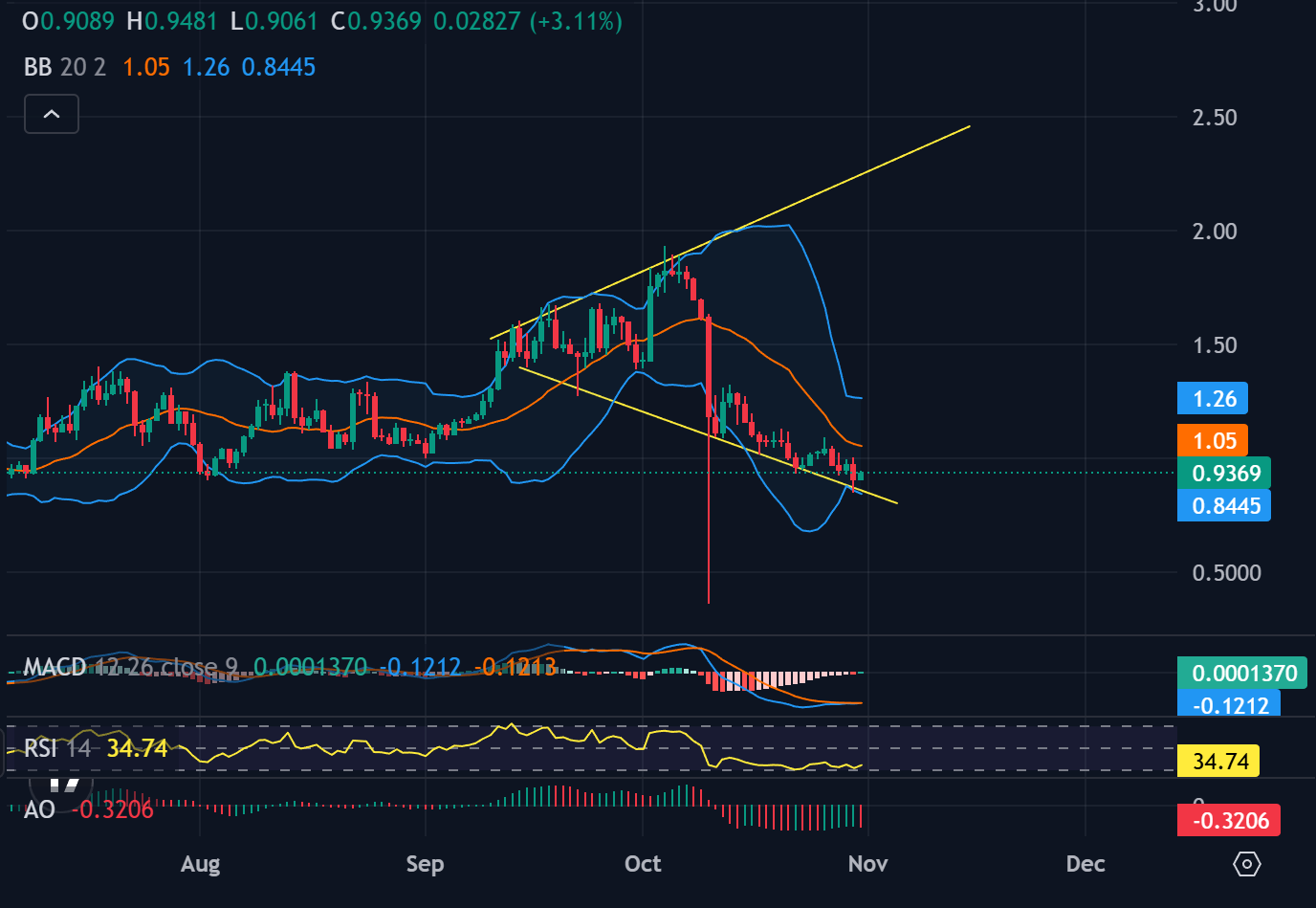
Litecoin charts indicate a potential bullish move, forming an intriguing pattern. Market watchers are eyeing a significant price level, hinting at possible gains. Could the cryptocurrency be on the verge of a breakout towards $90? An analysis reveals which coins might be poised for growth amidst this trend. Powered by Outset PR, this analysis reflects the agency’s commitment to strategic, data-driven communication for the crypto industry.  Litecoin Holds Steady Amid Market Fluctuations Source: tradingview  Litecoin (LTC) prices currently range between $80 and $86. The coin is navigating a cautious path near its 10-day average of about $83. While the value has dipped around 5% over the week, its steady position above $80 suggests resilience. The nearest hurdle lies at $89, but if surpassed, LTC could aim for the $95 mark, representing a potential 10% increase from the lower end of its range. However, a dip below the $78 support might signal further decline. With an RSI below 35, LTC hints at being oversold, indicating a possible bounce.  How Outset PR Leverages Data-Driven Approach in Crypto PR Outset PR connects market events with meaningful storytelling through a data-driven methodology rarely seen in the crypto communications space. Founded by PR strategist Mike Ermolaev, the agency approaches each campaign like a hands-on workshop—building narratives that align with market momentum instead of relying on generic coverage or templated outreach. Beyond just monitoring on-chain flows, Outset PR monitors the media trendlines and traffic distribution through the lens of its proprietary Outset Data Pulse intelligence to determine when a client’s message will achieve the highest lift. This analysis informs the choice of media outlets, the angle of each pitch, and the timing of publication. A key part of the agency’s workflow comes from its proprietary Syndication Map, an internal analytics system that identifies which publications deliver the strongest downstream syndication across aggregators such as CoinMarketCap and Binance Square. Because of this approach, Outset PR campaigns frequently achieve visibility several times higher than their initial placements. Outset PR ensures that each campaign is market-fit and tailored to deliver maximum relevance at the moment the audience is most receptive. Conclusion A current chart pattern shows strong potential for an upward move to $90 for LTC. The ascending triangle suggests bullish momentum. Market sentiment appears positive, and technical indicators support a breakout scenario. Investors are watching for a breach of the current resistance level. Traders should monitor any significant movements closely. A successful breakout could lead to continued gains.   Disclaimer: This article is provided for informational purposes only. It is not offered or intended to be used as legal, tax, investment, financial, or other advice.
Share
Coinstats2025/12/07 18:00