The cryptocurrency market experienced another wave of liquidations on Friday, with Bitcoin (BTC) prices dipping below the critical support level of $90,000. This decline followed a brief rally that had seen its price rise approximately $3,000 above this threshold earlier in the week. Crypto Market Faces $430 Million In Liquidations  Data from CoinGlass reveals that […]The cryptocurrency market experienced another wave of liquidations on Friday, with Bitcoin (BTC) prices dipping below the critical support level of $90,000. This decline followed a brief rally that had seen its price rise approximately $3,000 above this threshold earlier in the week. Crypto Market Faces $430 Million In Liquidations  Data from CoinGlass reveals that […]

Crypto Sell-Off: Binance, Coinbase, Dump Over $2 Billion In Bitcoin As Prices Dip Below $90,000

2025/12/06 20:00

The cryptocurrency market experienced another wave of liquidations on Friday, with Bitcoin (BTC) prices dipping below the critical support level of $90,000. This decline followed a brief rally that had seen its price rise approximately $3,000 above this threshold earlier in the week.

Crypto Market Faces $430 Million In Liquidations 

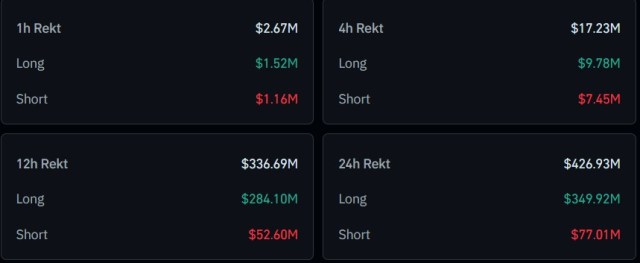
Data from CoinGlass reveals that nearly $430 million in liquidations occurred across the crypto market over the past 24 hours, predominantly affecting leveraged long positions, which accounted for about $350 million. 

During this period, Bitcoin underwent a 3.5% retracement, with its price settling at just above $89,120—a stark 29% below its all-time high of over $126,000 reached in October.
Crypto

Market expert OxNobler recently highlighted the role of both retail and institutional investors in this downturn. In a post on social media platform X, OxNobler detailed the reason behind Bitcoin’s decline: significant sell-offs by major players. 

According to the analyst, the world’s largest cryptocurrency exchange, Binance, sold 4,000 BTC; U.S.-based Coinbase (COIN) liquidated 5,675 BTC; and traditional finance giant Fidelity sold 3,288 BTC. Additionally, market maker Wintermute offloaded 1,793 BTC. 

Notably, the analyst pointed out that Strategy, formerly MicroStrategy, which is the largest public company holder of Bitcoin with over 650,000 coins, has also sold over 3,820 coins in this same time frame.

The firm’s sell-off comes on the heels of speculation regarding Strategy’s potential to liquidate some of its holdings due to the substantial losses affecting its financial performance amid declining Bitcoin prices. 

When Strategy CEO Phong Le was questioned about the possibility of selling off Bitcoin, he acknowledged that while the firm’s former CEO, Michael Saylor, has consistently opposed selling, circumstances may change if the company’s stock trades below the net value of its Bitcoin holdings, which aligns with the recent actions taken by the firm.

Coinbase Analysts Predict December Recovery 

Interestingly, while these institutional sell-offs have contributed to the current market dip, Coinbase’s institutional division has projected a potential recovery for the crypto market in December, citing improving liquidity, a 92% probability of the Federal Reserve (Fed) cutting rates, and supportive macroeconomic conditions.

Analysts have pointed out several reasons for optimism, including the recovery of liquidity, the resilience of the “AI bubble,” and the attractiveness of short US dollar trades at current levels. 

However, OxNobler warned that the situation may not be so straightforward. Alongside the activities of major institutions, he noted that BlackRock, the world’s largest asset manager, had recently sold $130 million worth of Bitcoin and Ethereum (ETH).

Furthermore, Vitalik Buterin, one of Ethereum’s co-founders, seems to have resumed selling Ethereum, with millions of ETH being moved from the foundation’s wallet through Gnosis Safe.

Ultimately, OxNobler asserts that these institutional activities may have a hand in manipulating crypto prices and preventing them from climbing to higher levels and key resistance points. 

Crypto

Featured image from DALL-E, chart from TradingView.com 

Disclaimer: The articles reposted on this site are sourced from public platforms and are provided for informational purposes only. They do not necessarily reflect the views of MEXC. All rights remain with the original authors. If you believe any content infringes on third-party rights, please contact service@support.mexc.com for removal. MEXC makes no guarantees regarding the accuracy, completeness, or timeliness of the content and is not responsible for any actions taken based on the information provided. The content does not constitute financial, legal, or other professional advice, nor should it be considered a recommendation or endorsement by MEXC.

You May Also Like

Why Tom Lee’s BitMine Is Buying Ethereum (ETH) Aggressively Despite Market Fear

Why Tom Lee’s BitMine Is Buying Ethereum (ETH) Aggressively Despite Market Fear

BitMine Immersion Technologies, the largest corporate holder of Ethereum (ETH), has doubled down on its acquisition of ETH in December, highlighting confidence in the asset. The renewed buying comes despite a tough environment for Ethereum. Rising exchange inflows and ongoing exchange-traded fund (ETF) outflows point to short-term pressure across the market. BitMine Scoops Up 138,452 ETH in a Week, Now Controls 3.2% of Supply According to a recent disclosure, BitMine acquired 138,452 ETH last week, representing a 156% increase over the previous four weeks. Its total holdings stand at 3.86 million ETH. This accounts for over 3.2% of Ethereum’s circulating supply. Furthermore, it puts BitMine two-thirds of the way toward its goal to control 5% of ETH’s supply. Since adopting ETH as a reserve asset, BitMine has continued to make large-scale purchases. Between June 30 and October 5, BitMine accumulated 2.83 million ETH. Since October 5, it has added another 1.03 million ETH to its holdings. Ethereum’s weakness throughout the fourth quarter makes BitMine’s steady accumulation even more notable. Since early October, ETH has shed about 24.8% of its value, reflecting persistent downward pressure. December has offered a small break from that trend. The price has climbed more than 4% since the start of the month, and with it have climbed BitMine’s ETH purchases. According to BitMine Chairman Tom Lee, the company’s accelerated purchasing activity reflects its confidence that ETH will likely see gains in the coming months, supported by several key catalysts. These include the Fusaka upgrade, which was activated last week and delivers meaningful improvements to Ethereum’s scalability, security, and overall network efficiency. BitMine also points to the broader macro backdrop, with the Federal Reserve ending quantitative tightening and potentially introducing another interest rate cut tomorrow. Together, these developments form the basis for the company’s view that market conditions could turn more supportive for ETH after weeks of volatility. “We are now more than 8 weeks past the October 10th liquidation shock event, a sufficient length of time to allow crypto to again trade on forward fundamentals,” Lee added. Market Conditions Point to Near-Term Volatility Despite this, on-chain data signals caution. CryptoOnchain noted that Ethereum exchange netflow to Binance has surged. The exchange received 162,084 ETH on December 5, 2025. This was the largest single-day inflow of ETH to the exchange since May 2023. Large deposits on exchanges often suggest impending sell pressure, since investors typically transfer tokens to platforms before liquidating. “Given the magnitude of this inflow, market participants should remain cautious. A supply shock of this size, if executed as market orders, could lead to heightened volatility or a short-term price correction,” the analyst stated. Furthermore, Ethereum exchange-traded funds are also signaling weakened demand. The ETFs experienced a record $1.4 billion in net outflows in November 2025, marking the largest monthly withdrawal on record. The trend has continued into December. According to SoSoValue, an additional $65.59 million exited ETH-focused ETFs in the first week of the month. “Historically, ETF flow reversals tell you more about liquidity pressure than about long term fundamentals. When redemptions spike, it’s usually a sign that broader risk sentiment is cracking, not that the asset itself broke. If ETF outflows continue, near term price action stays choppy as liquidity gets drained at the edges,” Milk Road posted. The ongoing divergence between direct accumulation and ETF redemptions highlights a market split, with retail and institutional players following diverging strategies regarding Ethereum’s outlook.
Share
Coinstats2025/12/09 16:08