NEAR Protocol partners with ADI Chain to debut TravAI, where AI agents handle complete travel booking workflows from search to payment using crypto. The post NEAR, ADI Launch TravAI, an AI-Based Travel Booking Platform appeared first on Coinspeaker.NEAR Protocol partners with ADI Chain to debut TravAI, where AI agents handle complete travel booking workflows from search to payment using crypto. The post NEAR, ADI Launch TravAI, an AI-Based Travel Booking Platform appeared first on Coinspeaker.

NEAR, ADI Launch TravAI, an AI-Based Travel Booking Platform

2025/12/06 03:02

NEAR Protocol and ADI Chain have partnered to launch TravAI, a travel booking platform powered by AI agents and intent-based operations. The platform lets users tell an AI concierge where they want to go and when—the agent then searches providers, builds the itinerary, books everything, and completes payments without manual steps.

All transactions settle on ADI Chain, an enterprise-focused layer-2 blockchain. Users can pay with Bitcoin BTC $89 517 24h volatility: 2.6% Market cap: $1.79 T Vol. 24h: $49.53 B , Ethereum ETH $3 028 24h volatility: 2.9% Market cap: $365.48 B Vol. 24h: $28.05 B , Solana SOL $132.4 24h volatility: 5.1% Market cap: $74.11 B Vol. 24h: $5.04 B , or any other major token supported by NEAR Intents. The chain abstraction, intent-based protocol powered by the NEAR stack handles the cross-chain conversion behind the scenes, according to the official announcement on the NEAR blog published on December 5.

TravAI is developed and operated by Datrics, while ADI Chain comes from Sirius International, the digital arm of UAE-listed IHC. The partnership targets both corporate travel teams and frequent individual travelers looking for faster, auditable booking flows.

NEAR co-founder Illia Polosukhin called the launch the arrival of “agentic commerce” that solves real-world problems. He highlighted fully automated planning-to-payment workflow in a post on X on the same day of the launch.

NEAR AI Initiatives and Price Analysis

The release follows NEAR’s recent push into AI tools. On December 3, the NEAR Foundation rolled out AI Cloud and Private Chat features with hardware-backed privacy, already adopted by projects reaching over 100 million users, according to Coinspeaker.

NEAR Intents, the cross-chain engine powering TravAI payments, has processed more than $7 billion in volume since launch, data showed earlier this week.

Nevertheless, NEAR NEAR $1.69 24h volatility: 5.3% Market cap: $2.16 B Vol. 24h: $198.77 M price remains in bearish territory, presenting a significant divergence from all the recent bullish news and fundamentals. To mention NEAR’s partnership with Brave, the leading privacy-focused web browser, and Kalshi, the leading US-based prediction market that started supporting NEAR payments.

As of this writing, the digital asset is trading outside a year-long price range, below this range’s support at $1.67 per token.
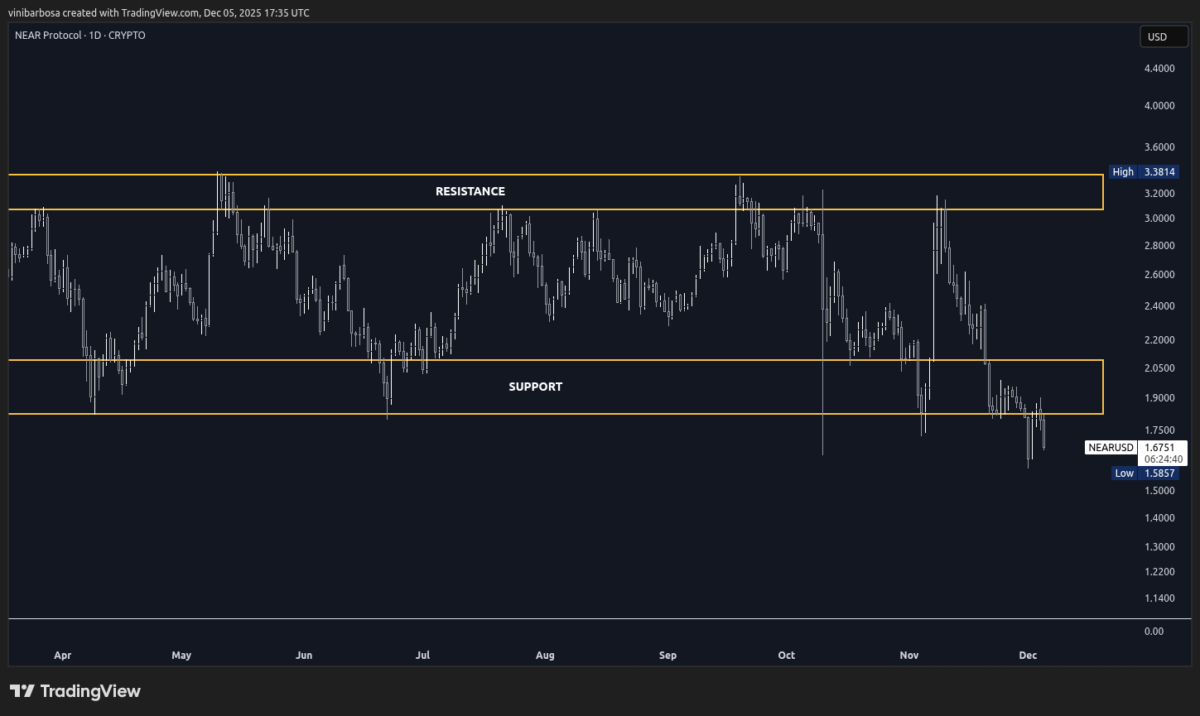
NEAR price chart (1D), as of December 5, 2025 | Source: TradingView

NEAR price chart (1D), as of December 5, 2025 | Source: TradingView

TravAI is currently inviting users to join the waitlist, with enterprise solutions also available.

next

The post NEAR, ADI Launch TravAI, an AI-Based Travel Booking Platform appeared first on Coinspeaker.

Disclaimer: The articles reposted on this site are sourced from public platforms and are provided for informational purposes only. They do not necessarily reflect the views of MEXC. All rights remain with the original authors. If you believe any content infringes on third-party rights, please contact service@support.mexc.com for removal. MEXC makes no guarantees regarding the accuracy, completeness, or timeliness of the content and is not responsible for any actions taken based on the information provided. The content does not constitute financial, legal, or other professional advice, nor should it be considered a recommendation or endorsement by MEXC.

You May Also Like

Bitcoin Institutional Adoption: Why Saylor Predicts a Crucial Shift in BTC Price Action

Bitcoin Institutional Adoption: Why Saylor Predicts a Crucial Shift in BTC Price Action

BitcoinWorld Bitcoin Institutional Adoption: Why Saylor Predicts a Crucial Shift in BTC Price Action The cryptocurrency world is constantly evolving, and few voices carry as much weight as Michael Saylor, the visionary co-founder of MicroStrategy. Recently, Saylor shared a fascinating perspective that could redefine how we view Bitcoin institutional adoption and its impact on future price movements. His insights suggest a significant shift on the horizon, one that promises both stability and perhaps a touch of unexpected calm for the often-turbulent crypto market. What Does Increased Bitcoin Institutional Adoption Mean for Volatility? During a recent appearance on the CoinStories YouTube channel, Michael Saylor elaborated on a crucial trend: the growing involvement of institutional investors in the Bitcoin ecosystem. He believes this influx of capital from large financial entities will fundamentally alter Bitcoin’s market behavior. Saylor explained that as institutions commit more capital, the market naturally becomes more robust and less susceptible to the dramatic price swings retail investors have grown accustomed to. This isn’t just a theory; it’s a natural progression for any maturing asset class. Essentially, more money from stable, long-term players means fewer sudden spikes and crashes driven by speculative fervor. Decreased Price Swings: Institutional capital tends to be ‘sticky,’ meaning it’s less likely to panic sell during minor corrections. Enhanced Market Depth: Larger orders from institutions provide greater liquidity, making it harder for single events to drastically move the price. Increased Stability: A more stable market is often seen as a prerequisite for even wider Bitcoin institutional adoption. This shift, while beneficial for long-term growth and legitimacy, might present a different experience for day traders who thrive on high volatility. Is Market Maturation a Disappointment for Some Investors? While the idea of a more stable Bitcoin might sound appealing to many, Saylor acknowledged that it could be a bittersweet development for a segment of the investor community. Specifically, those who have profited immensely from Bitcoin’s notorious volatility might find a subdued market less exciting. He described this as a natural part of Bitcoin’s maturation process. Think of it like a wild frontier slowly becoming a developed city; the excitement of the untamed wilderness gives way to established infrastructure and predictable routines. For Bitcoin institutional adoption to truly flourish, a certain level of predictability is necessary. However, this doesn’t mean Bitcoin will become boring. Instead, it suggests a transition from a speculative asset to a more recognized store of value and potentially a global reserve asset. The focus might shift from rapid, short-term gains to sustained, long-term appreciation, mirroring traditional financial assets that have undergone similar transformations. Bitcoin has indeed shown signs of this evolution, trading around the $115,000 level since reaching a new all-time high in August. This consolidation around higher levels suggests a foundational strength building up, rather than wild, unpredictable movements. Navigating the New Landscape of Bitcoin Institutional Adoption Understanding this evolving market dynamic is crucial for all participants. For institutions, a less volatile Bitcoin offers a more attractive risk profile, making it easier to justify larger allocations and integrate it into diversified portfolios. This further fuels Bitcoin institutional adoption. For retail investors, the strategy might need to adapt. Instead of chasing quick pumps and dumps, a long-term hodling strategy focused on Bitcoin’s fundamental value proposition could become even more paramount. The benefits of this maturation are clear: Greater Legitimacy: Institutions bring credibility and regulatory clarity. Reduced Risk: Less volatility means a safer asset for broader investment. Long-Term Growth Potential: A stable foundation supports sustainable value appreciation. The challenge, however, lies in managing expectations. Those accustomed to parabolic surges might need to adjust to more modest, albeit consistent, growth. This isn’t a signal to abandon Bitcoin, but rather to recognize its evolution into a more sophisticated financial instrument. Michael Saylor’s perspective highlights that while the ride might become smoother, the destination – a globally adopted, robust digital asset – remains incredibly compelling. The path to mainstream acceptance often involves shedding some of the wildness that initially attracted many, in favor of stability that appeals to the masses. Michael Saylor’s insights offer a powerful glimpse into Bitcoin’s future. The increasing tide of Bitcoin institutional adoption is set to transform its market dynamics, potentially ushering in an era of more subdued price action. While this might temper the excitement for some, it signifies a profound maturation, solidifying Bitcoin’s role as a legitimate and enduring asset class. This evolution is not a setback but a necessary step towards its ultimate potential, inviting a new wave of investors seeking stability alongside innovation. Frequently Asked Questions About Bitcoin’s Market Evolution Q1: What does Michael Saylor mean by “subdued BTC price action”? A1: Saylor suggests that as more institutional investors enter the Bitcoin market, its price swings (volatility) will likely decrease. This means fewer extremely large daily percentage gains or losses, leading to a more stable and predictable price trajectory. Q2: Why would institutional investors lead to less Bitcoin volatility? A2: Institutional investors typically operate with larger capital, longer investment horizons, and more rigorous risk management strategies. Their presence adds significant liquidity and depth to the market, making it less susceptible to rapid price movements caused by smaller, speculative trades. Q3: Is decreased volatility a good thing for Bitcoin? A3: For the long-term health and widespread acceptance of Bitcoin, yes. Lower volatility makes Bitcoin a more attractive asset for large corporations, pension funds, and traditional financial institutions, fostering greater Bitcoin institutional adoption and legitimacy. However, it might be less appealing for short-term traders who profit from large price swings. Q4: How should retail investors adapt to this potential shift? A4: Retail investors might consider shifting their focus from short-term trading to long-term investment strategies, often referred to as “hodling.” Emphasizing Bitcoin’s role as a store of value and a hedge against inflation could become even more pertinent in a less volatile market. Q5: Has Bitcoin shown signs of this maturation already? A5: Yes, the article mentions Bitcoin trading around the $115,000 level since reaching a new all-time high in August, suggesting a period of consolidation rather than extreme volatility, which aligns with Saylor’s observations. What are your thoughts on Michael Saylor’s predictions for Bitcoin? Do you welcome a more subdued market, or will you miss the wild rides? Share this article with your friends and fellow crypto enthusiasts on social media to spark a conversation about the future of Bitcoin institutional adoption! To learn more about the latest crypto market trends, explore our article on key developments shaping Bitcoin institutional adoption. This post Bitcoin Institutional Adoption: Why Saylor Predicts a Crucial Shift in BTC Price Action first appeared on BitcoinWorld.
Share
Coinstats2025/09/20 14:40
XRP Price Prediction As Spot ETF Inflows Near $1 Billion: What’s Next?

XRP Price Prediction As Spot ETF Inflows Near $1 Billion: What’s Next?

The post XRP Price Prediction As Spot ETF Inflows Near $1 Billion: What’s Next? appeared on BitcoinEthereumNews.com. XRP price dropped 5% in the last 24 hours, stabilizing around $2.00 as the market faced a bearish trend. Despite strong institutional growth within Ripple, the broader crypto market decline affected XRP.  Bitcoin price hovers below $90k, pushing down prices further. Nonetheless, inflows of Spot ETFs of close to $1 billion. Analysts are optimistic that XRP may experience a positive trend in case the market revives and institutional investments keep increasing. XRP Spot ETF Sees Unstoppable Growth: Nears $1 Billion in Inflows The United States XRP spot ETF is also taking the same direction as the ETF of SOL where it records 14 consecutive days inflows and zero outflows. Such a trend indicates an increasing interest in XRP, as the ETF now approaches a large milestone of a total inflows of $1 billion. The recent statistics show high net inflows, and the price of XRP changes insignificantly, which is a sign of a high demand of the cryptocurrency, which has a positive market mood. The US 🇺🇸 spot $XRP ETF is following in $SOL‘s footsteps with 14 straight days of inflows and zero outflows so far. Currently closing in on $1 Billion inflows 👌 pic.twitter.com/tj9A7nFgv7 — Rand (@cryptorand) December 5, 2025 XRP Price Signals Potential Buy, Says Analyst A crypto analyst Ali has just provided an intriguing study of the XRP markets. According to Ali, the cryptocurrency can be going through a period of buying according to the TD Sequential indicator. The TD Sequential is a trend-following tool that is widely used to predict market trends. The chart by Ali shows a possible buy point of XRP. The graph portrays candlesticks with some being big and others being small in size. $XRP is a buy, according to the TD Sequential. pic.twitter.com/uI9s9Qwu6Y — Ali (@ali_charts) December 5, 2025 Is XRP Price…
Share
BitcoinEthereumNews2025/12/06 12:17