Zcash surged past $375 following a public debate between founder Eli Ben-Sasson and Michael Saylor, reigniting interest in the privacy-focused cryptocurrency. The post Zcash Price Regains Footing Above $375 as Founder Responds to Michael Saylor’s Criticism appeared first on Coinspeaker.Zcash surged past $375 following a public debate between founder Eli Ben-Sasson and Michael Saylor, reigniting interest in the privacy-focused cryptocurrency. The post Zcash Price Regains Footing Above $375 as Founder Responds to Michael Saylor’s Criticism appeared first on Coinspeaker.

Zcash Price Regains Footing Above $375 as Founder Responds to Michael Saylor’s Criticism

2025/12/06 01:58

Zcash ZEC $365.7 24h volatility: 1.7% Market cap: $6.01 B Vol. 24h: $1.28 B regained footing above the $375 level on Dec. 5 after a heated public exchange between Zcash founder Eli Ben-Sasson and Bitcoin advocate Michael Saylor reignited market interest. The Bitcoin-maximalist stance led by the likes of Saylor, frames altcoins assets as securities vulnerable to market manipulation.

The dispute escalated on Nov. 16, just as Zcash briefly surged toward $700 in November, when Hunter Horsley, CEO of Bitwise, argued on X that Bitcoin maxis struggled to provide coherent criticisms of Zcash. His comments sparked heated debate that brought renewed attention to the privacy-coin.

On Dec. 5, Ben-Sasson shared details of his first discussion with Saylor, noting that newer project Starknet’s mission is ultimately to grow the Bitcoin economy through staking, yield generation and DeFi activity.

Ben-Sasson said, countering criticism of Zcash’s design, emphasizing that privacy and regulatory compliance can coexist alongside shielded transactions.

Reacting to Saylor warning about too-rapid innovation, Ben-Sasson argued that a decade of research is more than sufficient for activation. He concluded by noting he still intends to raise quantum-resilience in future discussions.

Coin Glass data shows Zcash open interest rose 6% mildly exceeding the 5% spot gains, showing that traders are backing spot purchases with healthy leverage, in anticipation of further upside. The long/short ratio flipped above 1.0 confirming that the fresh leverage positions were predominantly bullish on ZEC price.
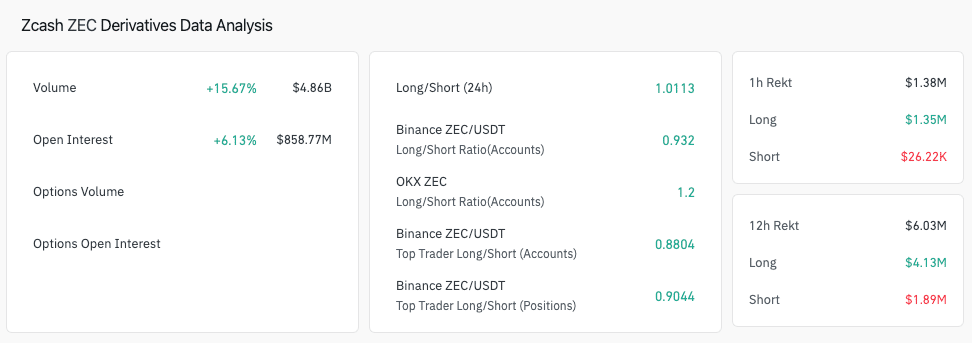
Zcash (ZEC) Derivative Market Analysis | Source: TradingView

Zcash (ZEC) Derivative Market Analysis | Source: TradingView

Zcash Price Analysis: Bullish Pennant Points Toward a Potential $700 Breakout

Zcash is trading near $369 at press time, recovering from a sharp late-November correction while forming a bullish pennant on the daily chart. The pattern follows a steep rally from the sub-$100 zone in September and now points to a potential retest of the $730 territory.
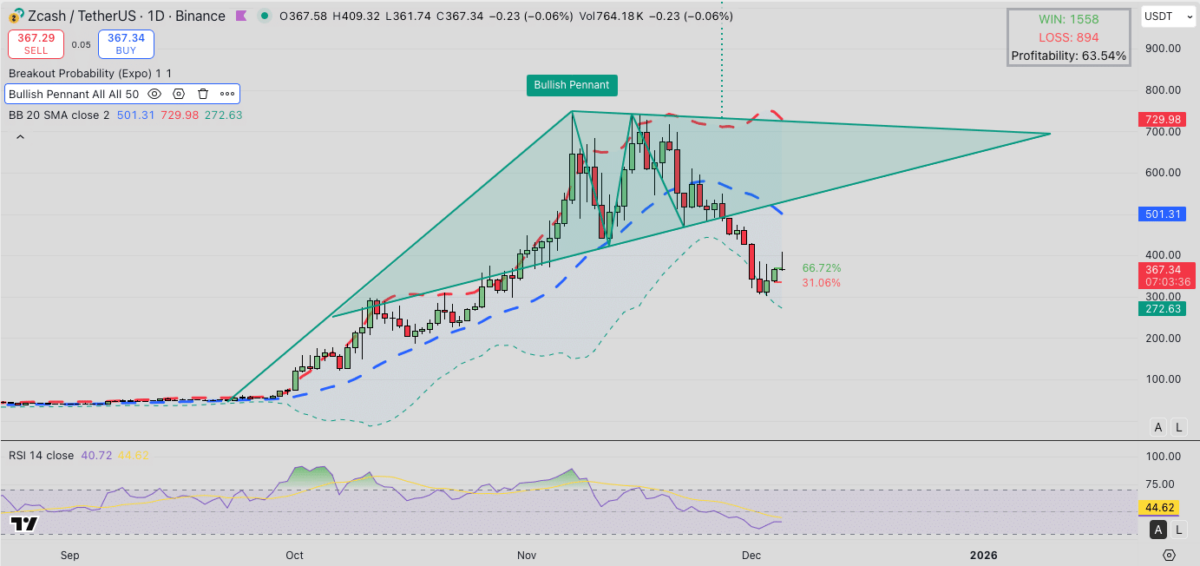
Zcash (ZEC) Price Analysis | TradingView

Zcash (ZEC) Price Analysis | TradingView

However, Zcash is yet to reclaim the middle Bollinger Band near $501. Holding this level prevents a return to the lower Bollinger band and keeps the ZEC bullish pennant in play. If momentum holds, ZEC could retest $500 first, followed by a breakout attempt toward $730, if leverage inflows persist.

On the downside, ZEC’s bullish pennant fails only if price closes below $272, the lower Bollinger Band and macro trendline. Before that level ZEC price is likely to find significant support at the weekly timeframe low of $305.

next

The post Zcash Price Regains Footing Above $375 as Founder Responds to Michael Saylor’s Criticism appeared first on Coinspeaker.

Disclaimer: The articles reposted on this site are sourced from public platforms and are provided for informational purposes only. They do not necessarily reflect the views of MEXC. All rights remain with the original authors. If you believe any content infringes on third-party rights, please contact service@support.mexc.com for removal. MEXC makes no guarantees regarding the accuracy, completeness, or timeliness of the content and is not responsible for any actions taken based on the information provided. The content does not constitute financial, legal, or other professional advice, nor should it be considered a recommendation or endorsement by MEXC.

You May Also Like

Maryland Man Sentenced for Allegedly Aiding North Korea’s US Company Infiltration and Sensitive Data Access

Maryland Man Sentenced for Allegedly Aiding North Korea’s US Company Infiltration and Sensitive Data Access

The post Maryland Man Sentenced for Allegedly Aiding North Korea’s US Company Infiltration and Sensitive Data Access appeared on BitcoinEthereumNews.com. North Korea’s IT workers infiltrated US companies through a Maryland man’s scheme, earning over $970,000 while enabling access to sensitive government systems. This operation supported the regime’s cyber activities, including crypto hacks that stole $2 billion in 2025, funding nuclear programs. Minh Phuong Ngoc Vong sentenced to 15 months in prison for aiding North Korean infiltration. He used fake credentials to secure jobs at 13 US firms, passing work to overseas conspirators. North Korea stole $2 billion in crypto in 2025 via hacks, totaling over $6 billion recently, per blockchain analytics firm Elliptic. Discover how North Korea’s IT infiltration and crypto hacking schemes threaten US security. Learn the details of the Maryland case and regime’s $6B theft. Stay informed on cybersecurity risks today. What is North Korea’s IT Infiltration Scheme in US Companies? North Korea’s IT infiltration scheme involves covertly placing regime-affiliated workers into US companies using fake identities to generate revenue and access sensitive systems. In a recent Maryland case, Minh Phuong Ngoc Vong was sentenced to 15 months in prison and three years of supervised release for facilitating this for three years across 13 companies. The operation netted over $970,000, much of which funded North Korea’s weapons programs through software work performed by overseas actors, including those in China near the border. How Does North Korea Use Crypto Hacking to Fund Its Programs? North Korea employs sophisticated cyber groups to target cryptocurrency exchanges and wallets, stealing digital assets that convert to fiat for regime funding. According to blockchain analytics firm Elliptic, these groups pilfered approximately $2 billion in cryptocurrencies in 2025 alone, contributing to a total exceeding $6 billion in recent years from hacks on platforms like Bybit and Upbit. This influx directly supports nuclear and missile development, as confirmed by US intelligence assessments. Experts note the regime’s…
Share
BitcoinEthereumNews2025/12/06 09:12