PEPE investors are at risk of losing their coins following a recent security incident. On-chain security firm Blockaid drew attention to a front-end attack on the meme coin’s website that could potentially drain users’ funds.  PEPE Investors At Risk With Website Front-End Attack In an X post, Blockaid stated that its system identified a front-end […]PEPE investors are at risk of losing their coins following a recent security incident. On-chain security firm Blockaid drew attention to a front-end attack on the meme coin’s website that could potentially drain users’ funds.  PEPE Investors At Risk With Website Front-End Attack In an X post, Blockaid stated that its system identified a front-end […]

If You’re A PEPE Investor, You Need To See This Or Risk Losing Your Coins

2025/12/06 00:30

PEPE investors are at risk of losing their coins following a recent security incident. On-chain security firm Blockaid drew attention to a front-end attack on the meme coin’s website that could potentially drain users’ funds. 

PEPE Investors At Risk With Website Front-End Attack

In an X post, Blockaid stated that its system identified a front-end attack on PEPE’s website. The security firm further revealed that the site contains a code of Inferno Drainer. This malware is known to be used to automatically drain users’ wallets, which puts holders at risk of losing their coins. 

The Inferno Drainer malware is said to redirect visitors on the website to a fake portal, where they risk clicking phishing links that are designed to drain their wallets. As such, the security firm advised investors and community members to avoid the website until the issue is resolved. 
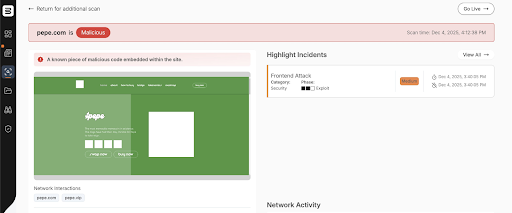
PEPE

Blockaid’s Threat Intelligence Team also told Cointelegraph that the Inferno Drainer code detected on the website matched a known drainer family they regularly identify. Meanwhile, the team has yet to make a statement on their official X platform regarding the malware. 

Notably, the website on the PEPE X platform redirects to a fake website (pepedotvip) instead of the original site (pepedotcom). The website also promotes a PEPE derivative, which is believed to be a rug coin. The price remained steady amid reports of the hack, climbing as high as 4% yesterday. 

However, the meme coin price has since retraced as part of a broader crypto market correction led by Bitcoin. The third-largest meme coin by market cap is also down over 75% year-to-date (YTD) thanks to the recent crypto market crash. 

The Rise In Inferno Drainer Attacks

The PEPE front-end isn’t the first to fall victim to an Inferno Drainer attack this year. Earlier in the year, Blockaid had identified that CoinMarketCap’s frontend was compromised by what appeared to be an Inferno Drainer. Back then, the CoinMarketCap website displayed a pop-up prompting users to verify their wallets, which ultimately drained their funds. 

The BNB Chain X account was also a victim of this Inferno Drainer in October. The hackers posted links that directed users to websites that employed the Inferno Drainer toolkit. This incident resulted in a total loss of around $8,000 for users, which the BNB Chain promised to reimburse. 

Blockaid last year revealed that the Inferno Drainer group stole $80 million from Web3 users by exploiting older, malicious decentralized applications. This kind of scam is also said to have tripled last year, resulting in significant losses for investors. 

At the time of writing, the meme coin price is trading at around $0.000004697, down over 3% in the last 24 hours, according to data from CoinMarketCap.

PEPE
Disclaimer: The articles reposted on this site are sourced from public platforms and are provided for informational purposes only. They do not necessarily reflect the views of MEXC. All rights remain with the original authors. If you believe any content infringes on third-party rights, please contact service@support.mexc.com for removal. MEXC makes no guarantees regarding the accuracy, completeness, or timeliness of the content and is not responsible for any actions taken based on the information provided. The content does not constitute financial, legal, or other professional advice, nor should it be considered a recommendation or endorsement by MEXC.

You May Also Like

Maryland Man Sentenced for Allegedly Aiding North Korea’s US Company Infiltration and Sensitive Data Access

Maryland Man Sentenced for Allegedly Aiding North Korea’s US Company Infiltration and Sensitive Data Access

The post Maryland Man Sentenced for Allegedly Aiding North Korea’s US Company Infiltration and Sensitive Data Access appeared on BitcoinEthereumNews.com. North Korea’s IT workers infiltrated US companies through a Maryland man’s scheme, earning over $970,000 while enabling access to sensitive government systems. This operation supported the regime’s cyber activities, including crypto hacks that stole $2 billion in 2025, funding nuclear programs. Minh Phuong Ngoc Vong sentenced to 15 months in prison for aiding North Korean infiltration. He used fake credentials to secure jobs at 13 US firms, passing work to overseas conspirators. North Korea stole $2 billion in crypto in 2025 via hacks, totaling over $6 billion recently, per blockchain analytics firm Elliptic. Discover how North Korea’s IT infiltration and crypto hacking schemes threaten US security. Learn the details of the Maryland case and regime’s $6B theft. Stay informed on cybersecurity risks today. What is North Korea’s IT Infiltration Scheme in US Companies? North Korea’s IT infiltration scheme involves covertly placing regime-affiliated workers into US companies using fake identities to generate revenue and access sensitive systems. In a recent Maryland case, Minh Phuong Ngoc Vong was sentenced to 15 months in prison and three years of supervised release for facilitating this for three years across 13 companies. The operation netted over $970,000, much of which funded North Korea’s weapons programs through software work performed by overseas actors, including those in China near the border. How Does North Korea Use Crypto Hacking to Fund Its Programs? North Korea employs sophisticated cyber groups to target cryptocurrency exchanges and wallets, stealing digital assets that convert to fiat for regime funding. According to blockchain analytics firm Elliptic, these groups pilfered approximately $2 billion in cryptocurrencies in 2025 alone, contributing to a total exceeding $6 billion in recent years from hacks on platforms like Bybit and Upbit. This influx directly supports nuclear and missile development, as confirmed by US intelligence assessments. Experts note the regime’s…
Share
BitcoinEthereumNews2025/12/06 09:12