Crypto Price Analysis December-5: ETH, XRP, ADA, BNB, and HYPE
This Friday, we examine Ethereum, Ripple, Cardano, Binance Coin, and Hyperliquid in greater detail.
Ethereum (ETH)
This week, Ethereum managed to reclaim the $3,000 level as support and closed 3% in profit. With buyers returning, there is hope of a sustained relief rally that could take this cryptocurrency up to the key resistance at $3,340.
With momentum picking up, ETH has a good chance to move higher. However, the buy volume has to increase to be able to sustain it and break the resistance.
Looking ahead, this cryptocurrency is finally trying to step away from its downtrend that started in October. To be successful, buyers will need to take Ethereum above $3,500 and even challenge the $4,000 resistance.
Ripple (XRP)
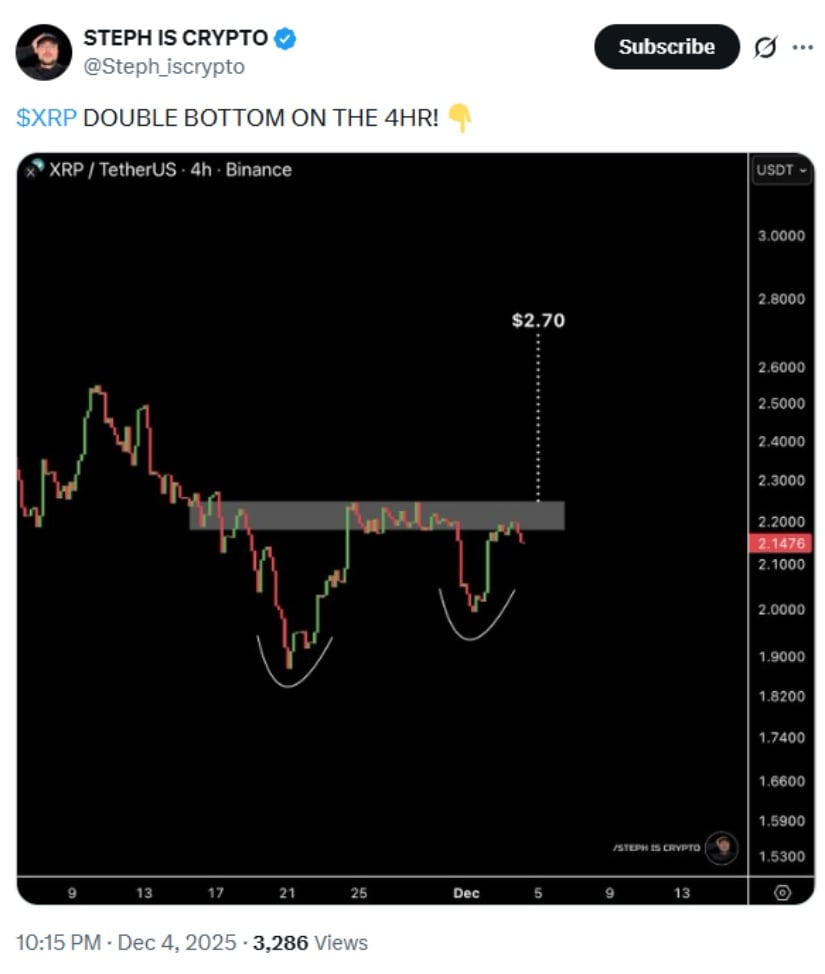
XRP tried to move away from the $2 support, but sellers pushed back the price, which is now struggling to hold above this key level. This also places XRP in the red with a 6% loss this week.
If buyers stay shy, then this cryptocurrency has a high chance to break lower and seek support at $1.8 or below that. On the other hand, the sales volume has been declining, which gives hope that buyers may return.
Looking ahead, the momentum remains bearish, and sellers retain the upper hand. Until the bulls return, lower price levels are likely in the future.
Cardano (ADA)
ADA managed to hold above 40 cents this week as the price closed with a modest 1% gain. While this is not much, it’s critical for this cryptocurrency to stay above this level if it wants to avoid lower lows.
While buyers seem in control right now, this can easily change if they can’t take ADA above the key resistance at 50 cents. Failure there could lead to lower lows later.
Looking ahead, Cardano is found in a tough spot after a disappointing end of the year where the price fell by over 60%. Hopefully, December can see a relief rally materialize.
Binance Coin (BNB)
This week, BNB tried again to move above the $900 resistance, but sellers rejected this attempt, which places the price in the same position as last week.
With buyers unable to break higher, Binance Coin remains in a downtrend, which could see it visit the $800 support in the future or even $692. To stop that, the resistance at $900 has to turn into a support.
Looking ahead, this cryptocurrency may continue its correction in the short term and fall lower before buyers return to take over and send it into a relief rally towards $1,000 which will act as a magnet for the price.
Hype (HYPE)
HYPE had another disappointing week after sellers stopped the price from reclaiming $35 as support. With the price back into a downtrend, this cryptocurrency closes the week in red with a 11% loss.
This poor performance has turned the chart quite bearish, especially on the weekly timeframe, where the MACD indicator shows clear lower lows on the histogram. Unless buyers reverse this trend, HYPE will continue to underperform.
Looking ahead, this cryptocurrency may revisit the support at $30 or fall even lower before buyers can make a serious attempt at a reversal.
The post Crypto Price Analysis December-5: ETH, XRP, ADA, BNB, and HYPE appeared first on CryptoPotato.
You May Also Like

US Prosecutors Seek 12-Year Prison for Do Kwon Over Terra Collapse
Highlights: US prosecutors requested a 12-year prison sentence for Do Kwon after the Terra collapse. Terraform’s $40 billion downfall caused huge losses and sparked a long downturn in crypto markets. Do Kwon will face sentencing on December 11 and must give up $19 million in earnings. US prosecutors have asked a judge to give Do Kwon, Terraform Labs co-founder, a 12-year prison sentence for his role in the remarkable $40 billion collapse of the Terra and Luna tokens. The request also seeks to finalize taking away Kwon’s criminal earnings. The court filing came in New York’s Southern District on Thursday. This is about four months after Kwon admitted guilt on two charges: wire fraud and conspiracy to defraud. Prosecutors said Kwon caused more losses than Samuel Bankman-Fried, Alexander Mashinsky, and Karl Sebastian Greenwood combined. U.S. prosecutors have asked a New York federal judge to sentence Terraform Labs co-founder Do Kwon to 12 years in prison, calling his role in the 2022 TerraUSD collapse a “colossal” fraud that triggered broader crypto-market failures, including the downfall of FTX. Sentencing is… — Wu Blockchain (@WuBlockchain) December 5, 2025 Terraform Collapse Shakes Crypto Market Authorities explained that Terraform’s collapse affected the entire crypto market. They said it helped trigger what is now called the ‘Crypto Winter.’ The filing stressed that Kwon’s conduct harmed many investors and the broader crypto world. On Thursday, prosecutors said Kwon must give up just over $19 million. They added that they will not ask for any additional restitution. They said: “The cost and time associated with calculating each investor-victim’s loss, determining whether the victim has already been compensated through the pending bankruptcy, and then paying out a percentage of the victim’s losses, will delay payment and diminish the amount of money ultimately paid to victims.” Authorities will sentence Do Kwon on December 11. They charged him in March 2023 with multiple crimes, including securities fraud, market manipulation, money laundering, and wire fraud. All connections are tied to his role at Terraform. After Terra fell in 2022, authorities lost track of Kwon until they arrested him in Montenegro on unrelated charges and sent him to the U.S. Do Kwon’s Legal Case and Sentencing In April last year, a jury ruled that both Terraform and Kwon committed civil fraud. They found the company and its co-founder misled investors about how the business operated and its finances. Jay Clayton, U.S. Attorney for the Southern District of New York, submitted the sentencing request in November. TERRA STATEMENT: “We are very disappointed with the verdict, which we do not believe is supported by the evidence. We continue to maintain that the SEC does not have the legal authority to bring this case at all, and we are carefully weighing our options and next steps.” — Zack Guzmán (@zGuz) April 5, 2024 The news of Kwon’s sentencing caused Terraform’s token, LUNA, to jump over 40% in one day, from $0.07 to $0.10. Still, this rise remains small compared to its all-time high of more than $19, which the ecosystem reached before collapsing in May 2022. In a November court filing, Do Kwon’s lawyers asked for a maximum five-year sentence. They argued for a shorter term partly because he could face up to 40 years in prison in South Korea, where prosecutors are also pursuing a case against him. The legal team added that even if Kwon serves time in the U.S., he would not be released freely. He would be moved from prison to an immigration detention center and then sent to Seoul to face pretrial detention for his South Korea charges. eToro Platform Best Crypto Exchange Over 90 top cryptos to trade Regulated by top-tier entities User-friendly trading app 30+ million users 9.9 Visit eToro eToro is a multi-asset investment platform. The value of your investments may go up or down. Your capital is at risk. Don’t invest unless you’re prepared to lose all the money you invest. This is a high-risk investment, and you should not expect to be protected if something goes wrong.

Cashing In On University Patents Means Giving Up On Our Innovation Future