YPF examines crypto payments for fuel as Argentina explores new digital settlement models amid ongoing currency reforms. Argentina’s state-owned YPF is assessing a plan to allow crypto payments for gasoline and diesel at its service stations. Moreover, officials said the review is still in progress, with no solid launch timeline. YPF Evaluates Digital Payment Expansion […] The post Argentina’s YPF Studies Plan for Paying Fuel with Crypto appeared first on Live Bitcoin News.YPF examines crypto payments for fuel as Argentina explores new digital settlement models amid ongoing currency reforms. Argentina’s state-owned YPF is assessing a plan to allow crypto payments for gasoline and diesel at its service stations. Moreover, officials said the review is still in progress, with no solid launch timeline. YPF Evaluates Digital Payment Expansion […] The post Argentina’s YPF Studies Plan for Paying Fuel with Crypto appeared first on Live Bitcoin News.

Argentina’s YPF Studies Plan for Paying Fuel with Crypto

2025/12/05 00:45

YPF examines crypto payments for fuel as Argentina explores new digital settlement models amid ongoing currency reforms.

Argentina’s state-owned YPF is assessing a plan to allow crypto payments for gasoline and diesel at its service stations. Moreover, officials said the review is still in progress, with no solid launch timeline.

YPF Evaluates Digital Payment Expansion

According to reports, the company is looking at a model that would be based on an exchange intermediary. Additionally, the system would probably refer to “crypto dollar” pricing, and not the official rate. Local coverage from La Nación and sector blogs confirms that Lemon, Ripio, and Binance are among the potential partners for the intermediary layer.

Related Reading: Dogecoin News: Argentina Embraces Dogecoin Payments Amid Inflation Concerns | Live Bitcoin News

YPF’s consideration of crypto comes after it accepted payments in fuel for U.S. dollars. In addition, the company became the first in Argentina to permit the direct transactions of dollars for gasoline and diesel. This development coincided with policy measures introduced by Economy Minister Luis Caputo, which were intended to promote the internal dollarization strategy of the country.

YPF said a crypto mechanism would operate on the same structure as that deployed for dollar payments. Additionally, people with eligible accounts can already transfer dollars to YPF’s checking account at Banco Santander by scanning a QR code.
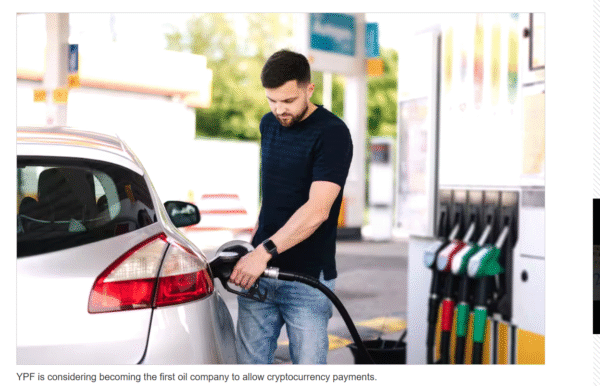
YPF examines crypto payments for fuel as Argentina explores new digital settlement models amid ongoing currency reforms.Source: La Nacion

However, YPF stressed that dollar payments are still limited to purchases within the company’s ecosystem. Moreover, the dollar system is not in the context of foreign exchange operations because there is no buying and selling of currency at all in the transaction. Therefore, a similar process for crypto would have the intermediaries handling valuation and settlement.

Regulatory and Operational Considerations Increase

The company clarified that the crypto markets are not using the official exchange rate of Argentina. Consequently, intermediaries may be required to convert crypto values into settlement amounts as they flow through the payment. Reports indicate that through the discussions, possible exchanges referenced might be able to provide pricing feeds and custody functionality.

Meanwhile, YPF also increased its technological initiatives for 2025. The company introduced a self-service fueling system where customers fill up without the help of staff. Additionally, the users receive 3% discount thanks to the lower operating costs, a model replicated from international retail fuel practices.

Energy analysts say that crypto payments can help diversify payment channels during economic transitions. Furthermore, industry watchers think flexibility would help support stations in tourist areas, where crypto adoption is growing steadily. However, they also warn that settlement risks and technical integration remain complicated for large-scale rollouts.

Financial experts add that pricing based on “crypto dollars” could make Argentina less reliant on its patchy exchange landscape. Nevertheless, any operational model needs to meet compliance, volatility protection, and custody standards via regulated intermediaries.

Broader Effects on Argentina’s Payment Modernization

As YPF is researching crypto settlement, there is speculation that wider payment reforms could be contingent on patterns of adoption in the wider retail sector. Additionally, the company’s focus on digital tools suggests a broader strategic shift in the fuel sector. Unless crypto acceptance deals are to stop, daily settlement processes, which may be subject to liquidation, may increase in levels of automation through exchange-backed channels. As a result, the payment ecosystem in Argentina could enter a more diversified and technology-driven stage.

The post Argentina’s YPF Studies Plan for Paying Fuel with Crypto appeared first on Live Bitcoin News.

Disclaimer: The articles reposted on this site are sourced from public platforms and are provided for informational purposes only. They do not necessarily reflect the views of MEXC. All rights remain with the original authors. If you believe any content infringes on third-party rights, please contact service@support.mexc.com for removal. MEXC makes no guarantees regarding the accuracy, completeness, or timeliness of the content and is not responsible for any actions taken based on the information provided. The content does not constitute financial, legal, or other professional advice, nor should it be considered a recommendation or endorsement by MEXC.

You May Also Like

The Channel Factories We’ve Been Waiting For

The Channel Factories We’ve Been Waiting For

The post The Channel Factories We’ve Been Waiting For appeared on BitcoinEthereumNews.com. Visions of future technology are often prescient about the broad strokes while flubbing the details. The tablets in “2001: A Space Odyssey” do indeed look like iPads, but you never see the astronauts paying for subscriptions or wasting hours on Candy Crush.  Channel factories are one vision that arose early in the history of the Lightning Network to address some challenges that Lightning has faced from the beginning. Despite having grown to become Bitcoin’s most successful layer-2 scaling solution, with instant and low-fee payments, Lightning’s scale is limited by its reliance on payment channels. Although Lightning shifts most transactions off-chain, each payment channel still requires an on-chain transaction to open and (usually) another to close. As adoption grows, pressure on the blockchain grows with it. The need for a more scalable approach to managing channels is clear. Channel factories were supposed to meet this need, but where are they? In 2025, subnetworks are emerging that revive the impetus of channel factories with some new details that vastly increase their potential. They are natively interoperable with Lightning and achieve greater scale by allowing a group of participants to open a shared multisig UTXO and create multiple bilateral channels, which reduces the number of on-chain transactions and improves capital efficiency. Achieving greater scale by reducing complexity, Ark and Spark perform the same function as traditional channel factories with new designs and additional capabilities based on shared UTXOs.  Channel Factories 101 Channel factories have been around since the inception of Lightning. A factory is a multiparty contract where multiple users (not just two, as in a Dryja-Poon channel) cooperatively lock funds in a single multisig UTXO. They can open, close and update channels off-chain without updating the blockchain for each operation. Only when participants leave or the factory dissolves is an on-chain transaction…
Share
BitcoinEthereumNews2025/09/18 00:09
OSL Hong Kong Lists XRP for Professional Investors Amid Signs of Sustained Market Interest

OSL Hong Kong Lists XRP for Professional Investors Amid Signs of Sustained Market Interest

The post OSL Hong Kong Lists XRP for Professional Investors Amid Signs of Sustained Market Interest appeared on BitcoinEthereumNews.com. OSL Hong Kong has listed XRP for professional investors, enabling deposits, withdrawals, and trading through pairs like XRP/HKD, XRP/USD, and XRP/USDT. This move supports Hong Kong’s regulated framework and reflects growing institutional interest in XRP amid ETF inflows exceeding $897 million. OSL Hong Kong launches XRP trading for professional investors under local licensing rules, expanding access to regulated digital asset services. XRP pairs including XRP/HKD, XRP/USD, and XRP/USDT are now available via Flash Trade, OTC channels, and the XRP Ledger. Market data from Santiment and SoSo indicates sustained accumulation by large holders, with $897.35 million in XRP ETF inflows despite a 32% market cap drop over two months. Discover how OSL Hong Kong’s XRP listing boosts professional trading options amid rising ETF interest. Explore key details, market insights, and implications for investors in this regulated expansion. What is the Significance of OSL Hong Kong Listing XRP? OSL Hong Kong’s listing of XRP marks a key expansion in regulated cryptocurrency trading for professional investors in the region. The exchange, licensed under Hong Kong’s Securities and Futures Commission, now supports XRP deposits, withdrawals, and trading through established pairs, enhancing accessibility via the XRP Ledger. This development aligns with broader institutional adoption trends, providing secure channels for cross-border transaction capabilities inherent to XRP. How Does OSL Hong Kong Facilitate XRP Trading? OSL Hong Kong enables XRP trading exclusively for professional investors, adhering to local regulatory standards that define eligibility based on financial expertise and net worth criteria. Trading pairs such as XRP/HKD, XRP/USD, and XRP/USDT became available this week, with operations routed through the platform’s Flash Trade for spot trading and OTC desk for larger transactions. Deposits and withdrawals integrate directly with the XRP Ledger, ensuring efficient settlement times of just a few seconds, as per blockchain specifications. The exchange’s official announcement emphasized…
Share
BitcoinEthereumNews2025/12/07 23:12
XRP Dips 6% Yet Spot ETFs Draw Steady Inflows Amid Potential Consolidation

XRP Dips 6% Yet Spot ETFs Draw Steady Inflows Amid Potential Consolidation

The post XRP Dips 6% Yet Spot ETFs Draw Steady Inflows Amid Potential Consolidation appeared on BitcoinEthereumNews.com. XRP experienced a 6% price slip last week, yet spot ETF inflows exceeded $10 million, signaling robust investor confidence. This resilience stems from steady open interest and positive funding rates, indicating long-term holders are undeterred by short-term volatility in the XRP market. XRP spot ETF inflows reached $10.23 million daily, pushing total net assets to $861.32 million despite price dips. XRP traded near $2.02, with consistent buying even on quieter market days. Momentum indicators like RSI and CMF show weak but stable demand, with capital flow remaining slightly positive at 0.04. Discover why XRP’s 6% dip didn’t deter investors, with strong ETF inflows and steady open interest. Explore the latest XRP price action and market signals for informed decisions. What Are the Latest XRP ETF Inflows and Their Impact? XRP ETF inflows demonstrated impressive resilience last week, totaling over $10.23 million in daily net additions despite the token’s 6% price decline. This surge, highlighted by a peak of more than $240 million earlier in the period, underscores sustained institutional interest in XRP. Total net assets under management climbed to $861.32 million, reflecting a broader trend of accumulation amid market fluctuations. How Has XRP’s Price Action Evolved Amid Recent Volatility? XRP’s price action has shown a pattern of consolidation around the $2.05 level, retreating from recent highs as resistance at $2.10 consistently capped upward moves. Technical indicators reveal a cooling but controlled environment: the Relative Strength Index (RSI) indicated subdued momentum without entering oversold territory, while the Chaikin Money Flow (CMF) hovered near 0.04, suggesting modest positive capital inflows. Data from TradingView illustrates this stability, with XRP positioned below the 20-day Exponential Moving Average (EMA) at $2.29, yet avoiding panic selling. According to market analysts at SoSoValue, such indicators point to a healthy pause rather than a bearish reversal. This phase…
Share
BitcoinEthereumNews2025/12/07 23:30