

Public Mining Companies Secure Billions in Debt to Shift Focus Towards AI Development
TLDR
- Public mining companies raise billions in debt, pivoting to AI and HPC services to diversify from Bitcoin mining.
- Bitfarms raises $500M, TeraWulf plans $3.2B debt issuance to expand into AI and high-performance computing.
- Mining companies raised $4.6B in debt in late 2024, signaling a major shift towards AI and data services.
- AI pivot brings risks of equity dilution as public mining companies aim to balance debt and revenue growth.
Public mining companies are increasingly raising capital to transition from Bitcoin mining to artificial intelligence (AI) and high-performance computing (HPC) services. Through large debt offerings, they aim to fund this pivot into AI infrastructure. This shift could change the financial landscape for mining companies, but it also brings risks of equity dilution and mounting debt.
Shift in Funding Strategies
In 2025, public mining companies have begun raising large amounts of capital to fund AI ventures. Bitfarms, for example, raised $500 million through convertible senior notes.
TeraWulf also proposed a $3.2 billion debt issuance to support its data center expansion. These moves mark a departure from past practices, where equipment like mining rigs was used as collateral for loans.
The total debt raised by public mining companies in late 2024 hit a record $4.6 billion. This marked the largest capital influx since 2021. Debt issuances fell below $200 million at the beginning of 2025 but surged back to $1.5 billion by Q2. This highlights the growing interest in AI and computing infrastructure as a key growth driver for mining companies.
AI and HPC Infrastructure as New Revenue Sources
Mining companies are now pivoting towards building infrastructure for AI and HPC services. This new focus aims to diversify their income sources beyond Bitcoin mining. Bitfarms, for example, secured a $300 million loan to develop HPC infrastructure at its Panther Creek project. Such projects promise more stable and long-term growth potential.
The move into AI infrastructure is also a response to the increasing demand for cloud computing and AI services. As AI and HPC markets grow, these companies can tap into the expanding demand for data-driven applications. With this new approach, mining companies aim to mitigate risks tied to the volatility of cryptocurrency mining.
Risks Associated with Debt-Fueled Expansion
Despite the potential for growth, the strategy of raising large amounts of debt comes with significant risks. Companies face the challenge of meeting performance expectations to justify their debt. If AI or HPC projects fail to generate sufficient income, the companies could face heavy equity dilution. Shareholders may bear the financial burden if revenue targets are not met.
The transition to AI-based business models also faces external challenges, such as high mining difficulty. This has reduced the profitability of traditional Bitcoin mining operations. Additionally, the rising cost of securing debt adds pressure on mining companies. To stay competitive, they must manage both innovation and financial risk carefully.
Public mining companies are testing new financial models, hoping to pivot successfully into AI and data services. This shift could transform the sector, but companies will need to perform well to avoid financial strain. How well they balance their debt and growth will determine the success of this transition.
The post Public Mining Companies Secure Billions in Debt to Shift Focus Towards AI Development appeared first on CoinCentral.
You May Also Like

US Prosecutors Seek 12-Year Prison for Do Kwon Over Terra Collapse
Highlights: US prosecutors requested a 12-year prison sentence for Do Kwon after the Terra collapse. Terraform’s $40 billion downfall caused huge losses and sparked a long downturn in crypto markets. Do Kwon will face sentencing on December 11 and must give up $19 million in earnings. US prosecutors have asked a judge to give Do Kwon, Terraform Labs co-founder, a 12-year prison sentence for his role in the remarkable $40 billion collapse of the Terra and Luna tokens. The request also seeks to finalize taking away Kwon’s criminal earnings. The court filing came in New York’s Southern District on Thursday. This is about four months after Kwon admitted guilt on two charges: wire fraud and conspiracy to defraud. Prosecutors said Kwon caused more losses than Samuel Bankman-Fried, Alexander Mashinsky, and Karl Sebastian Greenwood combined. U.S. prosecutors have asked a New York federal judge to sentence Terraform Labs co-founder Do Kwon to 12 years in prison, calling his role in the 2022 TerraUSD collapse a “colossal” fraud that triggered broader crypto-market failures, including the downfall of FTX. Sentencing is… — Wu Blockchain (@WuBlockchain) December 5, 2025 Terraform Collapse Shakes Crypto Market Authorities explained that Terraform’s collapse affected the entire crypto market. They said it helped trigger what is now called the ‘Crypto Winter.’ The filing stressed that Kwon’s conduct harmed many investors and the broader crypto world. On Thursday, prosecutors said Kwon must give up just over $19 million. They added that they will not ask for any additional restitution. They said: “The cost and time associated with calculating each investor-victim’s loss, determining whether the victim has already been compensated through the pending bankruptcy, and then paying out a percentage of the victim’s losses, will delay payment and diminish the amount of money ultimately paid to victims.” Authorities will sentence Do Kwon on December 11. They charged him in March 2023 with multiple crimes, including securities fraud, market manipulation, money laundering, and wire fraud. All connections are tied to his role at Terraform. After Terra fell in 2022, authorities lost track of Kwon until they arrested him in Montenegro on unrelated charges and sent him to the U.S. Do Kwon’s Legal Case and Sentencing In April last year, a jury ruled that both Terraform and Kwon committed civil fraud. They found the company and its co-founder misled investors about how the business operated and its finances. Jay Clayton, U.S. Attorney for the Southern District of New York, submitted the sentencing request in November. TERRA STATEMENT: “We are very disappointed with the verdict, which we do not believe is supported by the evidence. We continue to maintain that the SEC does not have the legal authority to bring this case at all, and we are carefully weighing our options and next steps.” — Zack Guzmán (@zGuz) April 5, 2024 The news of Kwon’s sentencing caused Terraform’s token, LUNA, to jump over 40% in one day, from $0.07 to $0.10. Still, this rise remains small compared to its all-time high of more than $19, which the ecosystem reached before collapsing in May 2022. In a November court filing, Do Kwon’s lawyers asked for a maximum five-year sentence. They argued for a shorter term partly because he could face up to 40 years in prison in South Korea, where prosecutors are also pursuing a case against him. The legal team added that even if Kwon serves time in the U.S., he would not be released freely. He would be moved from prison to an immigration detention center and then sent to Seoul to face pretrial detention for his South Korea charges. eToro Platform Best Crypto Exchange Over 90 top cryptos to trade Regulated by top-tier entities User-friendly trading app 30+ million users 9.9 Visit eToro eToro is a multi-asset investment platform. The value of your investments may go up or down. Your capital is at risk. Don’t invest unless you’re prepared to lose all the money you invest. This is a high-risk investment, and you should not expect to be protected if something goes wrong.
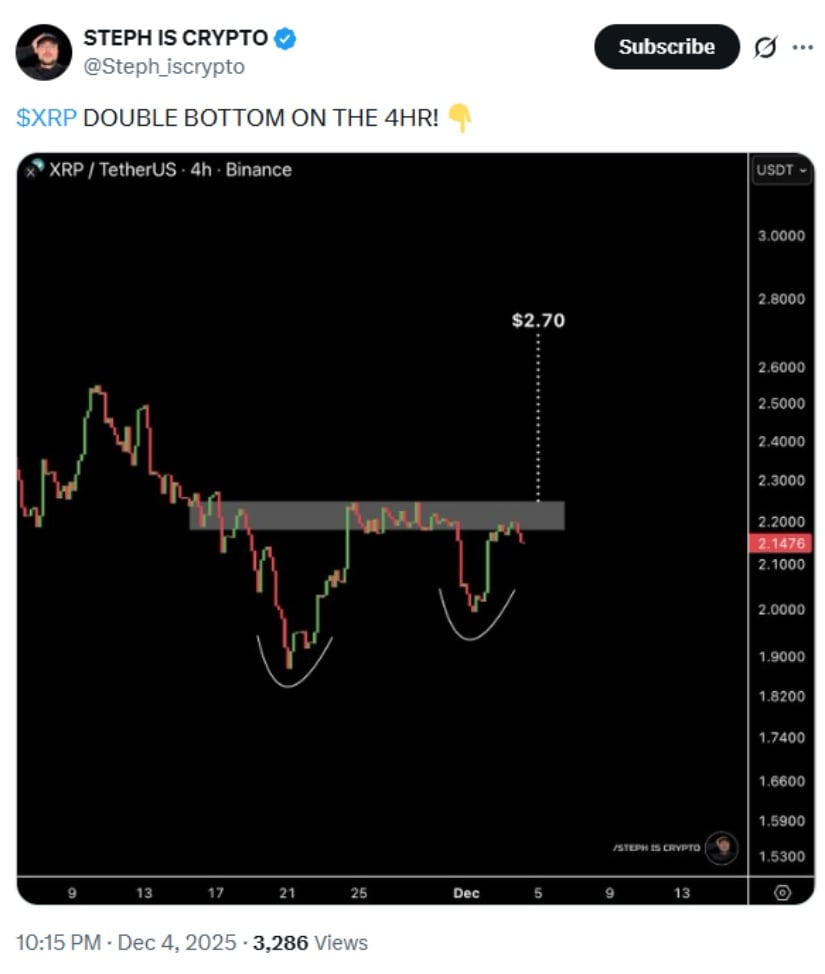
XRP Price Prediction: Double Bottom Near $1.80 Signals Potential Reversal Toward $2.70 Despite Market Weakness
