Vitalik Buterin said that the Ethereum gas futures market would allow developers, traders, and institutions to hedge against fee volatility. The proposal comes as Ethereum prepares for major scaling upgrades, including a 5x increase in the gas limit. Vitalik Buterin, the co-founder of Ethereum blockchain, shared a new idea on having an on-chain futures market [...]]]>Vitalik Buterin said that the Ethereum gas futures market would allow developers, traders, and institutions to hedge against fee volatility. The proposal comes as Ethereum prepares for major scaling upgrades, including a 5x increase in the gas limit. Vitalik Buterin, the co-founder of Ethereum blockchain, shared a new idea on having an on-chain futures market [...]]]>

Vitalik Buterin Proposes Onchain Gas Futures to Stabilize Ethereum Fees

2025/12/08 15:43
  • Vitalik Buterin said that the Ethereum gas futures market would allow developers, traders, and institutions to hedge against fee volatility.
  • The proposal comes as Ethereum prepares for major scaling upgrades, including a 5x increase in the gas limit.

Vitalik Buterin, the co-founder of Ethereum blockchain, shared a new idea on having an on-chain futures market for gas. Buterin said that this will help users get some clarity over transaction fees, amid a wide network adoption.

The proposal from Buterin came while responding to questions on whether the current roadmap can ensure low gas fee. In a post on X on Saturday, Vitalik Buterin said the Ethereum ecosystem needs a “trustless on-chain gas futures market.”

He suggested that one solution would be to allow users to lock in gas prices for future periods. Buterin noted that this could be achieved through a market for Ethereum’s base fees, which form the foundation of overall transaction costs.

Vitalik Buterin Explains How Ethereum Futures Market Would Work

In the traditional futures market, participants can buy and sell assets like Gold, stocks, oil, etc., through contracts, for a predetermined price in the future. This allows for both, speculation as well as risk hedging. Bringing a similar mechanism to Ethereum would allow users to lock in gas fees for specific future time windows. This would help in preventing any potential price surges.

Vitalik Buterin believes that a reliable and mature on-chain gas futures market would be beneficial for the ecosystem. This puts a clear benchmark for planning, forecasting, and building around expected network costs. In his message on the X platform, Vitalik Buterin wrote:

Such a gas-free prediction market would offer a crucial tool for high-volume network participants such as developers, traders, applications, and institutions. Also, users can forecast and manage their operational expenses with better cost certainty.

Last month, Vitalik Buterin assured that the Ethereum blockchain would undergo a 5x surge in gas limit, as mentioned in our previous story, as part of the team’s effort to accelerate scaling and optimization. According to Ethereum Foundation researcher Toni Wahrstätter, the upgrade will increase mainnet throughput substantially.

With the gas limit rising to 60 million, each block will be able to process more transactions, on-chain activity, and smart contract executions. This shows that the network is ready to handle more complex applications.

The Drop In ETH Gas Fee

Throughout this year in 2025, the average ETH gas fee has remained low and volatile. Basic Ethereum transactions currently cost around 0.474 gwei i.e. $0.01, according to Etherscan data.

More complex operations, including token swaps, NFT trades, and cross-chain bridging, carry higher costs, averaging approximately $0.16, $0.27, and $0.05, respectively. As said, the ETH gas fee has remained fluctuating throughout 2025.

Ycharts data indicates that average transaction costs began the year at $1 before falling to around $0.30. Throughout the year, fees have moved between highs of $2.60 and lows of $0.18, underscoring the persistent volatility Buterin aims to address.
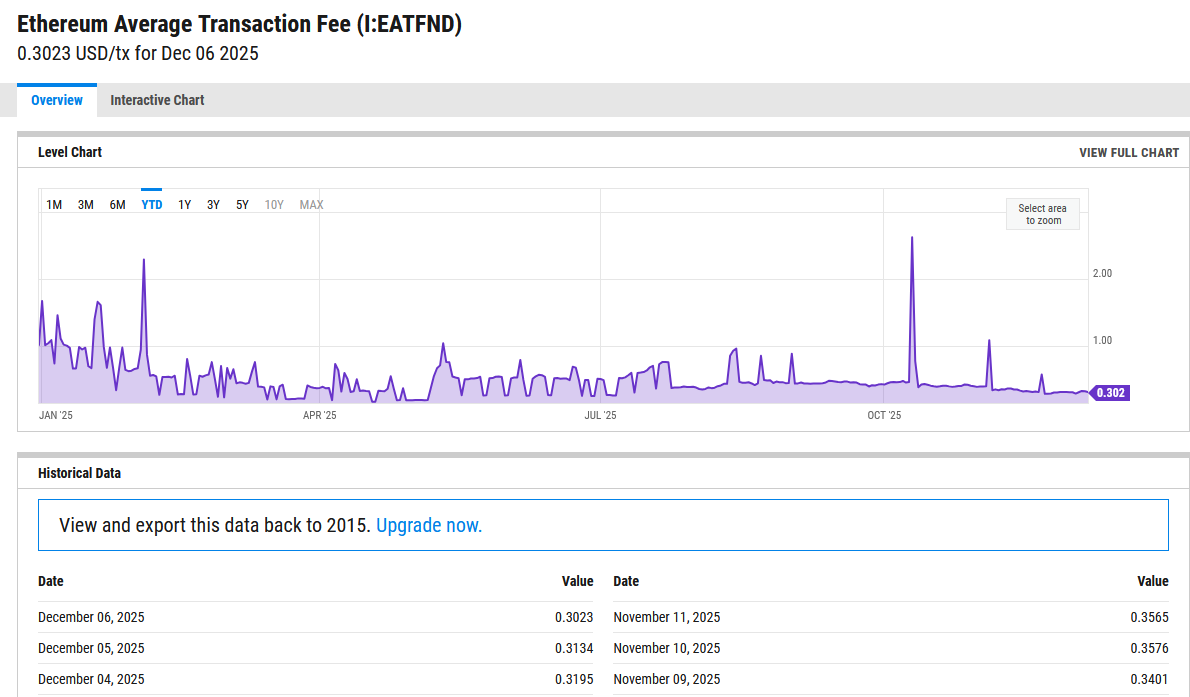
Vitalik Buterin Proposes Onchain Gas Futures to Stabilize Ethereum FeesSource: YCharts ]]>
Disclaimer: The articles reposted on this site are sourced from public platforms and are provided for informational purposes only. They do not necessarily reflect the views of MEXC. All rights remain with the original authors. If you believe any content infringes on third-party rights, please contact service@support.mexc.com for removal. MEXC makes no guarantees regarding the accuracy, completeness, or timeliness of the content and is not responsible for any actions taken based on the information provided. The content does not constitute financial, legal, or other professional advice, nor should it be considered a recommendation or endorsement by MEXC.

You May Also Like

CME Group to launch Solana and XRP futures options in October

CME Group to launch Solana and XRP futures options in October

The post CME Group to launch Solana and XRP futures options in October appeared on BitcoinEthereumNews.com. CME Group is preparing to launch options on SOL and XRP futures next month, giving traders new ways to manage exposure to the two assets.  The contracts are set to go live on October 13, pending regulatory approval, and will come in both standard and micro sizes with expiries offered daily, monthly and quarterly. The new listings mark a major step for CME, which first brought bitcoin futures to market in 2017 and added ether contracts in 2021. Solana and XRP futures have quickly gained traction since their debut earlier this year. CME says more than 540,000 Solana contracts (worth about $22.3 billion), and 370,000 XRP contracts (worth $16.2 billion), have already been traded. Both products hit record trading activity and open interest in August. Market makers including Cumberland and FalconX plan to support the new contracts, arguing that institutional investors want hedging tools beyond bitcoin and ether. CME’s move also highlights the growing demand for regulated ways to access a broader set of digital assets. The launch, which still needs the green light from regulators, follows the end of XRP’s years-long legal fight with the US Securities and Exchange Commission. A federal court ruling in 2023 found that institutional sales of XRP violated securities laws, but programmatic exchange sales did not. The case officially closed in August 2025 after Ripple agreed to pay a $125 million fine, removing one of the biggest uncertainties hanging over the token. This is a developing story. This article was generated with the assistance of AI and reviewed by editor Jeffrey Albus before publication. Get the news in your inbox. Explore Blockworks newsletters: Source: https://blockworks.co/news/cme-group-solana-xrp-futures
Share
BitcoinEthereumNews2025/09/17 23:55
Is Singapore Becoming Asia’s Digital Finance Regulatory Leader?

Is Singapore Becoming Asia’s Digital Finance Regulatory Leader?

The post Is Singapore Becoming Asia’s Digital Finance Regulatory Leader? appeared on BitcoinEthereumNews.com. Monetary Authority of Singapore (MAS) has moved ahead of many regional peers by setting clear rules on reserve backing, redemption rights, and licensing requirements for crypto service providers The country’s entire approach and plan was not to ban crypto, but instead to introduce rules to protect users and the financial system from its risks In June, Singapore cracked down on exchanges that serve overseas clients without a license Singapore is pushing further out front in Asia’s digital finance race. The Monetary Authority of Singapore (MAS) has built one of the region’s clearest frameworks for crypto service providers and stablecoins, spelling out reserve backing, redemption rights, and licensing requirements that many peers have yet to define.  While most countries around the world are still figuring out how to handle stablecoins and digital asset services, Singapore is trying to encourage new ideas while also keeping risks under control. The country’s entire approach and plan was not to ban crypto, but instead to introduce rules to protect users and the financial system from its risks. Singapore is also working on making it easier for crypto companies to work with banks, operate under clear guidelines, and separate trustworthy stablecoins and services from risky or purely speculative ones. Related: Singapore’s June 30 Crypto Deadline Forces Firms to Secure License or Exit Clear Rules, Stronger Trust Back in 2019, Singapore’s Payment Services Act of 2019 already set the rules for cryptocurrency businesses. It requires any firm based in Singapore to be fully licensed, even if all its clients are located outside the country. Then, in August 2023, MAS finalized regulations for single-currency stablecoins pegged to the Singapore dollar or any G10 currency.  The main rules say that companies issuing these coins must hold all the cash to back them up in safe assets, promise to buy…
Share
BitcoinEthereumNews2025/09/18 09:28