Ethereum saw a validator drop after the Fusaka upgrade due to a Prysm bug, and while recovery was quick, client diversity concerns remain. Ethereum faced a tough moment after the Fusaka upgrade. A bug in the Prysm consensus client caused a fall in validator votes, which pushed the network close to losing finality.  Developers acted […] The post Ethereum Sees Drop In Network Validator Participation After Fusaka Upgrade appeared first on Live Bitcoin News.Ethereum saw a validator drop after the Fusaka upgrade due to a Prysm bug, and while recovery was quick, client diversity concerns remain. Ethereum faced a tough moment after the Fusaka upgrade. A bug in the Prysm consensus client caused a fall in validator votes, which pushed the network close to losing finality.  Developers acted […] The post Ethereum Sees Drop In Network Validator Participation After Fusaka Upgrade appeared first on Live Bitcoin News.

Ethereum Sees Drop In Network Validator Participation After Fusaka Upgrade

2025/12/06 01:00

Ethereum saw a validator drop after the Fusaka upgrade due to a Prysm bug, and while recovery was quick, client diversity concerns remain.

Ethereum faced a tough moment after the Fusaka upgrade. A bug in the Prysm consensus client caused a fall in validator votes, which pushed the network close to losing finality. 

Developers acted fast and the network recovered, but the event raised new questions about client diversity.

Ethereum Validator Drop After Fusaka

Ethereum hit a sudden 25% drop in voting participation right after the Fusaka upgrade.

The fall happened due to a flaw in Prysm version v7.0.0. The client produced old states when it processed outdated attestations, and this caused nodes to stop working as expected. 

Prysm developers shared a temporary fix and told validators to start the client with a special flag.

However, Beaconcha.in data showed the hit clearly. At epoch 411448, sync participation dropped to 75% and voting participation reached about 74.7%. 
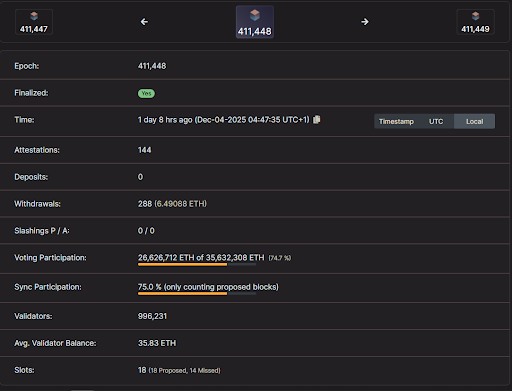
sync participation dropped to 75% and voting participation reached about 74.7% at Epoch 411448sync participation dropped to 75% and voting participation reached about 74.7% at Epoch 411448 | source: BeaconChai.in

Notably, Ethereum needs at least two-thirds of stakers to vote to keep finality. That means the network sat only a few percentage points away from losing that safety line.

Ethereum Client Diversity Brings Fresh Worries

Ethereum saw a fast recovery. At epoch 411712, voting participation climbed close to 99% and sync participation reached 97%. Before the issue, the network usually saw more than 99% of votes. 

The recovery proved that the issue stayed tied to one client group.

Validator data lined up with the scale of the drop. Prysm had about 22.7% of validators before the bug. That number dropped to 18% after the event. This matched the fall in voting participation and showed that the failure stayed focused on Prysm users.

A similar problem happened in 2022. Ethereum lost finality twice due to older attestation bugs in both Prysm and Teku. Back then, Prysm ran on most Ethereum consensus nodes. 

That created a higher risk because one client error could push the entire network into trouble.

Ethereum still has uneven client usage. Current MigaLabs data shows Lighthouse holds 52.55% of nodes while Prysm holds around 18%. 

Developers want no single client above 33% and that limit keeps the network safe, even if one client breaks. 

Thus, the recent event proved that the network still needs more balance.

Ethereum Faces Finality Challenge

Ethereum finality plays a major role in keeping the chain stable. If voting participation drops below two-thirds, the chain loses finality. 

Blocks can still appear, but they do not count as finalised. That creates real problems because bridges can freeze and rollups can halt withdrawals. Exchanges can also raise confirmation limits and users may face delays and higher risks during that period.

Prysm developers warned that the bug made nodes produce old states. This blocked proper voting and caused the sudden drop. 

The quick recovery, helped by the workaround, kept the chain safe. Yet the event served as a reminder. 

The network needs strong client diversity to protect itself from single-point failures.

Related Reading: Ethereum Rallies Strongly Past $3,000 Before the Upcoming Fusaka Upgrade

Ethereum Gains From Fusaka Despite Setback

The Fusaka upgrade still brought clear gains for Ethereum. It added PeerDAS through EIP-7594. 

This upgrade reduces bandwidth use and prepares Ethereum for higher throughput. It also supports more activity and lowers pressure on the base layer. In sum, the upgrade helps rollups scale and lowers costs for users.

Fusaka also increases blob capacity, which helps layer 2 networks. This means cheaper operations and smoother performance during heavy usage. It also makes Ethereum more suitable for large applications that need fast and cheap transactions.

Overall, the next months will show how validators respond and how fast the ecosystem builds on the upgrade.

The post Ethereum Sees Drop In Network Validator Participation After Fusaka Upgrade appeared first on Live Bitcoin News.

Disclaimer: The articles reposted on this site are sourced from public platforms and are provided for informational purposes only. They do not necessarily reflect the views of MEXC. All rights remain with the original authors. If you believe any content infringes on third-party rights, please contact service@support.mexc.com for removal. MEXC makes no guarantees regarding the accuracy, completeness, or timeliness of the content and is not responsible for any actions taken based on the information provided. The content does not constitute financial, legal, or other professional advice, nor should it be considered a recommendation or endorsement by MEXC.

You May Also Like

Strive CEO Urges MSCI to Reconsider Bitcoin-Holding Firms’ Index Exclusion

Strive CEO Urges MSCI to Reconsider Bitcoin-Holding Firms’ Index Exclusion

The post Strive CEO Urges MSCI to Reconsider Bitcoin-Holding Firms’ Index Exclusion appeared on BitcoinEthereumNews.com. MSCI’s proposed Bitcoin exclusion would bar companies with over 50% digital asset holdings from indexes, potentially costing firms like Strategy $2.8 billion in inflows. Strive CEO Matt Cole urges MSCI to let the market decide, emphasizing Bitcoin holders’ roles in AI infrastructure and structured finance growth. Strive’s letter to MSCI argues exclusion limits passive investors’ access to high-growth sectors like AI and digital finance. Nasdaq-listed Strive, the 14th-largest Bitcoin treasury firm, highlights how miners are diversifying into AI power infrastructure. The 50% threshold is unworkable due to Bitcoin’s volatility, causing index flickering and higher costs; JPMorgan analysts estimate significant losses for affected firms. Discover MSCI Bitcoin exclusion proposal details and Strive’s pushback. Learn impacts on Bitcoin treasury firms and AI diversification. Stay informed on crypto index changes—read now for investment insights. What is the MSCI Bitcoin Exclusion Proposal? The MSCI Bitcoin exclusion proposal seeks to exclude companies from its indexes if digital asset holdings exceed 50% of total assets, aiming to reduce exposure to volatile cryptocurrencies in passive investment vehicles. This move targets major Bitcoin treasury holders like Strategy, potentially disrupting billions in investment flows. Strive Enterprises, a key player in the space, has formally opposed it through a letter to MSCI’s leadership. How Does the MSCI Bitcoin Exclusion Affect Bitcoin Treasury Firms? The proposal could deliver a substantial setback to Bitcoin treasury firms by limiting their inclusion in widely tracked MSCI indexes, which guide trillions in passive investments globally. According to JPMorgan analysts, Strategy alone might see a $2.8 billion drop in assets under management if excluded from the MSCI World Index, as reported in their recent market analysis. This exclusion would hinder these firms’ ability to attract institutional capital, forcing them to compete at a disadvantage against traditional finance entities. Strive CEO Matt Cole, in his letter to…
Share
BitcoinEthereumNews2025/12/06 11:33
Snowflake and Anthropic Forge $200M AI Partnership for Global Enterprises

Snowflake and Anthropic Forge $200M AI Partnership for Global Enterprises

The post Snowflake and Anthropic Forge $200M AI Partnership for Global Enterprises appeared on BitcoinEthereumNews.com. Peter Zhang Dec 04, 2025 16:52 Snowflake and Anthropic unveil a $200 million partnership to integrate AI capabilities into enterprise data environments, enhancing AI-driven insights with Claude models across leading cloud platforms. In a strategic move to enhance AI capabilities for global enterprises, Snowflake and Anthropic have announced a significant partnership valued at $200 million. This multi-year agreement aims to integrate Anthropic’s Claude models into Snowflake’s platform, offering advanced AI-driven insights to over 12,600 global customers through leading cloud services such as Amazon Bedrock, Google Cloud Vertex AI, and Microsoft Azure, according to Anthropic. Expanding AI Capabilities This collaboration marks a pivotal step in deploying AI agents across the world’s largest enterprises. By leveraging Claude’s advanced reasoning capabilities, Snowflake aims to enhance its internal operations and customer offerings. The partnership facilitates a joint go-to-market initiative, enabling enterprises to extract insights from both structured and unstructured data while adhering to stringent security standards. Internally, Snowflake has already been utilizing Claude models to boost developer productivity and innovation. The Claude-powered GTM AI Assistant, built on Snowflake Intelligence, empowers sales teams to centralize data and query it using natural language, thereby streamlining deal cycles. Innovative AI Solutions for Enterprises Thousands of Snowflake customers are processing trillions of Claude tokens monthly via Snowflake Cortex AI. The partnership’s next phase will focus on deploying AI agents capable of complex, multi-step analysis. These agents, powered by Claude’s reasoning and Snowflake’s governed data environment, allow business users to ask questions in plain English and receive accurate answers, achieving over 90% accuracy on complex text-to-SQL tasks based on internal benchmarks. This collaboration is especially beneficial for regulated industries like financial services, healthcare, and life sciences, enabling them to transition from pilot projects to full-scale production confidently. Industry Impact and Customer…
Share
BitcoinEthereumNews2025/12/06 11:17
Pundi AI Teams Up with HyperGPT to Build an Open, Community-Driven AI Future With Tokenized Data and Web3 Tools

Pundi AI Teams Up with HyperGPT to Build an Open, Community-Driven AI Future With Tokenized Data and Web3 Tools

The post Pundi AI Teams Up with HyperGPT to Build an Open, Community-Driven AI Future With Tokenized Data and Web3 Tools appeared on BitcoinEthereumNews.com. Decentralized finance and AI industry watchers were briefed by COINOTAG News on December 6th about a strategic alliance between Pundi AI and HyperGPT. Official sources confirm the collaboration aims to build an open, transparent, and community-driven AI future, leveraging each party’s strengths to advance verifiable data infrastructure and governance. The partnership will fuse Data Pump with tokenized datasets to boost AI performance while mitigating model risk, enabling broader participation in AI training. HyperGPT provides developer-friendly tools via its ecosystem, including an AI application marketplace, HyperStore, the HyperSDK integration layer, and agents through HyperAgent, plus monetization paths via HyperNFT. For developers and users, the collaboration signals a tangible move from experimental pilots to scalable, production-ready Web3 AI solutions. The alliance is positioned to accelerate real-world adoption, drive ecosystem liquidity, and support sustainable value creation through credible data provenance and transparent AI tooling. Source: https://en.coinotag.com/breakingnews/pundi-ai-teams-up-with-hypergpt-to-build-an-open-community-driven-ai-future-with-tokenized-data-and-web3-tools
Share
BitcoinEthereumNews2025/12/06 11:42