

If You’re A PEPE Investor, You Need To See This Or Risk Losing Your Coins
PEPE investors are at risk of losing their coins following a recent security incident. On-chain security firm Blockaid drew attention to a front-end attack on the meme coin’s website that could potentially drain users’ funds.
PEPE Investors At Risk With Website Front-End Attack
In an X post, Blockaid stated that its system identified a front-end attack on PEPE’s website. The security firm further revealed that the site contains a code of Inferno Drainer. This malware is known to be used to automatically drain users’ wallets, which puts holders at risk of losing their coins.
The Inferno Drainer malware is said to redirect visitors on the website to a fake portal, where they risk clicking phishing links that are designed to drain their wallets. As such, the security firm advised investors and community members to avoid the website until the issue is resolved.
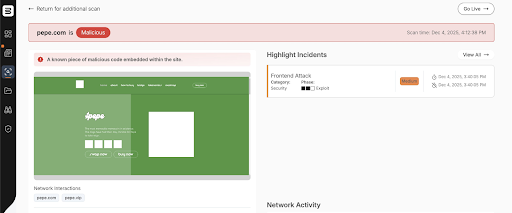
Blockaid’s Threat Intelligence Team also told Cointelegraph that the Inferno Drainer code detected on the website matched a known drainer family they regularly identify. Meanwhile, the team has yet to make a statement on their official X platform regarding the malware.
Notably, the website on the PEPE X platform redirects to a fake website (pepedotvip) instead of the original site (pepedotcom). The website also promotes a PEPE derivative, which is believed to be a rug coin. The price remained steady amid reports of the hack, climbing as high as 4% yesterday.
However, the meme coin price has since retraced as part of a broader crypto market correction led by Bitcoin. The third-largest meme coin by market cap is also down over 75% year-to-date (YTD) thanks to the recent crypto market crash.
The Rise In Inferno Drainer Attacks
The PEPE front-end isn’t the first to fall victim to an Inferno Drainer attack this year. Earlier in the year, Blockaid had identified that CoinMarketCap’s frontend was compromised by what appeared to be an Inferno Drainer. Back then, the CoinMarketCap website displayed a pop-up prompting users to verify their wallets, which ultimately drained their funds.
The BNB Chain X account was also a victim of this Inferno Drainer in October. The hackers posted links that directed users to websites that employed the Inferno Drainer toolkit. This incident resulted in a total loss of around $8,000 for users, which the BNB Chain promised to reimburse.
Blockaid last year revealed that the Inferno Drainer group stole $80 million from Web3 users by exploiting older, malicious decentralized applications. This kind of scam is also said to have tripled last year, resulting in significant losses for investors.
At the time of writing, the meme coin price is trading at around $0.000004697, down over 3% in the last 24 hours, according to data from CoinMarketCap.
You May Also Like

Pepeto vs Blockdag Vs Layer Brett Vs Remittix and Little Pepe

‘European SEC’ proposal sparks licensing concerns, institutional ambitions
Legal experts are concerned that transforming ESMA into the “European SEC” may hinder the licensing of crypto and fintech in the region. The European Commission’s proposal to expand the powers of the European Securities and Markets Authority (ESMA) is raising concerns about the centralization of the bloc’s licensing regime, despite signaling deeper institutional ambitions for its capital markets structure.On Thursday, the Commission published a package proposing to “direct supervisory competences” for key pieces of market infrastructure, including crypto-asset service providers (CASPs), trading venues and central counterparties to ESMA, Cointelegraph reported.Concerningly, the ESMA’s jurisdiction would extend to both the supervision and licensing of all European crypto and financial technology (fintech) firms, potentially leading to slower licensing regimes and hindering startup development, according to Faustine Fleuret, head of public affairs at decentralized lending protocol Morpho.Read more
