

Aster Burns 78 Million Tokens After Completing S3 Buyback Program
Aster removes 78 million tokens after its S3 buyback program, advancing deflation plans amid shifting market sentiment.
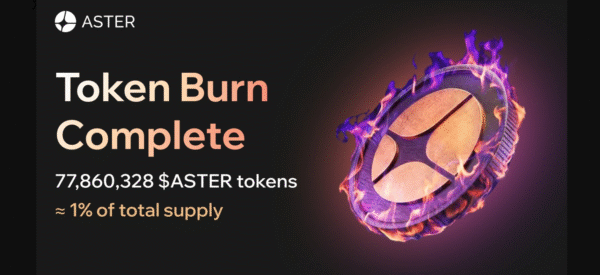
Aster executed a major token reduction on December 5, permanently burning about 78 million ASTER tokens following the completion of its Season 3 buyback program. The team confirmed the move in an announcement on Thursday and added that the re-acquisition of the tokens was intended to reinforce the long-term scarcity.
Token Burn Marks Milestone in Aster’s Buyback Strategy
According to the update of the project and supporting blog references, the S3 program bought back 155.7 million ASTER tokens. Aster subsequently burned 77,860,328 tokens when transferring the same to its airdrop-locked wallet. The team said those transfers were based on commitments that were included in its earlier public roadmap. They also confirmed S4 buyback operations as still running as part of a larger deflation plan.
Related Reading: Aster Unveils 2026 Roadmap with L1 Mainnet Launch | Live Bitcoin News
Background reports highlighted that Aster is a multi-chain DEX that has YZi Labs as its backing. The platform has held three buyback seasons since September with more than 296 million tokens removed from circulation. These buybacks aim to support pricing stability, increase confidence in the protocol, and set it up for cross-chain growth.
Market Impact Remains Limited Despite Supply Reduction
However, despite the large burn, the price of ASTER did not show a significant upward movement in the market. Market trackers indicated a live price of $1.03 on December 5, down 2.02% in the last 24 hours, and a trading volume of $260.2 million. Analysts said the burn amounted to around 1% of the overall supply, so it had limited near-term impact on pricing.
Furthermore, the drop in price came after a larger pullback across the crypto markets. Reports found that many digital assets suffered trading momentum due to the weakening of macroeconomic signals. Earlier optimism in November, caused by disclosures made about a personal purchase by Binance’s founder, evaporated as traders assumed a defensive stance.
 Source: ASTER
Market experts stated that Aster’s deflationary strategy works in harmony with the strategy followed by various multi-chain platforms on sustainable token economics. However, they contended that market sentiment ruined the benefits of the burn. Additionally, analysts were pointing towards bearish technical indicators such as declining volume strength and weaker trend confirmation.
Industry researchers commented that the locked airdrop structure has future upside to community participants. They said that the use of balanced burn and lock ratios helps in supporting liquidity management while reserving the tokens for ecosystem incentives for the project. However, they added that deflation cannot on its own necessarily offset external volatility.
Deflation Program Sets Foundation for Future Supply Dynamics
Aster’s three buyback seasons are a reflection of a continuing distribution of supply restructuring. The combination of burns and locked allocations does capture a design aiming to reinforce token value via long-term scarcity. In addition to this, the beginning of S4 activities point to sustained commitment to measured reductions.
Recurrent buybacks may contribute to liquidity stabilization in periods of adverse market. They also suggested that exchanges and DeFi platforms will need to take careful management of liquidation risks, especially when the prices of tokens dip. As a result, Aster’s stable reduction of circulating supply could be used in resilience in future cycles of collapse as new releases of its product increase the participation in the network.
The post Aster Burns 78 Million Tokens After Completing S3 Buyback Program appeared first on Live Bitcoin News.
You May Also Like

Kalshi Jumps to 62% Market Share While Polymarket Eyes $10B Valuation

DBS Partners With Franklin Templeton and Ripple for Tokenized Lending Platform
