The post Inside Cardano’s strategic “Pentad” push for network unity appeared on BitcoinEthereumNews.com. In an industry that thrives on noise and chaos, Cardano is betting its future on a “quiet” hard fork and improved coordination among its leading internal stakeholders. The blockchain network is preparing to execute a technical upgrade engineered to be virtually invisible to the market. Known as Protocol Version 11, the “no new era” hard fork is a deliberate departure from the spectacle-driven upgrades that have become the standard in the crypto sector. Instead of launching a new roadmap phase, developers are focusing on tightening the ledger and resolving operational risks. This technical “quiet reset” coincides with a sweeping organizational overhaul led by founder Charles Hoskinson. Facing stagnant growth metrics and a fragmented leadership structure, Hoskinson is pushing to consolidate Cardano’s disparate entities under a single executive function dubbed the “Pentad.” The move aims to inject commercial discipline into the decentralized network, giving it a unified voice to compete with Ethereum and Solana. A low-drama fix The upcoming hard fork, which keeps the network within the current “Conway” era, is designed to minimize disruption. There will be no new ledger version and minimal integration costs for exchanges or wallet providers. However, the upgrade is critical for shoring up network resilience following a rare stumble last year. In November, a malformed delegation transaction triggered a chain split that fractured the network. While no funds were lost, the incident served as a wake-up call for governance leaders and developers. It showed that operational clarity and deterministic behavior had become more valuable to the network’s survival than raw throughput speed. In response, the Protocol v11 fork “introduces refinements, fixes, optimisations, and new features that do not require an era transition.” The upgrade includes stricter enforcement of unique Verifiable Random Function (VRF) key hashes and input rules for Plutus V1/V2. Faster scripts, cheaper DeFi… The post Inside Cardano’s strategic “Pentad” push for network unity appeared on BitcoinEthereumNews.com. In an industry that thrives on noise and chaos, Cardano is betting its future on a “quiet” hard fork and improved coordination among its leading internal stakeholders. The blockchain network is preparing to execute a technical upgrade engineered to be virtually invisible to the market. Known as Protocol Version 11, the “no new era” hard fork is a deliberate departure from the spectacle-driven upgrades that have become the standard in the crypto sector. Instead of launching a new roadmap phase, developers are focusing on tightening the ledger and resolving operational risks. This technical “quiet reset” coincides with a sweeping organizational overhaul led by founder Charles Hoskinson. Facing stagnant growth metrics and a fragmented leadership structure, Hoskinson is pushing to consolidate Cardano’s disparate entities under a single executive function dubbed the “Pentad.” The move aims to inject commercial discipline into the decentralized network, giving it a unified voice to compete with Ethereum and Solana. A low-drama fix The upcoming hard fork, which keeps the network within the current “Conway” era, is designed to minimize disruption. There will be no new ledger version and minimal integration costs for exchanges or wallet providers. However, the upgrade is critical for shoring up network resilience following a rare stumble last year. In November, a malformed delegation transaction triggered a chain split that fractured the network. While no funds were lost, the incident served as a wake-up call for governance leaders and developers. It showed that operational clarity and deterministic behavior had become more valuable to the network’s survival than raw throughput speed. In response, the Protocol v11 fork “introduces refinements, fixes, optimisations, and new features that do not require an era transition.” The upgrade includes stricter enforcement of unique Verifiable Random Function (VRF) key hashes and input rules for Plutus V1/V2. Faster scripts, cheaper DeFi…

Inside Cardano’s strategic “Pentad” push for network unity

2025/12/05 21:26

In an industry that thrives on noise and chaos, Cardano is betting its future on a “quiet” hard fork and improved coordination among its leading internal stakeholders.

The blockchain network is preparing to execute a technical upgrade engineered to be virtually invisible to the market.

Known as Protocol Version 11, the “no new era” hard fork is a deliberate departure from the spectacle-driven upgrades that have become the standard in the crypto sector. Instead of launching a new roadmap phase, developers are focusing on tightening the ledger and resolving operational risks.

This technical “quiet reset” coincides with a sweeping organizational overhaul led by founder Charles Hoskinson.

Facing stagnant growth metrics and a fragmented leadership structure, Hoskinson is pushing to consolidate Cardano’s disparate entities under a single executive function dubbed the “Pentad.”

The move aims to inject commercial discipline into the decentralized network, giving it a unified voice to compete with Ethereum and Solana.

A low-drama fix

The upcoming hard fork, which keeps the network within the current “Conway” era, is designed to minimize disruption.

There will be no new ledger version and minimal integration costs for exchanges or wallet providers. However, the upgrade is critical for shoring up network resilience following a rare stumble last year.

In November, a malformed delegation transaction triggered a chain split that fractured the network.

While no funds were lost, the incident served as a wake-up call for governance leaders and developers. It showed that operational clarity and deterministic behavior had become more valuable to the network’s survival than raw throughput speed.

In response, the Protocol v11 fork “introduces refinements, fixes, optimisations, and new features that do not require an era transition.”

The upgrade includes stricter enforcement of unique Verifiable Random Function (VRF) key hashes and input rules for Plutus V1/V2.

Faster scripts, cheaper DeFi

While the upgrade is billed as a maintenance patch, it introduces significant performance enhancements under the hood.

Protocol v11 grants developers access to new built-in primitives for arrays, modular exponentiation, and multi-asset values.

Most notably, the fork enables BLS12-381 multi-scalar multiplication. This cryptographic standard is foundational for zero-knowledge proofs and cross-chain attestations, critical components for linking Cardano to other blockchains and institutional systems.

Benchmarks from the Plutus development team suggest these changes will yield double-digit gains in deserialization speed.

If decentralized exchanges (DEXs) and lending protocols integrate these new primitives, transaction costs for complex contracts could drop significantly. While modest in isolation, these savings are expected to compound across thousands of transactions, improving the overall user experience.

The ‘Pentad’

The technical refinements are merely the substrate for a larger political restructuring.

On Dec. 1, Hoskinson proposed unifying the “Pentad,” which comprises the Cardano Foundation, Emurgo, Input Output Global (IOG), the Midnight Foundation, and Intersect, into a cohesive executive body.

Historically, these entities have operated with distinct mandates: the Foundation handled outreach, Emurgo led commercialization, and IOG focused on research.

Hoskinson argued that the lack of a central strategy often left the ecosystem unable to negotiate large-scale deals or coordinate effectively. He noted:

The proposed model outlines a two-phase approach. The initial “try before you buy” phase will see the five entities collaborate to deliver core infrastructure missing from the ecosystem, such as stablecoins, bridges, and oracles. Success will be measured on a strict pass-fail basis.

If successful, the group will transition to a second phase focused on a unified growth strategy to expand Cardano’s DeFi footprint.

Why Cardano needs these moves

The urgency for this restructuring stems from market realities that have been challenging for Cardano.

Despite its high profile, Cardano’s on-chain metrics lag behind its peers. According to DeFiLlama data, the network’s Total Value Locked (TVL) sits below $700 million, far off its 2021 highs, while daily active addresses hover around 20,000.

ADA, the native token, trades near $0.45, moving essentially in lockstep with macro sentiment rather than responding to protocol developments.

To bridge the gap between engineering output and economic impact, the Pentad plans to implement a targeted stimulus package.

The strategy involves identifying the top 10-15 decentralized applications (dapps) and treating them as “showcases.” By improving funding and technical support for these projects, the network hopes to boost transaction volume and secure listings on major exchanges.

The Pentad also intends to establish official Key Performance Indicators (KPIs). Future budgets would be linked to tangible improvements in ecosystem health, such as monthly active users and TVL growth.

These metrics would be ratified through on-chain “info actions,” effectively creating a performance-based governance system.

The long View

Cardano’s shift presents a stark contrast to the broader crypto market, where competitors like Solana and Ethereum frequently advertise major named upgrades and aggressive roadmap shifts.

The Hoskinson-led network’s choice to pursue smaller, continuous improvements may appear conservative, but proponents argue it builds a “rhythm of reliability” absent elsewhere.

Hoskinson contends that patience remains an asset. He points to upcoming initiatives like Midnight, a privacy-focused sidechain designed to open institutional channels, and a new “RealFi” protocol targeting off-chain yield, as evidence of a diversified future.

Considering this, he stated:

Mentioned in this article

Source: https://cryptoslate.com/cardano-is-executing-a-silent-reset-after-a-critical-ledger-error-nearly-fractured-the-network-in-november/

Disclaimer: The articles reposted on this site are sourced from public platforms and are provided for informational purposes only. They do not necessarily reflect the views of MEXC. All rights remain with the original authors. If you believe any content infringes on third-party rights, please contact service@support.mexc.com for removal. MEXC makes no guarantees regarding the accuracy, completeness, or timeliness of the content and is not responsible for any actions taken based on the information provided. The content does not constitute financial, legal, or other professional advice, nor should it be considered a recommendation or endorsement by MEXC.

You May Also Like

XRP Near $2 as ETFs Smash $1B AUM — Institutional Money Quietly Takes Over

XRP Near $2 as ETFs Smash $1B AUM — Institutional Money Quietly Takes Over

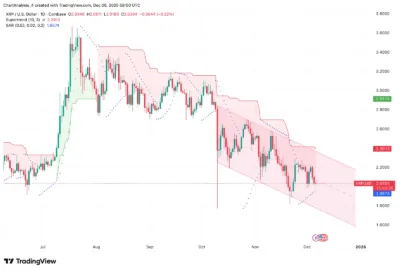
XRP trades near $2.04 after climbing more than 12% in the last month, yet the token struggles to reclaim strong momentum. The asset slipped through the past week and lost close to 8% while traders weighed a rare combination of institutional strength and short-term weakness. With a market capitalization near $125 billion and daily volume above $3.3 billion, XRP keeps its position as one of the most liquid crypto assets. The market now watches the psychological $2 support level as heavy inflows clash ih rising short exposure and fading retail conviction.Sentiment Breakdown Creates a Contrarian SetupMarket sentiment around XRP sits inside one of the deepest fear zones since October. Santiment reports that sentiment prints the same level of panic that preceded a sharp twenty-two percent rebound on November 21. RSI sits near 45 and the SAR indicator keeps flipping into bearish territory. Source: XTraders feel trapped between disbelief and fatigue after a two-month decline of thirty-one percent. The present slide shows structural weakness rather than blind panic, which means any reversal must appear through rising volume and inflow recovery rather than pure emotion. Traders hunt for signs that shorts may reach exhaustion as they did during past rebounds.Institutions Accumulate While Retail Steps BackInstitutional appetite continues to grow even as retail traders exit. U.S. spot XRP ETFs attracted $906 million in net inflows since launch, with not a single day of outflows. The flagship XRPC ETF now holds $336 million, which places it above every competing fund.Franklin Templeton now lists XRP as a top-four holding in its regulated multi-asset crypto product. These flows form a clear divergence: Institutional portfolios build long-horizon positions while retail traders short the asset. The setup shows a market where deep pockets accumulate quietly below the surface, waiting for fear to drain out of the system.Ripple’s $4B Expansion Reshapes Global FinanceRipple pushed aggressively into global finance through a $4 billion acquisition wave across GTreasury, Rail, Palisade, and Ripple Prime. The company now holds strategic control over treasury management, liquidity services, payments, and institutional crypto infrastructure. Regulatory traction strengthens the expansion. Approvals in Singapore and the UAE, plus FSRA authorization of the RLUSD stablecoin, anchor Ripple inside the regulated payments ecosystem. Ripple also reached a major U.S. milestone when Bitnomial launched the first CFTC-approved XRP spot product. This move places XRP beside commodities such as Treasuries on a federally regulated exchange. Markets have not priced this transformation yet, leaving a wide gap between Ripple’s operational dominance and XRP’s market performance.On-Chain Data Reveals a Structural SplitThe XRP Ledger shows its highest transaction velocity of the year at 0.0324, marking strong network usage. Open interest climbed to $3.85 billion while funding rates stayed negative, which confirms heavy short positioning. A regional concentration also emerges: Upbit holds more than six billion XRP, far above Binance at 2.6 billion. The imbalance introduces the risk of region-based liquidation waves during volatility spikes. Liquidity remains deep and participation strong, yet direction stays capped by pressure from leveraged traders.Long-Term Holders Rotate as Whales Step InLong-term holder dormancy dropped ninety-one percent since mid-November, signaling that older coins rarely move. At the same time, cohorts that held XRP for six months to three years trimmed positions and locked in profits. Institutions absorbed much of that volume through ETF demand, which removed nearly half a percent of total supply from circulation as ETFs crossed one billion dollars in assets under management. Whales keep buying while early holders reduce exposure. This rotation delays any strong recovery but builds the foundation for a future supply squeeze once distribution slows.XRP now enters a rare moment where institutional strength outweighs retail fear, setting the stage for a potential shift once the market resolves its internal pressure.
Share
Coinstats2025/12/06 21:24
XRP Price Prediction for December 7: Sellers Continue to Dominate as Weak Momentum Persists

XRP Price Prediction for December 7: Sellers Continue to Dominate as Weak Momentum Persists

XRP struggles below $2.05, with bearish sentiment dominating market momentum. Weak spot inflows signal cautious sentiment as traders avoid aggressive positions. $2.00 support zone crucial; failure risks further declines towards $1.72. XRP’s price outlook for December 7 reveals ongoing weakness, as the cryptocurrency hovers near $2.03, continuing its downward trend since September. The failure to maintain any meaningful upward movement, coupled with consistent rejections at higher levels, has shifted the market bias firmly in favor of sellers. The token is now testing the critical $2.00 support zone, and if it fails to hold, further downside could be imminent. Also Read: Ethereum Price Prediction for November 9: Sellers Dominate as Weak Flows Persist Price Action and Key Technical Indicators XRP’s price action remains confined to a descending channel, with every rebound met with rejection at lower levels. The Supertrend indicator remains red, signaling ongoing bearish pressure, and the Parabolic SAR dots continue to sit above the price, reinforcing the dominance of sellers. Currently, the $2.00 level is a key support zone, but the inability to sustain a recovery above this level could lead to further losses, targeting $1.83 and $1.72. Source: Tradingview On the one-hour chart, XRP broke below a short-term ascending trendline, which had previously supported a minor recovery attempt. This has caused the price to consolidate beneath the trendline, keeping the bearish bias intact for the short term. Additionally, XRP remains within the lower half of the Bollinger Bands, indicating that downward pressure persists, with little sign of a sustained reversal. Market Sentiment and Data Reinforce Bearish Outlook Recent spot market data reveals weak flows, as $4.36 million in inflows were recorded in the latest session. However, these inflows seem more reactive than proactive, signaling a lack of strong accumulation interest and a market still wary of significant upside potential. Traders appear more focused on stabilizing the price rather than seeking aggressive bullish positions, indicating that sentiment remains fragile. Source: Coinglass In the derivatives market, open interest stands at $3.64 billion, showing a decline from recent highs. This drop, along with an 18% decrease in futures volume and a 60% collapse in options volume, underscores a lack of conviction in the market. Top traders remain predominantly net-long, but their reduced exposure further suggests a cautious approach in the current environment. XRP Price Forecast Looking ahead to December 7, the outlook remains largely bearish unless XRP can reclaim key resistance levels. A break above $2.15 and $2.39 would signal a potential shift in momentum, opening the door to higher targets such as $2.62 and $2.91. However, if the $2.00 support fails to hold, XRP is at risk of further declines towards $1.83 and $1.72. The technical indicators, spot flows, and derivatives data all point to continued bearish momentum for XRP. Sellers remain in control, and any recovery attempts are likely to face strong resistance. The next few sessions will be critical in determining whether the price can stabilize or if further downside is ahead. Also Read: Ethereum Classic (ETC) Price Prediction 2025–2029: Can ETC Hit $20 Soon? The post XRP Price Prediction for December 7: Sellers Continue to Dominate as Weak Momentum Persists appeared first on 36Crypto.
Share
Coinstats2025/12/06 21:06
The Federal Reserve cut interest rates by 25 basis points, and Powell said this was a risk management cut

The Federal Reserve cut interest rates by 25 basis points, and Powell said this was a risk management cut

PANews reported on September 18th, according to the Securities Times, that at 2:00 AM Beijing time on September 18th, the Federal Reserve announced a 25 basis point interest rate cut, lowering the federal funds rate from 4.25%-4.50% to 4.00%-4.25%, in line with market expectations. The Fed's interest rate announcement triggered a sharp market reaction, with the three major US stock indices rising briefly before quickly plunging. The US dollar index plummeted, briefly hitting a new low since 2025, before rebounding sharply, turning a decline into an upward trend. The sharp market volatility was closely tied to the subsequent monetary policy press conference held by Federal Reserve Chairman Powell. He stated that the 50 basis point rate cut lacked broad support and that there was no need for a swift adjustment. Today's move could be viewed as a risk-management cut, suggesting the Fed will not enter a sustained cycle of rate cuts. Powell reiterated the Fed's unwavering commitment to maintaining its independence. Market participants are currently unaware of the risks to the Fed's independence. The latest published interest rate dot plot shows that the median expectation of Fed officials is to cut interest rates twice more this year (by 25 basis points each), one more than predicted in June this year. At the same time, Fed officials expect that after three rate cuts this year, there will be another 25 basis point cut in 2026 and 2027.
Share
PANews2025/09/18 06:54