Allos is a Python SDK for building AI agents that can switch between OpenAI, Anthropic, and more with a single command. Allos is built on a single philosophy: developers deserve the freedom to choose the best model for each job, without penalty.Allos is a Python SDK for building AI agents that can switch between OpenAI, Anthropic, and more with a single command. Allos is built on a single philosophy: developers deserve the freedom to choose the best model for each job, without penalty.

Why I Built Allos to Decouple AI Agents From LLM Vendors

2025/12/04 14:17

Introducing Allos: A Python SDK for building AI agents that can switch between OpenAI, Anthropic, and more with a single command.

The Frustration That Sparked a Project

If you've spent any time building with Large Language Models, you've probably felt the same frustration I did. You start a project with, say, OpenAI's API. Your agent is working perfectly. Then, Anthropic releases a new Claude model that's faster, cheaper, or better at reasoning for your specific use case.

What do you do?

The painful reality is that you're facing a significant rewrite. The tool-calling formats are different. The message structures are different. The entire client library is different. You're locked in.

I found myself wrestling with complex frameworks that promised flexibility but delivered a mountain of boilerplate, or simple frameworks that chained me to a single provider. I spent more time fighting abstractions than actually building my agent.

I thought: "There has to be a better way."

That's why I built Allos.

Introducing Allos: Freedom to Choose

Today, I'm launching Allos v0.0.1, an open-source, MIT-licensed agentic SDK for Python that I built to solve this exact problem.

Allos (from the Greek ἄλλος, meaning "other" or "different") is built on a single philosophy: developers deserve the freedom to choose the best model for each job, without penalty.

With Allos, you write your agent's logic once. Switching the underlying "brain" from GPT-4o to Claude 3.5 Sonnet is as simple as changing a single command-line flag. No code changes. No headaches.

See It in Action: 0 to a Full App in Under 4 Minutes

Talk is cheap. Here's a video of Allos building a complete, multi-file FastAPI application—including a database, tests, and a README—from a single prompt, and then switching providers on the fly.

https://youtu.be/rWc-8awcAJo?embedable=true

How It Works: Simplicity by Design

Allos isn't just another heavy abstraction layer. It's a production-ready toolkit designed with a fanatical focus on developer experience.

A Polished and Powerful CLI

The allos CLI is the heart of the experience. You can go from an idea to a running application in minutes.

# Create a complete application from a single prompt allos "Create a REST API for a todo app with FastAPI, SQLite, CRUD operations, and tests."

\

Truly Provider Agnostic

This is the core promise. Use the best model for every job.

# Start with OpenAI allos --provider openai "Refactor this code for readability." # Switch to Anthropic for deeper reasoning allos --provider anthropic --session refactor.json "Continue the analysis." # Run locally with Ollama (coming soon!) allos --provider ollama "Same task, offline."

\

Less Code, More Power

Frameworks should get out of your way. Allos is designed to be minimal and intuitive.

\ Boilerplate for Allos
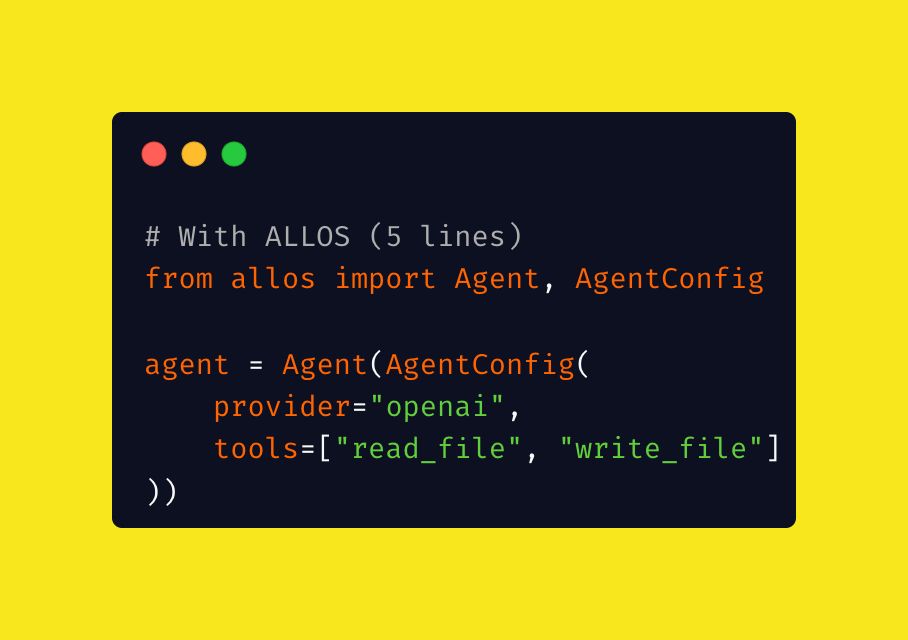
\

Key Features in v0.0.1

  • Secure Tools: Built-in tools for filesystem I/O and shell execution, with a human-in-the-loop permission system by default.
  • Session Management: Never lose your progress. The --session flag saves your entire conversation context.
  • Extensible by Design: Creating your own custom tools is as simple as writing a Python class with a @tool decorator.
  • Built for Quality: 100% unit test coverage, a full integration suite, and production-ready error handling.

The Roadmap: Building an Open Ecosystem

This MVP with OpenAI and Anthropic support is just the beginning. The public roadmap is driven by what the community needs next:

  • 🔌 Ollama Support: For running local models.
  • 🌐 Web Tools: Built-in web_search and web_fetch + MCP!.
  • 🧠 More Providers: Google Gemini, Cohere, and others.
  • 🤖 More Agentic Frameworks: smolagents, Pydantic AI, and more.

Get Started in 2 Minutes

Step 1: Install

uv pip install "allos-agent-sdk[all]"

Step 2: Configure

export OPENAI_API_KEY="your_key_here"

Step 3: Run!

allos "Create a simple FastAPI app in main.py and tell me how to run it."

Join the Movement

Allos is more than a tool—it's a bet on an open, flexible future for AI development. If you believe developers should be free to choose the best model without vendor lock-in, I'd love your support.

  • Star on GitHub: https://github.com/Undiluted7027/allos-agent-sdk
  • 📖 Read the Docs: https://github.com/Undiluted7027/allos-agent-sdk/tree/main/docs
  • 💬 Join the Discussion: Share ideas, ask questions, and help shape the roadmap.

Allos is built in the open, for the community. I'm incredibly proud of this first release and can't wait to see what you build with it. Thanks for reading.

Disclaimer: The articles reposted on this site are sourced from public platforms and are provided for informational purposes only. They do not necessarily reflect the views of MEXC. All rights remain with the original authors. If you believe any content infringes on third-party rights, please contact service@support.mexc.com for removal. MEXC makes no guarantees regarding the accuracy, completeness, or timeliness of the content and is not responsible for any actions taken based on the information provided. The content does not constitute financial, legal, or other professional advice, nor should it be considered a recommendation or endorsement by MEXC.

You May Also Like

Strive CEO Urges MSCI to Reconsider Bitcoin-Holding Firms’ Index Exclusion

Strive CEO Urges MSCI to Reconsider Bitcoin-Holding Firms’ Index Exclusion

The post Strive CEO Urges MSCI to Reconsider Bitcoin-Holding Firms’ Index Exclusion appeared on BitcoinEthereumNews.com. MSCI’s proposed Bitcoin exclusion would bar companies with over 50% digital asset holdings from indexes, potentially costing firms like Strategy $2.8 billion in inflows. Strive CEO Matt Cole urges MSCI to let the market decide, emphasizing Bitcoin holders’ roles in AI infrastructure and structured finance growth. Strive’s letter to MSCI argues exclusion limits passive investors’ access to high-growth sectors like AI and digital finance. Nasdaq-listed Strive, the 14th-largest Bitcoin treasury firm, highlights how miners are diversifying into AI power infrastructure. The 50% threshold is unworkable due to Bitcoin’s volatility, causing index flickering and higher costs; JPMorgan analysts estimate significant losses for affected firms. Discover MSCI Bitcoin exclusion proposal details and Strive’s pushback. Learn impacts on Bitcoin treasury firms and AI diversification. Stay informed on crypto index changes—read now for investment insights. What is the MSCI Bitcoin Exclusion Proposal? The MSCI Bitcoin exclusion proposal seeks to exclude companies from its indexes if digital asset holdings exceed 50% of total assets, aiming to reduce exposure to volatile cryptocurrencies in passive investment vehicles. This move targets major Bitcoin treasury holders like Strategy, potentially disrupting billions in investment flows. Strive Enterprises, a key player in the space, has formally opposed it through a letter to MSCI’s leadership. How Does the MSCI Bitcoin Exclusion Affect Bitcoin Treasury Firms? The proposal could deliver a substantial setback to Bitcoin treasury firms by limiting their inclusion in widely tracked MSCI indexes, which guide trillions in passive investments globally. According to JPMorgan analysts, Strategy alone might see a $2.8 billion drop in assets under management if excluded from the MSCI World Index, as reported in their recent market analysis. This exclusion would hinder these firms’ ability to attract institutional capital, forcing them to compete at a disadvantage against traditional finance entities. Strive CEO Matt Cole, in his letter to…
Share
BitcoinEthereumNews2025/12/06 11:33
Snowflake and Anthropic Forge $200M AI Partnership for Global Enterprises

Snowflake and Anthropic Forge $200M AI Partnership for Global Enterprises

The post Snowflake and Anthropic Forge $200M AI Partnership for Global Enterprises appeared on BitcoinEthereumNews.com. Peter Zhang Dec 04, 2025 16:52 Snowflake and Anthropic unveil a $200 million partnership to integrate AI capabilities into enterprise data environments, enhancing AI-driven insights with Claude models across leading cloud platforms. In a strategic move to enhance AI capabilities for global enterprises, Snowflake and Anthropic have announced a significant partnership valued at $200 million. This multi-year agreement aims to integrate Anthropic’s Claude models into Snowflake’s platform, offering advanced AI-driven insights to over 12,600 global customers through leading cloud services such as Amazon Bedrock, Google Cloud Vertex AI, and Microsoft Azure, according to Anthropic. Expanding AI Capabilities This collaboration marks a pivotal step in deploying AI agents across the world’s largest enterprises. By leveraging Claude’s advanced reasoning capabilities, Snowflake aims to enhance its internal operations and customer offerings. The partnership facilitates a joint go-to-market initiative, enabling enterprises to extract insights from both structured and unstructured data while adhering to stringent security standards. Internally, Snowflake has already been utilizing Claude models to boost developer productivity and innovation. The Claude-powered GTM AI Assistant, built on Snowflake Intelligence, empowers sales teams to centralize data and query it using natural language, thereby streamlining deal cycles. Innovative AI Solutions for Enterprises Thousands of Snowflake customers are processing trillions of Claude tokens monthly via Snowflake Cortex AI. The partnership’s next phase will focus on deploying AI agents capable of complex, multi-step analysis. These agents, powered by Claude’s reasoning and Snowflake’s governed data environment, allow business users to ask questions in plain English and receive accurate answers, achieving over 90% accuracy on complex text-to-SQL tasks based on internal benchmarks. This collaboration is especially beneficial for regulated industries like financial services, healthcare, and life sciences, enabling them to transition from pilot projects to full-scale production confidently. Industry Impact and Customer…
Share
BitcoinEthereumNews2025/12/06 11:17
