Tether Data Introduces QVAC Fabric, Bringing AI Fine-Tuning to Consumer Hardware
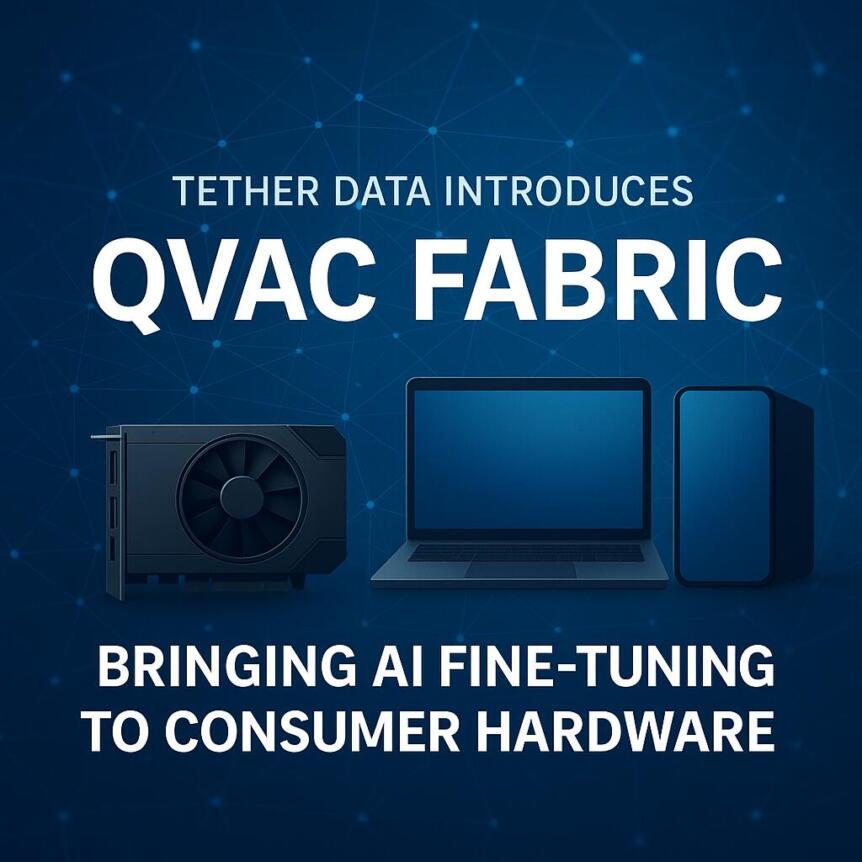
2 December, 2025 – Tether Data today announced the launch of QVAC Fabric LLM, a new comprehensive LLM inference runtime and fine-tuning framework that makes it possible to execute, train and personalize large language models directly on everyday hardware, including consumer GPUs, laptops, and even smartphones. What once required high-end cloud servers or specialized NVIDIA (NASDAQ: NVDA) systems can now happen locally on devices people already own.
High Performance LLM Inference Runtime and Fine-tuning have traditionally been reserved for companies with access to expensive infrastructure, but QVAC Fabric shifts that model entirely. It is the first unified, portable, cross-platform, highly-scalable system capable of full LLM inference execution, LoRA, and instruction-tuning across mobile operating systems (iOS and Android) as well as all other laptop, desktop, and server environments (Windows, macOS, Linux), allowing developers and organizations to build, deploy, execute, and customize AI privately and independently. No cloud dependency, no vendor lock-in, and no sensitive data leaving the device.
A major breakthrough in this release is the ability to fine-tune models on mobile GPUs such as Qualcomm Adreno and ARM Mali. This is the first time a production-ready framework has enabled modern LLM training on smartphone-class hardware. It opens the door to personalized AI that can learn directly from users on their devices, preserving privacy and functioning even without an internet connection, and powering a new generation of highly resilient, anti-fragile, on-device AI applications.
QVAC Fabric LLM also expands the capabilities of the llama.cpp ecosystem by adding fine-tuning support for modern models such as LLama3, Qwen3, and Gemma3. These models, previously unsupported in this environment, can now be fine-tuned through a simple, consistent workflow across all hardware types.
By enabling training across a wide range of GPUs, AMD (NASDAQ: AMD), Intel (NASDAQ: INTC), NVIDIA, Apple Silicon, and mobile chips, QVAC Fabric LLM breaks the longstanding assumption that meaningful AI development requires access to specialized, single-vendor hardware. Consumer GPUs now play on equal footing, and even mobile devices enter the conversation as legitimate training platforms. This is a significant step toward diversifying the hardware available for AI development.
For enterprises, the implications extend beyond convenience. Organizations can now fine-tune AI models in-house, on secure hardware, without exposing sensitive data to external cloud providers. This makes it easier to meet privacy, regulatory, and cost requirements while still deploying modern AI tailored to internal needs. It moves fine-tuning from centralized GPU clusters to the broader device fleet companies already manage.
Tether Data has released QVAC Fabric LLM as open-source software under the Apache 2.0 license, along with multi-platform binaries and ready-to-use adapters on Hugging Face. Developers can begin fine-tuning with only a few commands, lowering the barrier to AI customization in a way that has not been possible before.
QVAC Fabric LLM represents a practical shift toward decentralized, user-controlled AI. While much of the industry continues to focus on cloud-first solutions, Tether Data is making advanced personalization accessible on local edge hardware to ensure operational continuity in high-latency geographical areas (i.e., emerging markets), to provide an anti-fragile, privacy-first, highly-resilient, and scalable AI platform.
Developers can evaluate QVAC Fabric LLM on Hugging Face via the published technical overview available here.
About Tether Data
Tether Data, S.A. de C.V. (“Tether Data”) is part of Tether’s broader vision to advance freedom, transparency, and innovation through technology. Its mission is to enable people and organizations to connect and share information directly, without unnecessary intermediaries. By creating secure, peer-to-peer systems, Tether Data gives users greater control over their data, communications, and digital interactions. Tether Data aims to redefine how information flows across networks by replacing centralized models with decentralized infrastructure designed for privacy, efficiency, and resilience. The company’s goal is to make global connectivity faster, safer, and more private, empowering individuals and institutions alike to exchange information freely and securely.
About QVAC
QVAC is Tether Data’s advanced AI research initiative dedicated to building open, decentralized, and adaptive intelligence systems. Its mission is Local AI. Infinite Intelligence. No Compromise envisions a world where AI lives and learns on any device, empowering individuals and communities rather than concentrating power in corporate data centers.
This article was originally published as Tether Data Introduces QVAC Fabric, Bringing AI Fine-Tuning to Consumer Hardware on Crypto Breaking News – your trusted source for crypto news, Bitcoin news, and blockchain updates.
You May Also Like

US Prosecutors Seek 12-Year Prison for Do Kwon Over Terra Collapse
Highlights: US prosecutors requested a 12-year prison sentence for Do Kwon after the Terra collapse. Terraform’s $40 billion downfall caused huge losses and sparked a long downturn in crypto markets. Do Kwon will face sentencing on December 11 and must give up $19 million in earnings. US prosecutors have asked a judge to give Do Kwon, Terraform Labs co-founder, a 12-year prison sentence for his role in the remarkable $40 billion collapse of the Terra and Luna tokens. The request also seeks to finalize taking away Kwon’s criminal earnings. The court filing came in New York’s Southern District on Thursday. This is about four months after Kwon admitted guilt on two charges: wire fraud and conspiracy to defraud. Prosecutors said Kwon caused more losses than Samuel Bankman-Fried, Alexander Mashinsky, and Karl Sebastian Greenwood combined. U.S. prosecutors have asked a New York federal judge to sentence Terraform Labs co-founder Do Kwon to 12 years in prison, calling his role in the 2022 TerraUSD collapse a “colossal” fraud that triggered broader crypto-market failures, including the downfall of FTX. Sentencing is… — Wu Blockchain (@WuBlockchain) December 5, 2025 Terraform Collapse Shakes Crypto Market Authorities explained that Terraform’s collapse affected the entire crypto market. They said it helped trigger what is now called the ‘Crypto Winter.’ The filing stressed that Kwon’s conduct harmed many investors and the broader crypto world. On Thursday, prosecutors said Kwon must give up just over $19 million. They added that they will not ask for any additional restitution. They said: “The cost and time associated with calculating each investor-victim’s loss, determining whether the victim has already been compensated through the pending bankruptcy, and then paying out a percentage of the victim’s losses, will delay payment and diminish the amount of money ultimately paid to victims.” Authorities will sentence Do Kwon on December 11. They charged him in March 2023 with multiple crimes, including securities fraud, market manipulation, money laundering, and wire fraud. All connections are tied to his role at Terraform. After Terra fell in 2022, authorities lost track of Kwon until they arrested him in Montenegro on unrelated charges and sent him to the U.S. Do Kwon’s Legal Case and Sentencing In April last year, a jury ruled that both Terraform and Kwon committed civil fraud. They found the company and its co-founder misled investors about how the business operated and its finances. Jay Clayton, U.S. Attorney for the Southern District of New York, submitted the sentencing request in November. TERRA STATEMENT: “We are very disappointed with the verdict, which we do not believe is supported by the evidence. We continue to maintain that the SEC does not have the legal authority to bring this case at all, and we are carefully weighing our options and next steps.” — Zack Guzmán (@zGuz) April 5, 2024 The news of Kwon’s sentencing caused Terraform’s token, LUNA, to jump over 40% in one day, from $0.07 to $0.10. Still, this rise remains small compared to its all-time high of more than $19, which the ecosystem reached before collapsing in May 2022. In a November court filing, Do Kwon’s lawyers asked for a maximum five-year sentence. They argued for a shorter term partly because he could face up to 40 years in prison in South Korea, where prosecutors are also pursuing a case against him. The legal team added that even if Kwon serves time in the U.S., he would not be released freely. He would be moved from prison to an immigration detention center and then sent to Seoul to face pretrial detention for his South Korea charges. eToro Platform Best Crypto Exchange Over 90 top cryptos to trade Regulated by top-tier entities User-friendly trading app 30+ million users 9.9 Visit eToro eToro is a multi-asset investment platform. The value of your investments may go up or down. Your capital is at risk. Don’t invest unless you’re prepared to lose all the money you invest. This is a high-risk investment, and you should not expect to be protected if something goes wrong.
ArtGis Finance Partners with MetaXR to Expand its DeFi Offerings in the Metaverse