This article outlines the implementation details for RECKONING, which uses a GPT-2-base model and runs on NVIDIA A100 GPUs.This article outlines the implementation details for RECKONING, which uses a GPT-2-base model and runs on NVIDIA A100 GPUs.

Technical Setup for RECKONING: Inner Loop Gradient Steps, Learning Rates, and Hardware Specification

2025/10/29 23:29

Abstract and 1. Introduction

  1. Background

  2. Method

  3. Experiments

    4.1 Multi-hop Reasoning Performance

    4.2 Reasoning with Distractors

    4.3 Generalization to Real-World knowledge

    4.4 Run-time Analysis

    4.5 Memorizing Knowledge

  4. Related Work

  5. Conclusion, Acknowledgements, and References

\ A. Dataset

B. In-context Reasoning with Distractors

C. Implementation Details

D. Adaptive Learning Rate

E. Experiments with Large Language Models

C Implementation Details

We select GPT-2-base [59] as the model for our method and all the baselines. We use the version implemented by the Huggingface Transformers library [78]. All the experiments for RECKONING

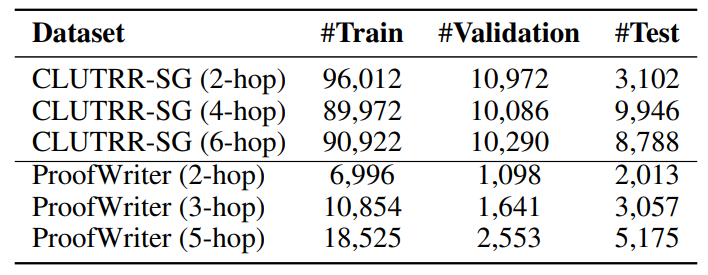
\ Table 6: Dataset splits and statistics for our experiments
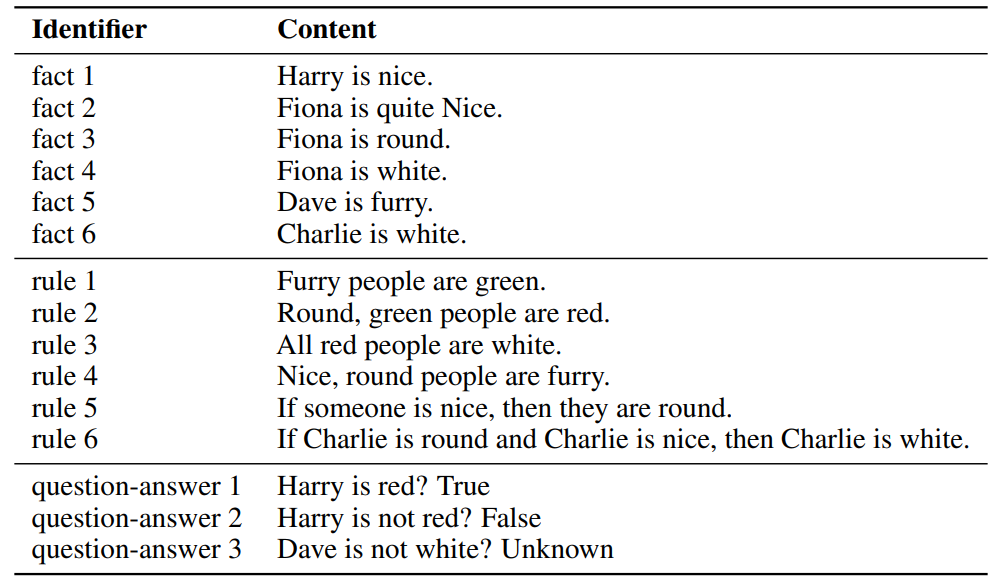
\ Table 7: An example from the dataset ProofWriter. There are 6 facts and 6 rules mapped to three question-answer pairs. Each question can be answered based on the given facts and rules.

are conducted on a cluster with NVIDIA A100 (40GB) GPUs. All the baseline experiments are conducted on a local machine with NVIDIA RTX 3090 GPU (24GB).

\ Fine-tuned In-context Reasoning We set the train batch size to 16 and train the model for 6 epochs with early stopping based on the validation label accuracy. We set the learning rate to 3e-5 and use the AdamW optimizer with ϵ set to 1e-8. We validate the model on the development set for every epoch and select the best checkpoint using the validation accuracy as the metric.

\ RECKONING In the inner loop, we generally perform 4 gradient steps for lower-hop questions (2, 3, 4-hop) and 5 gradient steps for higher-hop questions (5 and 6-hop). We select the AdamW [46] as the optimizer for the inner loop since the main task is language modeling. The inner-loop learning rate is set to 3e-5 before training, and the algorithm dynamically learns a set of optimal learning rates when converged. In our experiments and analysis, we only report the results from RECKONING with a multi-task objective since its performance is better than the single-task objective. In the outer loop, we also use the AdamW with a learning rate of 3e-5. For both optimizers, we set ϵ to 1e-8. We set the train batch size to 2 due to memory limitations. We apply the technique of gradient accumulation and set the accumulation step to 2. We train the model for 6 epochs with early stopping. For each epoch, we validate the model twice: once in the middle and once at the end. We select the best model checkpoint based on the validation label accuracy

\

:::info Authors:

(1) Zeming Chen, EPFL (zeming.chen@epfl.ch);

(2) Gail Weiss, EPFL (antoine.bosselut@epfl.ch);

(3) Eric Mitchell, Stanford University (eric.mitchell@cs.stanford.edu)';

(4) Asli Celikyilmaz, Meta AI Research (aslic@meta.com);

(5) Antoine Bosselut, EPFL (antoine.bosselut@epfl.ch).

:::


:::info This paper is available on arxiv under CC BY 4.0 DEED license.

:::

\

Disclaimer: The articles reposted on this site are sourced from public platforms and are provided for informational purposes only. They do not necessarily reflect the views of MEXC. All rights remain with the original authors. If you believe any content infringes on third-party rights, please contact service@support.mexc.com for removal. MEXC makes no guarantees regarding the accuracy, completeness, or timeliness of the content and is not responsible for any actions taken based on the information provided. The content does not constitute financial, legal, or other professional advice, nor should it be considered a recommendation or endorsement by MEXC.

You May Also Like

Superstate launches an on-chain direct issuance solution, enabling companies to raise funds in stablecoins to issue tokenized shares.

Superstate launches an on-chain direct issuance solution, enabling companies to raise funds in stablecoins to issue tokenized shares.

PANews reported on December 10th that Superstate, led by Compound founder Robert Leshner, announced the launch of "Direct Issuance Programs." This program allows publicly traded companies to raise funds directly from KYC-verified investors by issuing tokenized shares, with investors paying in stablecoins and settling instantly. The service will run on Ethereum and Solana, with the first offering expected to launch in 2026. The program requires no underwriters, complies with SEC regulations, and aims to promote the on-chaining of capital markets.
Share
PANews2025/12/10 21:07
Trump to start final Fed chair interviews beginning with Kevin Warsh

Trump to start final Fed chair interviews beginning with Kevin Warsh

The post Trump to start final Fed chair interviews beginning with Kevin Warsh appeared on BitcoinEthereumNews.com. President Donald Trump will begin the final interviews of candidates for the Federal Reserve chair this week, putting back on track the formal selection process that began this summer. “We’re going to be looking at a couple different people, but I have a pretty good idea of who I want,” Trump said Tuesday night aboard Air Force One to reporters. The interviews by Trump and Treasury Secretary Scott Bessent will begin with former Fed governor Kevin Warsh on Wednesday and also include Kevin Hassett, the director of the National Economic Council, at some point, according to two sources. It restarts the process that was derailed a bit last week when interviews with candidates were abruptly canceled. Trump said recently he knew who he was going to pick to replace current Chair Jerome Powell, and prediction markets overwhelmingly believed it would be Hassett. But his possible selection received some pushback from the markets recently, especially among fixed income investors concerned Hassett would only do Trump’s bidding and keep rates too low even if inflation snaps back. So it’s unclear if these interviews are a sign Trump has changed his mind or just the final stage of the formal process. CNBC first reported in October that Trump had narrowed the candidate list down to five people. Four of those five will be part of these final interviews. The group also includes current Governors Christopher Waller and Michelle Bowman as well as BlackRock fixed income chief Rick Rieder. The Fed will likely lower rates for a third time this year on Wednesday, but Powell, whose term as chair is up in May, is expected to strike a cautious tone at his post-meeting press conference on how much lower the central bank will go next year. The Fed’s latest forecast released in September called…
Share
BitcoinEthereumNews2025/12/10 21:07