You learn by comparing to what you already know. I was recently bitten by assuming Rust worked as Java regarding transitive dependency version resolution. In this post, I want to compare the two.You learn by comparing to what you already know. I was recently bitten by assuming Rust worked as Java regarding transitive dependency version resolution. In this post, I want to compare the two.

Transitive Dependency Version Resolution in Rust and Java: Comparing the Two

2025/09/21 23:00

You learn by comparing to what you already know. I was recently bitten by assuming Rust worked as Java regarding transitive dependency version resolution. In this post, I want to compare the two.

Dependencies, Transitivity, and Version Resolution

Before diving into the specifics of each stack, let's describe the domain and the problems that come with it.

\ When developing any project above Hello World level, chances are you'll face problems that others have faced before. If the problem is widespread, the probability is high that somebody was kind and civic-minded enough to have packaged the code that solves it, for others to re-use. Now, you can use the package and focus on solving your core problem. It's how industry builds most projects today, even if it brings other problems: you sit on the shoulders of giants.

\ Languages come with build tools that can add such packages to your project. Most of them refer to packages you add to your project as dependencies. In turn, projects' dependencies can have their own dependencies: the latter are called transitive dependencies.
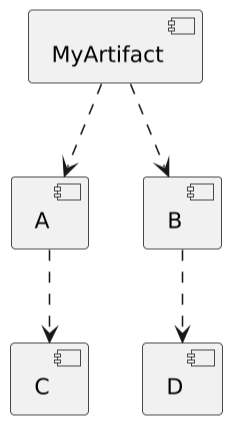
Transitive dependencies

In the above diagram, C and D are transitive dependencies.

\ Transitive dependencies have issues on their own. The biggest one is when a transitive dependency is required from different paths, but in different versions. In the diagram below, A and B both depend on C, but on different versions of it.
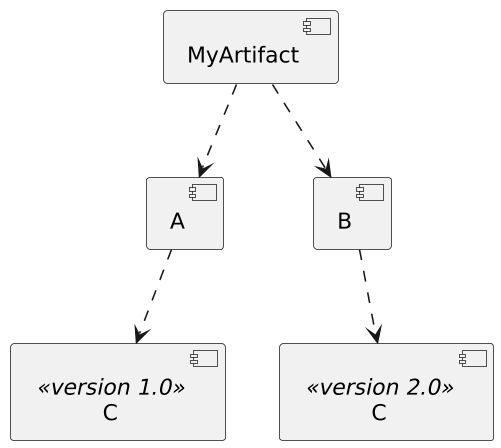
Which version of C should the build tool include in your project? Java and Rust have different answers. Let's describe them in turn.

Java Transitive Dependency Version Resolution

Reminder: Java code compiles to bytecode, which is then interpreted at runtime (and sometimes compiled to native code, but this is outside of our current problem space). I'll first describe runtime dependency resolution and build-time dependency resolution.

\ At runtime, the Java Virtual Machine offers the concept of a classpath. When having to load a class, the runtime searches through the configured classpath in order. Imagine the following class:

public static Main {     public static void main(String[] args) {         Class.forName("ch.frankel.Dep");     } } 

\ Let's compile it and execute it:

java -cp ./foo.jar:./bar.jar Main 

\ The above will first look in the foo.jar for the ch.frankel.Dep class. If found, it stops there and loads the class, regardless of whether it might also be present in the bar.jar; if not, it looks further in the bar.jar class. If still not found, it fails with a ClassNotFoundException.

\ Java's runtime dependency resolution mechanism is ordered and has a per-class granularity. It applies whether you run a Java class and define the classpath on the command line as above, or whether you run a JAR that defines the classpath in its manifest.

\ Let's change the above code to the following:

public static Main {     public static void main(String[] args) {         var dep = new ch.frankel.Dep();     } } 

\ Because the new code references Dep directly, new code requires class resolution at compile-time. Classpath resolution works in the same way:

javac -cp ./foo.jar:./bar.jar Main 

\ The compiler looks for Dep in foo.jar, then in bar.jar if not found. The above is what you learn at the beginning of your Java learning journey.

\ Afterwards, your unit of work is the Java Archive, known as the JAR, instead of the class. A JAR is a glorified ZIP archive, with an internal manifest that specifies its version.

\ Now, imagine that you're a user of foo.jar. Developers of foo.jar set a specific classpath when compiling, possibly including other JARs. You'll need this information to run your own command. How does a library developer pass this knowledge to downstream users?

\ The community came up with a few ideas to answer this question: The first response that stuck was Maven. Maven has the concept of Project Object Model, where you set your project's metadata, as well as dependencies. Maven can easily resolve transitive dependencies because they also publish their POM, with their own dependencies. Hence, Maven can trace each dependency's dependencies down to the leaf dependencies.

\ Now, back to the problem statement: how does Maven resolve version conflicts? Which dependency version will Maven resolve for C, 1.0 or 2.0?

\ The documentation is clear: the nearest.
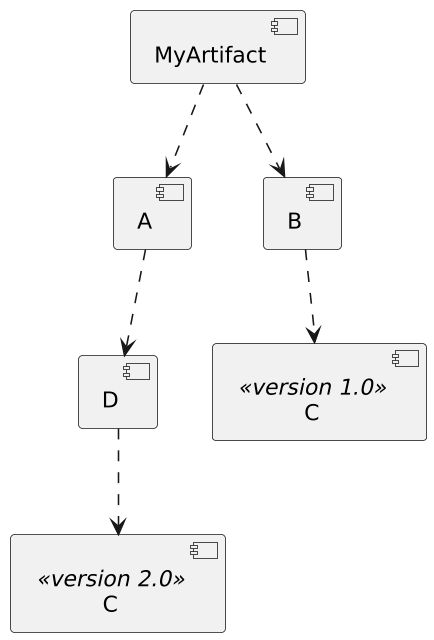
Dependency resolution with the same dependency in different versions

In the above diagram, the path to v1 has a distance of two, one to B, then one to C; meanwhile, the path to v2 has a distance of three, one to A, then one to D, then finally one to C. Thus, the shortest path points to v1.

\ However, in the initial diagram, both C versions are at the same distance from the root artifact. The documentation provides no answer. If you're interested in it, it depends on the order of declaration of A and B in the POM! In summary, Maven returns a single version of a duplicated dependency to include it on the compile classpath.

\ If A can work with C v2.0 or B with C 1.0, great! If not, you'll probably need to upgrade your version of A or downgrade your version of B, so that the resolved C version works with both. It's a manual process that is painful–ask me how I know. Worse, you might find out there's no C version that works with both A and B. Time to replace A or B.

Rust Transitive Dependency Version Resolution

Rust differs from Java in several aspects, but I think the following are the most relevant for the sake of our discussion:

  • Rust has the same dependency tree at compile-time and at runtime
  • It provides a build tool out of the box, Cargo
  • Dependencies are resolved from source

\ Let's examine them one by one.

\ Java compiles to bytecode, then you run the latter. You need to set the classpath both at compilation time and at runtime. Compiling with a specific classpath and running with a different one can lead to errors. For example, imagine you compile with a class you depend on, but the class is absent at runtime. Or alternatively, it's present, but in an incompatible version.

\ Contrary to this modular approach, Rust compiles to a unique native package the crate's code and every dependency. Moreover, Rust provides its own build too, thus avoiding having to remember the quirks of different tools. I mentioned Maven, but other build tools likely have different rules to resolve the version in the use case above.

\ Finally, Java resolves dependencies from binaries: JARs. On the contrary, Rust resolves dependencies from sources. At build time, Cargo resolves the entire dependency tree, downloads all required sources, and compiles them in the correct order.

\ With this in mind, how does Rust resolve the version of the C dependency in the initial problem? The answer may seem strange if you come from a Java background, but Rust includes both. Indeed, in the above diagram, Rust will compile A with C v1.0 and compile B with C v2.0. Problem solved.

Conclusion

JVM languages, and Java in particular, offer both a compile-time classpath and a runtime classpath. It allows modularity and reusability, but opens the door to issues regarding classpath resolution. On the other hand, Rust builds your crate into a single self-contained binary, whether a library or an executable.

\ To go further:

  • Maven - Introduction to the Dependency Mechanism
  • Effective Rust - Item 25: Manage your dependency graph

Originally published at A Java Geek on September 14th, 2025

Disclaimer: The articles reposted on this site are sourced from public platforms and are provided for informational purposes only. They do not necessarily reflect the views of MEXC. All rights remain with the original authors. If you believe any content infringes on third-party rights, please contact service@support.mexc.com for removal. MEXC makes no guarantees regarding the accuracy, completeness, or timeliness of the content and is not responsible for any actions taken based on the information provided. The content does not constitute financial, legal, or other professional advice, nor should it be considered a recommendation or endorsement by MEXC.

You May Also Like

The Urgency Index: BullZilla “Sell-Out Clock” Is the Hottest Metric in Best Crypto to Buy Now as XRP and Cardano Stable

The Urgency Index: BullZilla “Sell-Out Clock” Is the Hottest Metric in Best Crypto to Buy Now as XRP and Cardano Stable

What if the best crypto to buy right now wasn’t a top-20 coin, but a presale project exploding so fast that stages flip every 48 hours, or sooner if $100,000 pours in? That’s exactly what’s happening with the BullZilla presale, now considered one of the most explosive launches of 2025. While the broader market gains momentum, BullZilla crypto is moving at an unmatched speed, triggering intense FOMO and attracting early investors seeking massive upside. The BZIL presale is built on a unique stage progression system that rewards early buyers with massive ROI. BullZilla coin buyers in Stage 13 have already seen ROI boosts exceeding 1,500% against its listing price. This performance alone secures BullZilla’s status among the best crypto to buy right now, combining scarcity, narrative-driven branding, and deflationary mechanics that mimic the success arcs of previous 1000x meme tokens. Even as XRP jumps and Cardano holds firm, BullZilla price action continues to dominate investor conversations. The presale tally has crossed $1 million, over 3,600 holders, and more than 32 billion BZIL tokens sold. Meanwhile, staged increases, such as the jump from $0.00032572 to $0.00033238, demonstrate that early buyers benefit instantly. It’s no surprise that traders repeatedly call BullZilla the best crypto to buy right now, driven by its high-energy presale momentum. BullZilla Presale: The New Gold Standard for Early-Stage ROI The BullZilla presale is engineered to reward urgency. With price increases locked every 48 hours or once each stage hits $100,000, investors find themselves in a high-adrenaline race to secure tokens before the next price bump. This structure alone elevates BZIL into the category of the best crypto to buy right now, particularly for anyone who understands how early-stage tokenomics create exponential returns. The Urgency Index: BullZilla "Sell-Out Clock" Is the Hottest Metric in Best Crypto to Buy Now as XRP and Cardano Stable 4 BullZilla price has been rising with precision and consistency. From earlier phases to Stage 13, early supporters witnessed 5,564.69% ROI, proving that entry timing is everything. Beyond ROI, scarcity ensures long-term value. Token burns are hard-coded into supply mechanics, with each burn tightening the supply and increasing token desirability. Combined with active staking, referral bonuses, and cinematic branding, BullZilla crypto surpasses traditional presales and justifies its title as the best crypto to buy right now for high-growth seekers. As bullish sentiment rises across the market, BZIL presale stands out as the project moving with the greatest velocity. Its ability to generate organic hype without relying on artificial inflation or paid influencer campaigns further solidifies its reputation as the best crypto to buy right now. Scarcity, Burns & Stage 13B: BullZilla’s Formula for Explosive Gains One of BullZilla’s most powerful catalysts is the scarcity baked into its tokenomics. Stage 13B, priced at $0.00033238 is witnessing rapid depletion, with less than 90,000 tokens remaining. Over 666,666 tokens have already been burned, proving that BullZilla’s deflationary mechanics are not theoretical, they are actively shaping supply and investor expectations. As supply shrinks and demand accelerates, BullZilla coin naturally strengthens its position as the best crypto to buy right now, especially for investors seeking tokens with built-in scarcity. Historically, meme coins with aggressive burn structures have outperformed expectations (e.g., SHIB’s early surge), and BullZilla crypto mirrors this pattern with even tighter presale controls. The storytelling aspect of BullZilla also amplifies its appeal. Unlike generic meme coins, BZIL introduces stage names like Zilla Sideways Smash, a branding strategy that enhances memorability and community engagement. This narrative construction makes investors feel connected to the project’s progression, increasing loyalty and enthusiasm. With each price surge, burned token event, and presale milestone, BullZilla adds another layer to its identity, strengthening its claim as the best crypto to buy right now. XRP ($XRP): Strong Momentum, But Still Overshadowed by BullZilla’s Presale Pace XRP has recorded a 7% jump, reaching $2.19 in the last 24 hours. Momentum is strong, fueled by positive sentiment and increased inflows of liquidity. For traditional crypto traders, this is encouraging, but compared to the explosive movement in the BullZilla presale, XRP’s pace appears more stable than aggressive. XRP remains a reliable asset backed by institutional interest and large-scale adoption. It has strong fundamentals, a resilient community, and long-term relevance in the payments sector. However, XRP’s growth curve is steady rather than exponential. When compared to BullZilla coin’s rapid-staging price increases, XRP doesn’t deliver the immediate high-risk, high-reward opportunity that traders seeking the best crypto to buy right now often chase. XRP is strong, but it is not multiplying investor capital at the same speed as BZIL presale. The difference is simple: XRP grows with utility and market cycles, while BullZilla grows through staged presale mechanics designed to maximize early ROI. Cardano (ADA): Stability, Expansion, and Slow-Building Growth Cardano trades with consistent performance, driven by ongoing ecosystem development and staking participation. Its layered blockchain architecture and research-focused roadmap keep it positioned as a dependable long-term investment. ADA remains one of the most academically respected blockchains in the world. But the challenge for Cardano is time. Its growth is slow, steady, and fundamentally driven, not explosive. For investors prioritizing immediate gains or early-stage risk plays, ADA cannot compete with the energy, scarcity mechanics, and stage-based ROI of the BullZilla presale. While ADA is excellent for holding, staking, and long-term stability, it lacks the rapid movement that makes BullZilla the best crypto to buy right now. Cardano is a backbone asset in any diversified portfolio. But for traders looking for a high-octane opportunity where small capital can generate exponential growth, BullZilla price action remains unmatched. How to Join BullZilla Before Stage 13C Hits For investors ready to enter one of the best crypto to buy right now, the steps are simple: Visit the official BullZilla presale portal.Connect your Web3 wallet.Purchase BZIL using ETH, USDT, or card. Stake immediately to earn rewards. Use referral codes for up to 10% bonuses. With stages progressing rapidly, timing is crucial. Each delay risks entering at a higher BullZilla price, reducing overall token allocation and potential ROI. The Urgency Index: BullZilla "Sell-Out Clock" Is the Hottest Metric in Best Crypto to Buy Now as XRP and Cardano Stable 5 Conclusion: BullZilla Dominates the Market Conversation The crypto market is gaining momentum, but no project is generating more excitement than the BZIL presale. With explosive early-stage ROI, rapid stage progression, token burns, scarcity mechanics, and narrative-driven hype, BullZilla crypto stands alone as the best crypto to buy right now for investors seeking exponential returns. XRP is climbing, Cardano remains fundamentally strong, but neither matches BullZilla’s presale velocity. With a price of $0.00033238, over 32 billion tokens sold, 3,600+ holders, and millions raised, the BullZilla presale is quickly becoming the most-watched meme coin launch of 2025. If you’re looking for the best crypto to buy right now, the window to enter BullZilla before Stage 13C is closing fast. The Urgency Index: BullZilla "Sell-Out Clock" Is the Hottest Metric in Best Crypto to Buy Now as XRP and Cardano Stable 6 For More Information:  BZIL Official Website Join BZIL Telegram Channel Follow BZIL on X  (Formerly Twitter) Summary The article spotlights BullZilla as the breakout opportunity in the crypto market, emphasizing the explosive momentum of the BZIL presale, which is already accelerating through stages that shift every 48 hours or once $100,000 is raised. Investors are urged to join the earliest round to secure the highest possible gains before prices increase. Alongside BullZilla, the article compares XRP and Cardano, but reinforces that BullZilla’s early–stage mechanics create a uniquely powerful setup for rapid growth. Throughout the piece, the phrase “best crypto to buy right now” is repeatedly positioned to establish BZIL as the top contender in the current market, supported by hype-driven analysis of BullZilla price potential, BullZilla crypto appeal, and the expanding excitement around the BZIL presale Read More: The Urgency Index: BullZilla “Sell-Out Clock” Is the Hottest Metric in Best Crypto to Buy Now as XRP and Cardano Stable">The Urgency Index: BullZilla “Sell-Out Clock” Is the Hottest Metric in Best Crypto to Buy Now as XRP and Cardano Stable
Share
Coinstats2025/12/08 02:15
Exploring Market Buzz: Unique Opportunities in Cryptocurrencies

Exploring Market Buzz: Unique Opportunities in Cryptocurrencies

In the ever-evolving world of cryptocurrencies, recent developments have sparked significant interest. A closer look at pricing forecasts for Cardano (ADA) and rumors surrounding a Solana (SOL) ETF, coupled with the emergence of a promising new entrant, Layer Brett, reveals a complex market dynamic. Cardano's Prospects: A Closer Look Cardano, a stalwart in the blockchain space, continues to hold its ground with its research-driven development strategy. The latest price predictions for ADA suggest potential gains, predicting a double or even quadruple increase in its valuation. Despite these optimistic forecasts, the allure of exponential gains drives traders toward more speculative ventures. The Buzz Around Solana ETF The potential introduction of a Solana ETF has the crypto community abuzz, potentially catapulting SOL prices to new heights. As investors await regulatory decisions, the impact of such an ETF on Solana's value could be substantial, potentially reaching up to $300. However, as with Cardano, the substantial market capitalization of Solana may temper its growth potential. Why Layer Brett is Gaining Traction Amidst established names, a new contender, Layer Brett, has started to capture the market's attention with its early presale stages. Offering a low entry price of just $0.0058 and promising over 700% in staking rewards, Layer Brett presents a tempting proposition for those looking to maximize returns. Comparative Analysis: ADA, SOL, and $LBRETT While both ADA and SOL offer stable investment choices with reliable growth, Layer Brett emerges as a high-risk, high-reward option that could potentially offer significantly higher returns due to its nascent market position and aggressive economic model. Initial presale pricing lets investors get in on the ground floor. Staking rewards currently exceed 690%, a persuasive incentive for early adopters. Backed by Ethereum's Layer 2 for enhanced transaction speed and reduced costs. A community-focused $1 million giveaway to further drive engagement and investor interest. Predicted by some analysts to offer up to 50x returns in coming years. Shifting Sands: Investor Movements As the crypto market landscape shifts, many investors, including those traditionally holding ADA and SOL, are beginning to diversify their portfolios by turning to high-potential opportunities like Layer Brett. The combination of strategic presale pricing and significant staking rewards is creating a momentum of its own. Act Fast: Time-Sensitive Opportunities As September progresses, opportunities to capitalize on these low entry points and high yield offerings from Layer Brett are likely to diminish. With increasing attention and funds being directed towards this new asset, the window to act is closing quickly. Invest in Layer Brett now to secure your position before the next price hike and staking rewards reduction. For more information, visit the Layer Brett website, join their Telegram group, or follow them on X by clicking the following links: Website Telegram X Disclaimer: This is a sponsored press release and is for informational purposes only. It does not reflect the views of Bitzo, nor is it intended to be used as legal, tax, investment, or financial advice.
Share
Coinstats2025/09/18 18:39
XRP’s Potential Surge Above $15 Amid Technical Patterns and Regulatory Clarity

XRP’s Potential Surge Above $15 Amid Technical Patterns and Regulatory Clarity

The post XRP’s Potential Surge Above $15 Amid Technical Patterns and Regulatory Clarity appeared on BitcoinEthereumNews.com. XRP is poised for a potential surge above $15 in the coming years, driven by historical technical patterns mirroring 2017 breakouts, spiking on-chain velocity in 2025, and emerging U.S. regulatory clarity that could classify it as a commodity, boosting investor confidence and institutional inflows. XRP technical patterns suggest a 600%+ gain, targeting $15 or higher based on multi-year chart analysis since 2014. On-chain velocity has reached record highs in 2025, indicating accelerated transaction activity and sustained price momentum. A proposed U.S. Senate bill could reclassify XRP as a commodity under CFTC oversight, potentially unlocking billions in institutional investment, according to regulatory experts. Discover XRP’s breakout potential with technical signals and regulatory tailwinds driving massive gains in 2025. Stay ahead of the crypto surge—explore key insights and predictions now. What Is Driving XRP’s Potential Price Surge in 2025? XRP’s potential price surge in 2025 stems from a confluence of technical chart patterns, surging on-chain metrics, and favorable regulatory developments in the U.S. Historical analysis shows XRP forming identical breakout structures to its 2017 rally, which could propel the price from current levels around $2.10 to over $15. This momentum is amplified by record transaction velocity and the prospect of commodity status, attracting institutional capital previously sidelined by uncertainty. How Do Historical Technical Patterns Support XRP’s Breakout? XRP’s price history reveals a series of descending triangles and consolidation phases that have preceded explosive rallies, providing a strong foundation for current predictions. From 2014, XRP formed its first major descending triangle over 1,209 days, followed by a sharp decline and subsequent reversal marked by false breakdowns below support levels. This pattern led to a dramatic surge from 2020 lows to nearly $2.00 in 2021, demonstrating XRP’s resilience. Entering 2022 and 2023, the asset consolidated between $0.40 and $0.50, building pressure for the next…
Share
BitcoinEthereumNews2025/12/08 02:54