Here’s why Polygon price is at risk of a 25% plunge
Polygon price continued its freefall, reaching its lowest level since April 21, as the broader crypto sell-off gained momentum.
Polygon (POL) dropped to $0.1915, down 32% from its highest point in May and 74% below its 2024 peak. The crash has pulled its market cap down from $5.68 billion at its peak to $2 billion today.
Polygon has underperformed the broader market due to rising competition in the layer-2 sector. Data shows it holds a total value locked of $1.17 billion and $2.3 billion in stablecoin supply.
In contrast, Base, the Coinbase-backed layer-2 launched in 2023, has $5.14 billion in TVL and $4.16 billion in stablecoins. Similarly, Arbitrum (ARB) holds over $3 billion in assets and $3.5 billion in stablecoins.
Most importantly, Unichain, launched by Uniswap (UNI) in March, has already gained $1.12 billion in assets and $316 million in stablecoins.
The Polygon token has also tumbled following the shutdown of Polygon zkEVM, which was originally acquired as Hermes for $250 million. The CEO cited delayed technical execution, lack of product-market fit, and overly ambitious goals as key reasons for the decision.
On the positive side, Nansen data indicates that Polygon’s network activity is growing. The number of transactions jumped 33% over the past 30 days to 85.6 million, while active addresses rose 23% to 6.49 million.
Its transactions and addresses are higher than a popular network like Ethereum (ETH). Ethereum’s active addresses rose by 5.5%, while its transactions rose to over 34 million.
Polygon price technical analysis
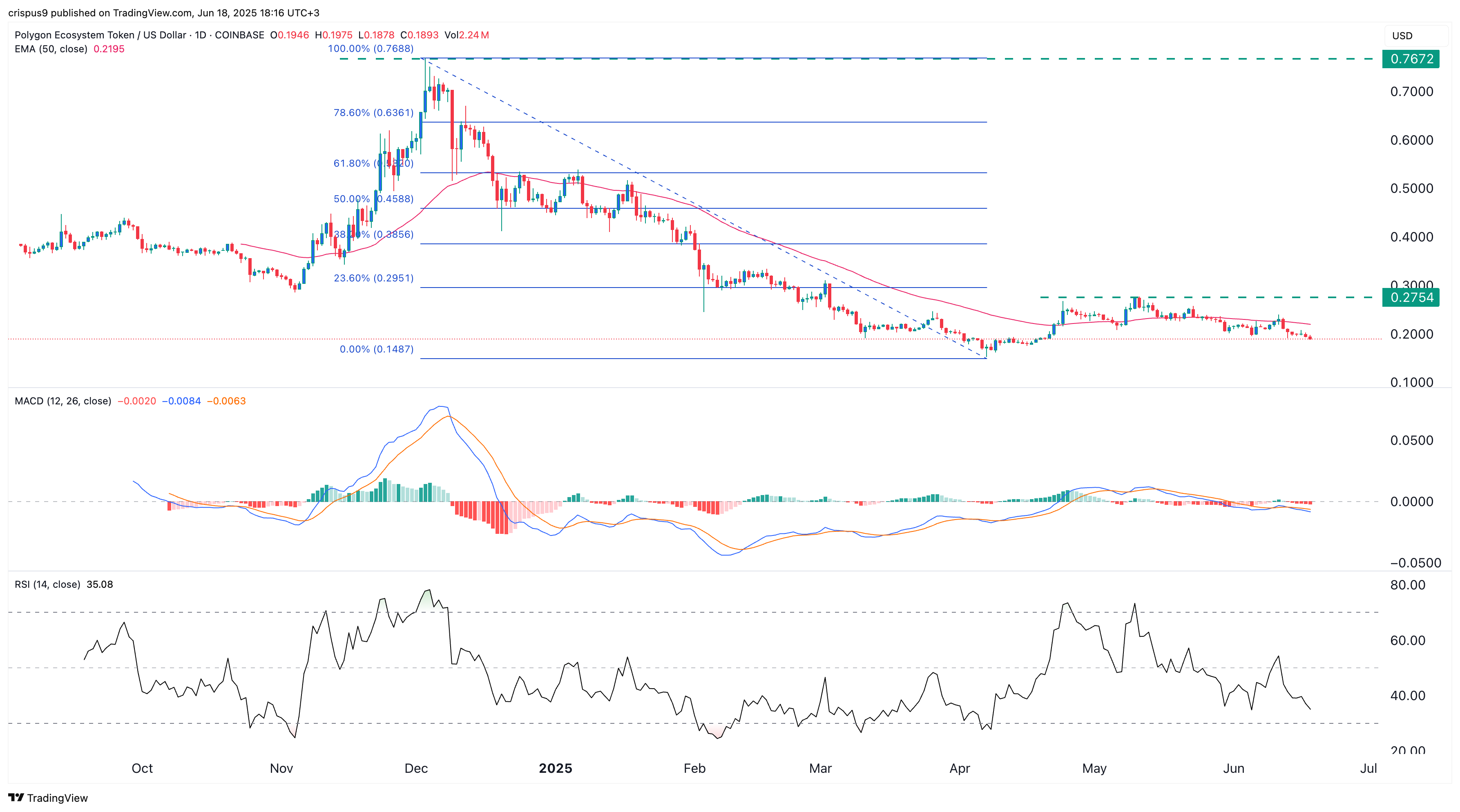
On the daily chart, the POL token peaked at $0.7672 in December. It has since plunged below the 23.6% Fibonacci retracement level at $0.2950.
POL has also fallen below its 50-day moving average. Additionally, both the MACD and Relative Strength Index have continued to decline.
Therefore, the token will likely continue dropping as sellers target the year-to-date low of $0.1487—around 26% below the current level. A move above the 50% retracement level at $0.2195 would invalidate this bearish outlook.
You May Also Like

‘European SEC’ proposal sparks licensing concerns, institutional ambitions
Legal experts are concerned that transforming ESMA into the “European SEC” may hinder the licensing of crypto and fintech in the region. The European Commission’s proposal to expand the powers of the European Securities and Markets Authority (ESMA) is raising concerns about the centralization of the bloc’s licensing regime, despite signaling deeper institutional ambitions for its capital markets structure.On Thursday, the Commission published a package proposing to “direct supervisory competences” for key pieces of market infrastructure, including crypto-asset service providers (CASPs), trading venues and central counterparties to ESMA, Cointelegraph reported.Concerningly, the ESMA’s jurisdiction would extend to both the supervision and licensing of all European crypto and financial technology (fintech) firms, potentially leading to slower licensing regimes and hindering startup development, according to Faustine Fleuret, head of public affairs at decentralized lending protocol Morpho.Read more

Western Union Eyes Stablecoin Card for Inflation Zones