This article explores the implementation of gradient descent algorithms for minimizing global loss functions in neural networks, particularly in problems governed by Rankine-Hugoniot conditions. While gradient descent reliably converges, scalability issues arise when handling large domains with many coupled networks. To address this, a domain decomposition method (DDM) is introduced, enabling parallel optimization of local loss functions. The result is faster convergence, improved scalability, and a more efficient framework for training complex AI models.This article explores the implementation of gradient descent algorithms for minimizing global loss functions in neural networks, particularly in problems governed by Rankine-Hugoniot conditions. While gradient descent reliably converges, scalability issues arise when handling large domains with many coupled networks. To address this, a domain decomposition method (DDM) is introduced, enabling parallel optimization of local loss functions. The result is faster convergence, improved scalability, and a more efficient framework for training complex AI models.

Why Gradient Descent Converges (and Sometimes Doesn’t) in Neural Networks

2025/09/19 18:38

Abstract and 1. Introduction

1.1. Introductory remarks

1.2. Basics of neural networks

1.3. About the entropy of direct PINN methods

1.4. Organization of the paper

  1. Non-diffusive neural network solver for one dimensional scalar HCLs

    2.1. One shock wave

    2.2. Arbitrary number of shock waves

    2.3. Shock wave generation

    2.4. Shock wave interaction

    2.5. Non-diffusive neural network solver for one dimensional systems of CLs

    2.6. Efficient initial wave decomposition

  2. Gradient descent algorithm and efficient implementation

    3.1. Classical gradient descent algorithm for HCLs

    3.2. Gradient descent and domain decomposition methods

  3. Numerics

    4.1. Practical implementations

    4.2. Basic tests and convergence for 1 and 2 shock wave problems

    4.3. Shock wave generation

    4.4. Shock-Shock interaction

    4.5. Entropy solution

    4.6. Domain decomposition

    4.7. Nonlinear systems

  4. Conclusion and References

3. Gradient descent algorithm and efficient implementation

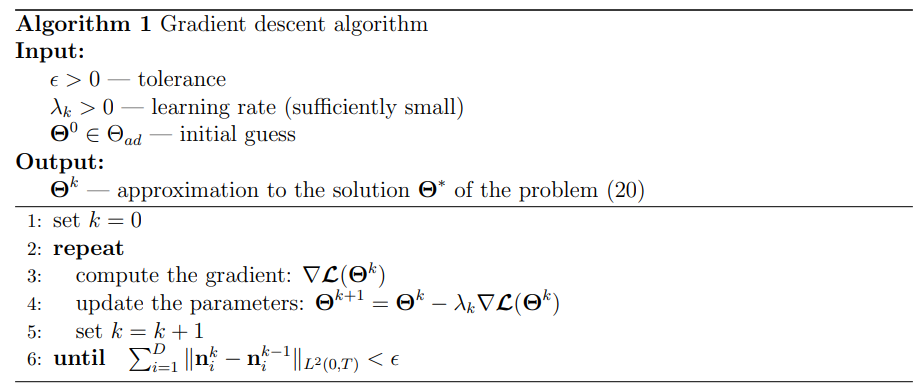
In this section we discuss the implementation of gradient descent algorithms for solving the minimization problems (11), (20) and (35). We note that these problems involve a global loss functional measuring the residue of HCL in the whole domain, as well Rankine-Hugoniot conditions, which results in training of a number of neural networks. In all the tests we have done, the gradient descent method converges and provides accurate results. We note also, that in problems with a large number of DLs, the global loss functional couples a large number of networks and the gradient descent algorithm may converge slowly. For these problems we present a domain decomposition method (DDM).

3.1. Classical gradient descent algorithm for HCLs

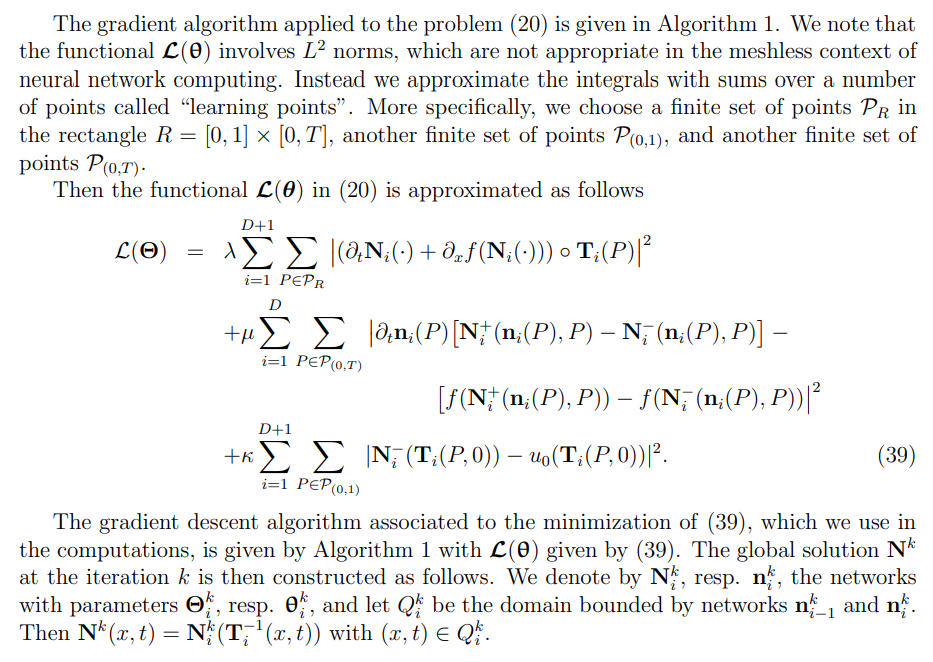
All the problems (11), (20) and (35) being similar, we will demonstrate in details the algorithm for the problem (20). We assume that the solution is initially constituted by i) D ∈ {1, 2, . . . , } entropic shock waves emanating from x1, . . . , xD, ii) an arbitrary number of rarefaction waves, and that iii) there is no shock generation for t ∈ [0, T].

\
\
3.2. Gradient descent and domain decomposition methods

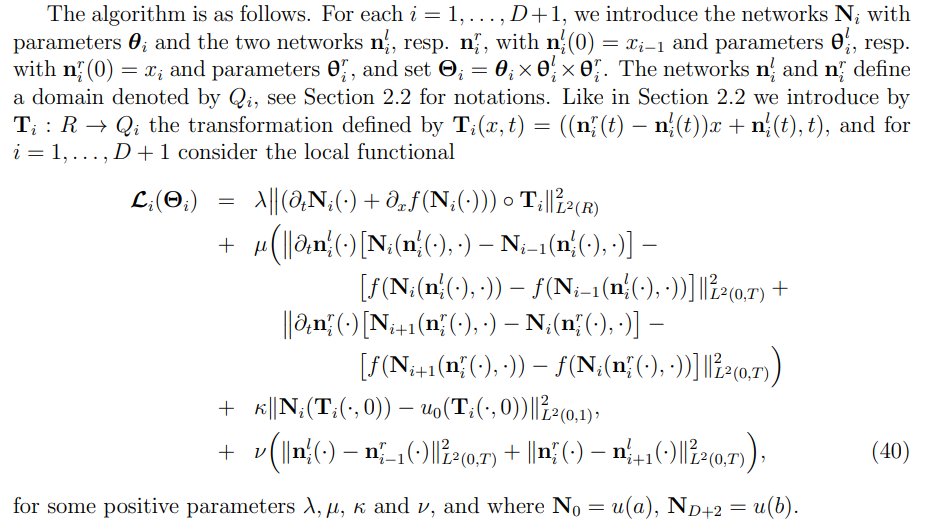
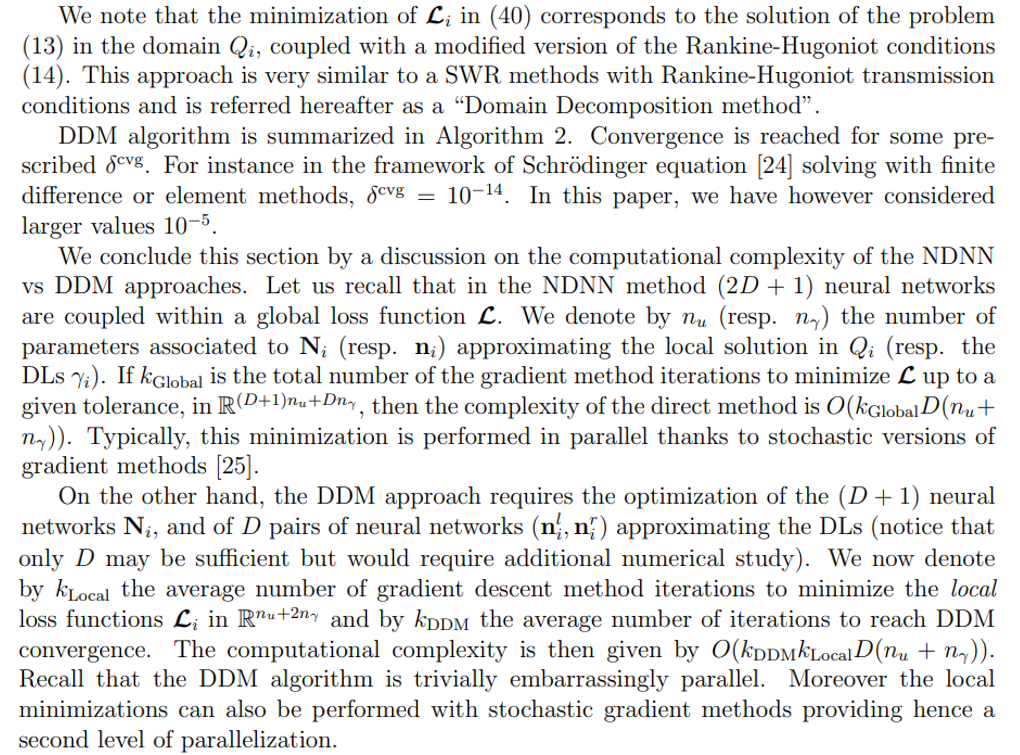
Rather than minimizing the global loss function (21) (or (12), (36)), we here propose to decouple the optimization of the neural networks, and make it scalable. The approach is closely connected to domain decomposition methods (DDMs) Schwarz Waveform Relaxation (SWR) methods [21, 22, 23]. The resulting algorithm allows for embarrassingly parallel computation of minimization of local loss functions.

\ \
\ \ \
\ \ \
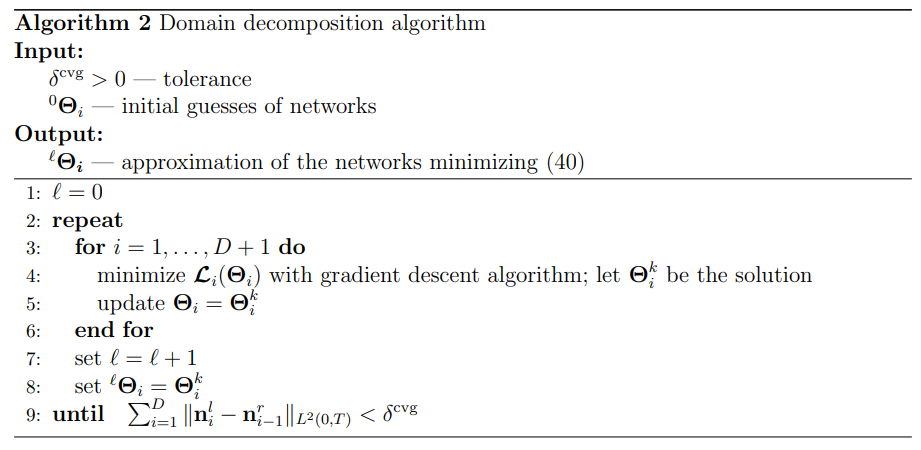
\ \ In conclusion, the DDM becomes relevant thanks to its scalability and for kDDMkLocal < kGlobal, which is expected for D large.

\

:::info Authors:

(1) Emmanuel LORIN, School of Mathematics and Statistics, Carleton University, Ottawa, Canada, K1S 5B6 and Centre de Recherches Mathematiques, Universit´e de Montr´eal, Montreal, Canada, H3T 1J4 (elorin@math.carleton.ca);

(2) Arian NOVRUZI, a Corresponding Author from Department of Mathematics and Statistics, University of Ottawa, Ottawa, ON K1N 6N5, Canada (novruzi@uottawa.ca).

:::


:::info This paper is available on arxiv under CC by 4.0 Deed (Attribution 4.0 International) license.

:::

\

Disclaimer: The articles reposted on this site are sourced from public platforms and are provided for informational purposes only. They do not necessarily reflect the views of MEXC. All rights remain with the original authors. If you believe any content infringes on third-party rights, please contact service@support.mexc.com for removal. MEXC makes no guarantees regarding the accuracy, completeness, or timeliness of the content and is not responsible for any actions taken based on the information provided. The content does not constitute financial, legal, or other professional advice, nor should it be considered a recommendation or endorsement by MEXC.

You May Also Like

UK Looks to US to Adopt More Crypto-Friendly Approach

UK Looks to US to Adopt More Crypto-Friendly Approach

The post UK Looks to US to Adopt More Crypto-Friendly Approach appeared on BitcoinEthereumNews.com. The UK and US are reportedly preparing to deepen cooperation on digital assets, with Britain looking to copy the Trump administration’s crypto-friendly stance in a bid to boost innovation.  UK Chancellor Rachel Reeves and US Treasury Secretary Scott Bessent discussed on Tuesday how the two nations could strengthen their coordination on crypto, the Financial Times reported on Tuesday, citing people familiar with the matter.  The discussions also involved representatives from crypto companies, including Coinbase, Circle Internet Group and Ripple, with executives from the Bank of America, Barclays and Citi also attending, according to the report. The agreement was made “last-minute” after crypto advocacy groups urged the UK government on Thursday to adopt a more open stance toward the industry, claiming its cautious approach to the sector has left the country lagging in innovation and policy.  Source: Rachel Reeves Deal to include stablecoins, look to unlock adoption Any deal between the countries is likely to include stablecoins, the Financial Times reported, an area of crypto that US President Donald Trump made a policy priority and in which his family has significant business interests. The Financial Times reported on Monday that UK crypto advocacy groups also slammed the Bank of England’s proposal to limit individual stablecoin holdings to between 10,000 British pounds ($13,650) and 20,000 pounds ($27,300), claiming it would be difficult and expensive to implement. UK banks appear to have slowed adoption too, with around 40% of 2,000 recently surveyed crypto investors saying that their banks had either blocked or delayed a payment to a crypto provider.  Many of these actions have been linked to concerns over volatility, fraud and scams. The UK has made some progress on crypto regulation recently, proposing a framework in May that would see crypto exchanges, dealers, and agents treated similarly to traditional finance firms, with…
Share
BitcoinEthereumNews2025/09/18 02:21