Grayscale’s fresh SUI ETF filing trails the new leveraged TXXS debut and signals rising institutional interest. SUI price outlook shows rebound prospects above key levels, though weakness remains if support breaks. Grayscale has submitted a fresh S-1 registration to the U.S. Securities and Exchange Commission seeking approval to launch the “Grayscale Sui Trust.” The proposed [...]]]>Grayscale’s fresh SUI ETF filing trails the new leveraged TXXS debut and signals rising institutional interest. SUI price outlook shows rebound prospects above key levels, though weakness remains if support breaks. Grayscale has submitted a fresh S-1 registration to the U.S. Securities and Exchange Commission seeking approval to launch the “Grayscale Sui Trust.” The proposed [...]]]>

Grayscale Sui Trust Filing Follows Momentum From 21Shares’ SUI ETF Debut

2025/12/06 22:40
  • Grayscale’s fresh SUI ETF filing trails the new leveraged TXXS debut and signals rising institutional interest.
  • SUI price outlook shows rebound prospects above key levels, though weakness remains if support breaks.

Grayscale has submitted a fresh S-1 registration to the U.S. Securities and Exchange Commission seeking approval to launch the “Grayscale Sui Trust.” The proposed trust will offer exposure to the Sui blockchain through a publicly traded security. 

According to the filing, the trust is designed to mirror the price of SUI, subtracting fees and expenses, allowing investors to gain regulated access without directly handling the token.

The filing came shortly after 21Shares introduced the first U.S.-listed leveraged ETF linked to the Sui blockchain. That product, trading under the ticker TXXS on Nasdaq, is designed to offer twice the daily price exposure of SUI using derivatives. The fund saw more than 4,700 shares traded on its first day of launch and ended the session at $24.57. 
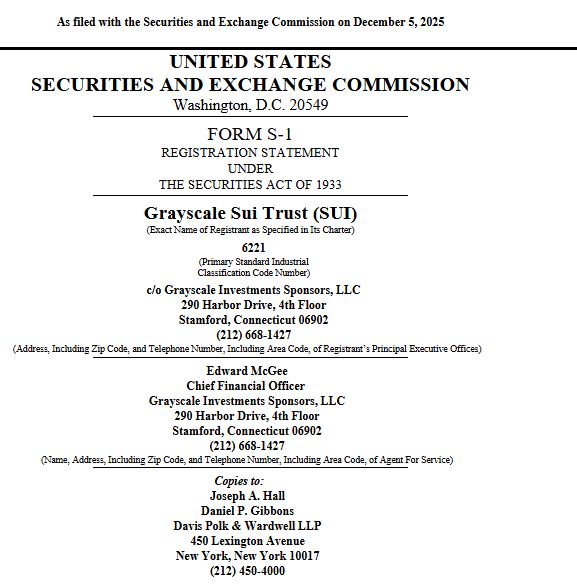
Grayscale Sui Trust Filing Follows Momentum From 21Shares’ SUI ETF DebutSource: Sec.gov

Grayscale’s application adds to its broader expansion of single-asset ETFs in 2025. As we reported, the company introduced a Chainlink ETF earlier this week on NYSE Arca and began trading a Dogecoin ETF on November 24. It has also filed to convert its Zcash Trust into a spot ETF. These steps show an effort to satisfy growing investor demand for access to individual tokens through financial products.

Broader ETF Interest Around SUI

The listing of TXXS came during a time of rising institutional and retail investors’ interest in the Sui network. The token appeal comes from its fast transaction processing, developer-friendly design, and the rising activity of stablecoin transactions on the chain. These factors make SUI a potential candidate for an ETF.

Russell Barlow, CEO of 21Shares, commented on the release of TXXS, stating, 

In July, Canary Funds also entered the SEC review process with a separate proposal for a spot SUI fund. While that product has not yet received approval, its filing marked another example of asset managers seeking regulated vehicles tied to this blockchain. 

SUI Market Performance

As of latest data, SUI was priced at $1.53, and its market cap stands at $5.75 billion. It saw a daily decline of 5.86%, and the trading volume reached $870 million. 

Analysts pointed to a support zone at $1.31 as a level that may allow for recovery toward $1.60. If price strength continues, breaking the $1.64 resistance could create a path toward $1.97, with the next technical ceiling at $2.18. However, if the support at $1.28 does not hold, a drop toward $0.9171 could follow.

Ali Martinez stated in his X post that both the SUI chart and its fundamentals are giving positive buy signals at the moment, suggesting that the recent price drop may be temporary.

]]>
Disclaimer: The articles reposted on this site are sourced from public platforms and are provided for informational purposes only. They do not necessarily reflect the views of MEXC. All rights remain with the original authors. If you believe any content infringes on third-party rights, please contact service@support.mexc.com for removal. MEXC makes no guarantees regarding the accuracy, completeness, or timeliness of the content and is not responsible for any actions taken based on the information provided. The content does not constitute financial, legal, or other professional advice, nor should it be considered a recommendation or endorsement by MEXC.

You May Also Like

Wall Street Giant Bernstein Predicts Bitcoin Price To Hit $1 Million By 2033

Wall Street Giant Bernstein Predicts Bitcoin Price To Hit $1 Million By 2033

Wall Street research firm Bernstein has reiterated one of the boldest long-term calls in traditional finance, confirming a $1 million Bitcoin price target for 2033 while materially revising how and when it expects the market to get there. Bernstein Keeps $1 Million Price Target For Bitcoin The latest shift surfaced after Matthew Sigel, head of digital assets research at VanEck, shared an excerpt from a new Bernstein note on X. In it, the analysts write: “In view of recent market correction, we believe, the Bitcoin cycle has broken the 4-year pattern (cycle peaking every 4 years) and is now in an elongated bull-cycle with more sticky institutional buying offsetting any retail panic selling.” The analyst from Bernstein added: “Despite a ~30% Bitcoin correction, we have seen less than 5% outflows via ETFs. We are moving our 2026E Bitcoin price target to $150,000, with the cycle potentially peaking in 2027E at $200,000. Our long term 2033E Bitcoin price target remains ~$1,000,000.” Related Reading: Did 2025 Mark A Bear Market For Bitcoin? Predictions Point To A $150,000 Rally In 2026 This marks a clear evolution from Bernstein’s earlier cycle roadmap. In mid-2024, when the firm first laid out the $1 million-by-2033 thesis as part of its initiation on MicroStrategy, it projected a “cycle-high” of around $200,000 by 2025, up from an already-optimistic $150,000 target, explicitly driven by strong US spot ETF inflows and constrained supply. Subsequent commentary reiterated that path and framed Bitcoin firmly within the traditional four-year halving rhythm: ETF demand would supercharge, but not fundamentally alter, the classic post-halving boom-and-bust pattern. Reality forced an adjustment. Bitcoin did break to new highs on the back of ETF demand, validating Bernstein’s structural call that regulated spot products would be a decisive catalyst. However, price action has fallen short of the earlier timing: the market topped out in the mid-$120,000s rather than the $200,000 band originally envisaged for 2025, and a roughly 30% drawdown followed. Related Reading: Bitcoin To Hit $50 Million By 2041, Says EMJ Capital CEO What changed is not the end-state, but the path. Bernstein now argues that the four-year template has been superseded by a longer, ETF-anchored bull cycle. The critical datapoint underpinning this view is behavior in the recent correction: despite a near one-third price decline, spot Bitcoin ETFs have seen only about 5% net outflows, which the firm interprets as evidence of “sticky” institutional capital rather than the reflexive retail capitulation that defined previous tops. In the new framework, earlier targets are effectively rescheduled rather than abandoned. The mid-2020s six-figure region is shifted out by roughly one to two years, with $150,000 now penciled in for 2026 and a potential cycle peak near $200,000 in 2027, while the 2033 $1 million objective is left unchanged. In that sense, Bernstein’s track record is mixed but internally consistent. The firm has been directionally right on the drivers—ETF adoption, institutionalization, and supply absorption—but too aggressive on the speed at which those forces would translate into price. The latest note formalizes that recognition: same destination, slower ascent, and a Bitcoin market that Bernstein now sees as governed less by halvings and more by the behavior of large, ETF-mediated capital pools over the rest of the decade. At press time, BTC traded at $90,319. Featured image created with DALL.E, chart from TradingView.com
Share
NewsBTC2025/12/10 01:00