

Building the "TCP/IP" of Modern Messaging: Architecting a Universal Communication Highway
We have a paradox: We are more connected than ever, yet our communication is more fragmented than ever.
If I want to send a file to a colleague, I have to remember: "Do they use WhatsApp? Slack? Signal? Or was it Teams?" Unlike Email (SMTP), which is a protocol, modern messaging apps are walled gardens.
But the problem gets worse when you add AI Agents and IoT devices to the mix. How does your Fridge communicate with your ChatGPT bot? How does a Customer Support AI on Telegram route an alert to a Supervisor on Teams?
We need a Universal Messaging Highway (UMH).
In this architectural guide, we are going to design a middleware layer that abstracts platform complexities. We will look at how to route messages between Humans (P2P), Machines (M2M), and AI Agents (P2M) using a unified JSON envelope and GenAI-powered routing.
The Concept: From "Apps" to "Highways"
The goal is to stop thinking about "Apps" and start thinking about "Routing." The UMH acts as a hybrid between a DNS resolver and a Message Broker (like RabbitMQ or Kafka).
It creates a standardized fabric where:
- Identity is Abstracted: A user isn't just +1-555-0199; they are a Universal ID linked to multiple endpoints.
- Payloads are Standardized: A message is just a JSON blob with a header and a body.
- Context is King: GenAI enriches messages in transit to translate "Human Speak" into "Machine Commands."
The Architecture
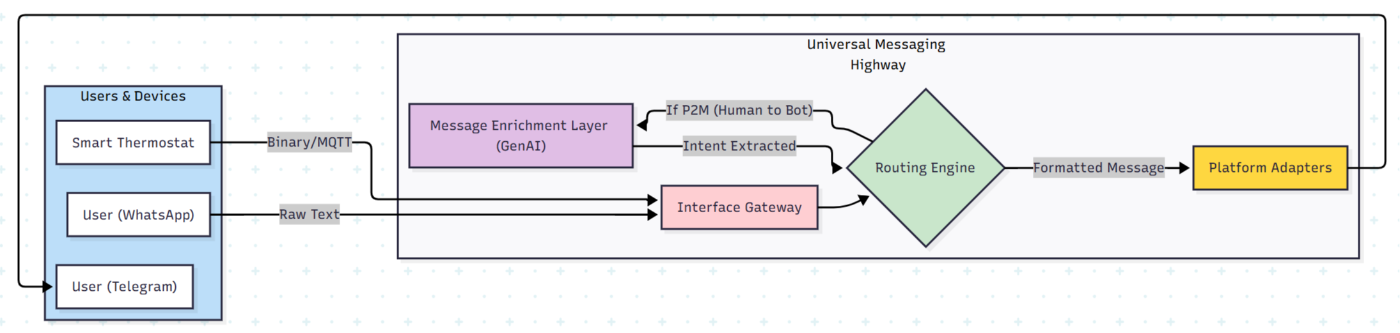
Here is the high-level data flow. Notice how the Message Enrichment Layer sits in the middle to handle translation between different "species" of nodes (Humans vs. Bots).Phase 1: The Universal Message Format (UMF)
\ 
Phase 1: The Universal Message Format (UMF)
To make Telegram talk to an IoT device, we need a common language. We can't use proprietary schemas. We need a JSON Envelope strategy.
We separate the message into Metadata (Headers) and Payload (Body). This allows us to encrypt the payload end-to-end (E2EE) while leaving the routing headers visible to the highway.
The JSON Structure
Here is the schema we will use. It supports P2P (Person-to-Person) and M2P (Machine-to-Person) flows.
{ "umh_version": "1.0", "message_id": "uuid-1234-abcd", "timestamp": "2025-11-27T10:00:00Z", // ROUTING LAYER (Visible) "source": { "type": "person", "platform": "whatsapp", "id": "user_a_handle" }, "destination": { "type": "machine", "platform": "mqtt_broker", "id": "device_thermostat_01" }, // METADATA LAYER (For Handling) "metadata": { "priority": "high", "encryption": "aes-256-gcm", // Payload is encrypted "schema_id": "urn:umh:schema:command:v1", "expiration": 3600 }, // DATA LAYER (Encrypted/Private) "payload": { "type": "command", "content_type": "application/json", "body": { "intent": "set_temperature", "value": 22, "unit": "C" } } }
Note: By using a schema_id in the metadata, we can support versioning. If an IoT device sends a binary payload (Protobuf/Avro), the header tells the receiver how to decode it.
Phase 2: The Three Traffic Flows
The power of UMH lies in Polymorphism. The payload object changes structure based on who is talking to whom.
1. P2P (Person-to-Person)
Standard chat. Cross-platform (e.g., WhatsApp to Signal). \n The payload is simple, text-heavy, and formatted for UI display.
"msg_type": "P2P", "payload": { "type": "text", "content": "Hey, are you coming to the deployment party tonight?", "format": "plain", "attachments": [] }
2. P2M (Person-to-Machine)
Intent-driven. This flow triggers the GenAI layer. \n A human sends a vague command ("Turn on the AC"). The GenAI layer processes it and replaces the payload with a structured Intent before it reaches the machine.
"msg_type": "P2M", "payload": { "intent": "SetRoomTemperature", "confidence": 0.98, "parameters": { "value": 22, "unit": "Celsius", "target_device": "LivingRoom_AC" }, "original_utterance": "Set the living room to 22 degrees." }
3. M2P (Machine-to-Person)
Data-driven. Alerts and Insights. \n Machines usually send raw logs. The UMH converts these into human-readable notifications.
"msg_type": "M2P", "payload": { "alert_type": "ThresholdExceeded", "severity": "critical", "data": { "sensor": "Temp_Sensor_04", "current_value": 85, "threshold": 70, "unit": "C" }, "action_required": true }
Phase 3: The "Message Enrichment" Layer (GenAI)
This is where standard message brokers fail. If a human sends a message to a machine, the machine expects structured data. The human sends chaos.
- User says: "It's freezing in here, turn up the heat."
- Machine needs: {"command": "set_temp", "target": 24}
We inject a Message Enrichment Step (GenAI) into the pipeline. This layer uses LLMs (like GPT-4 or local Llama-3) to perform Named Entity Recognition (NER) and Intent Detection.
The Enrichment Pipeline
We can model this process using a Python pseudo-code structure that sits within our message consumer.
import json from umh_core import llm_engine, router def process_message(message_packet): msg_type = message_packet['metadata']['msg_type'] payload = message_packet['payload'] # 1. Check if Enrichment is needed (P2M context) if msg_type == 'P2M' and payload['format'] == 'text': # 2. Extract Intent via GenAI (LLM NER) # Input: "It's freezing in here, turn up the heat." enriched_data = llm_engine.extract_intent( text=payload['content'], context=message_packet['source'] ) # Output: {"intent": "increase_temp", "entities": {"value": "high"}} # 3. Transform for Machine Consumption final_payload = { "action": enriched_data['intent'], "parameters": enriched_data['entities'] } # 4. Update Packet message_packet['payload'] = final_payload message_packet['metadata']['enriched'] = True # 5. Forward to Routing router.dispatch(message_packet)
Message Enrichment Core Functionalities:
Phase 4: The Tech Stack
You don't need to build this from zero. We can compose this architecture using existing open-source tools.
| Component | Recommended Technology | Role | |----|----|----| | Transport Core | Kafka / RabbitMQ | Handles the high-throughput message queue. | | Protocol Adapter | Matrix / XMPP | The "Federation" layer. Matrix is excellent for bridging Slack/Discord/Telegram. | | Integration | Apache Camel | For routing rules and protocol transformation (HTTP to MQTT). | | Identity | OAuth / DID | Decentralized Identity (DID) to map a user to multiple apps. | | AI Engine | LangChain + Local LLM | To run the "Enrichment" logic without leaking privacy. |
Real-World Use Case: The Smart Support Bot
- Input: A user complains on Telegram: "My order #999 is broken."
- Enrichment: GenAI detects Sentiment: Negative and extracts Order: #999.
- Routing: The Router sees "High Priority" and routes the message not to the standard chatbot, but to the Human Agent's Dashboard on Teams.
- Reply: The agent replies on Teams. UMH translates it back to Telegram.
The user never leaves Telegram; the Agent never leaves Teams. The "Highway" handles the traffic.
\
Conclusion
The era of "App Silos" is ending. By combining JSON-based routing, Protocol Adapters, and GenAI Enrichment, we can build a Universal Messaging Highway that finally connects our fragmented digital lives.
Ready to build? Start by spinning up a local Matrix Synapse server and writing a simple bridge to an MQTT broker. That’s your first step onto the highway.
You May Also Like

KindlyMD Secures A Landmark $210 Million USDT Loan From Kraken Operator

“I Wasted 8 Years in Crypto”: A Builder’s Exit Note Goes Viral Across Asia

Vivek Ramaswamy's Strive to raise $500M to buy Bitcoin
Strive, co-founded in 2022 by American entrepreneur Vivek Ramaswamy, launched a $500 million preferred stock offering to acquire more Bitcoin and Bitcoin-related products. Publicly traded asset manager and Bitcoin treasury company Strive has announced a $500 million stock sales program to raise funds for additional BTC purchases.The firm, which was co-founded in 2022 by American entrepreneur and politician Vivek Ramaswamy, stated on Tuesday that it intends to use the net proceeds from the sale for “general corporate purposes, including, among other things, the acquisition of Bitcoin and Bitcoin-related products and for working capital.”It also intends to purchase “income-generating assets” to grow the company’s business, but did not specify which. Read more