This article presents an ablation study showing that the proposed IIL method performs well with larger networksThis article presents an ablation study showing that the proposed IIL method performs well with larger networks

Network Size and Task Number: Ablation Study on IIL Performance and Stability

2025/11/12 23:30

Abstract and 1 Introduction

  1. Related works

  2. Problem setting

  3. Methodology

    4.1. Decision boundary-aware distillation

    4.2. Knowledge consolidation

  4. Experimental results and 5.1. Experiment Setup

    5.2. Comparison with SOTA methods

    5.3. Ablation study

  5. Conclusion and future work and References

    \

Supplementary Material

  1. Details of the theoretical analysis on KCEMA mechanism in IIL
  2. Algorithm overview
  3. Dataset details
  4. Implementation details
  5. Visualization of dusted input images
  6. More experimental results

12. More experimental results

12.1. Ablation study on network size

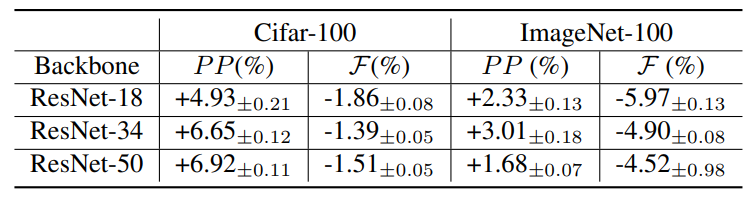
\ To investigate the impact of network size on the proposed method, we compare the performance of ResNet-18, ResNet-34 and ResNet-50 on the ImageNet-100. As shown in Tab. 5, the proposed method performs well with bigger

\ Table 5. Impact of the network size on the proposed method.
\ Table 6. Performance of the proposed method with different IIL task numbers.

\ network size. When the network size is larger, more parameters can be utilized for new knowledge learning with the proposed decision boundary-aware distillation. Hence, consolidating knowledge from student to teacher causes less forgetting.

\ 12.2. Ablation study on the task number

\ As mentioned in Sec. 7, our method accumulates the error along with the consecutive IIL tasks. However, such a kind of error accumulates slowly and mainly affects the performance on old tasks, i.e. forgetting rate. We further study the impact of task length on the performance of the proposed method by splitting the incremental data into different number of subsets. As shown in Tab. 6, with the incremental of task number, the performance promotion changes less but the forgetting rate increased slightly. Minor variation of performance promotion reveals that the proposed method is stable in learning new knowledge, irrespective of the number of tasks. The acquisition of new knowledge primarily hinges on the volume of new data involved. Although we increase the task number in the experiments, the total number of new data utilized in IIL phase is the same. While increasing the task number will increase the EMA steps, which causes more forgetting on the old data. Experimental results in Tab. 6 well validate our analysis in Sec. 7.

\ Compared to the performance promotion, forgetting on the old data is negligible. Noteworthy, when the task number is relatively small, such as 5 in Tab. 6, the proposed method slightly boosts the model’s performance on the base data. This behavior is similar with full-data model, which demonstrates the capability of our method in accumulating knowledge from new data.

\ 12.3. Detailed comparison between the KC-EMA and vanilla EMA

\ The performance of vanilla EMA and the proposed KCEMA during training is shown in Fig. 11. As can be seen, the student model’s accuracy initially plummets due to the introduction of new data. However, around the 10th epoch,

\ Figure 11. Comparison between the proposed KC-EMA and vanilla EMA during training in the first IIL task, where t denotes the teacher model and s denotes the student model. Result is achieved on Cifar-100.
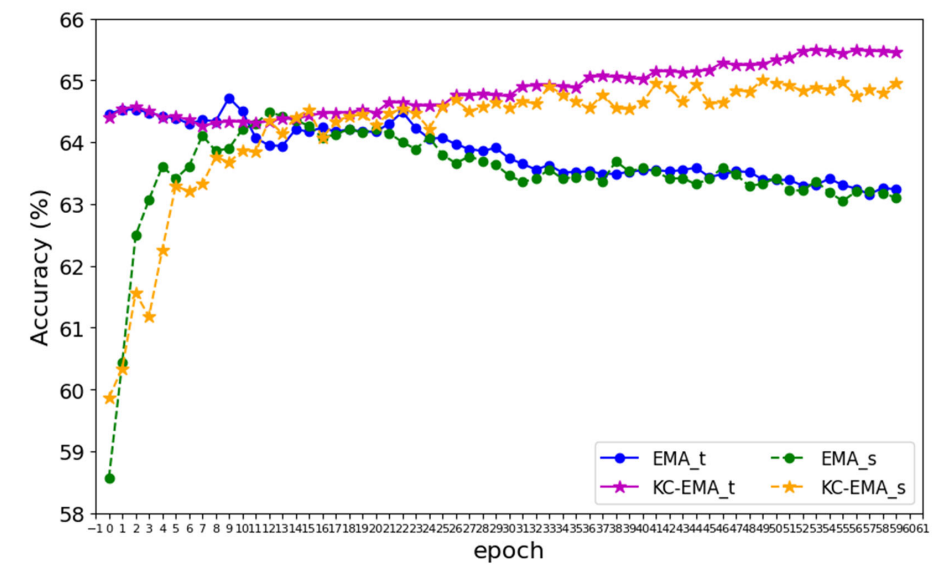
\ there’s a resurgence in accuracy for both the KC-EMA and vanilla EMA models. Therefore, we empirically set a freezing epoch of 10 in the proposed method.

\ When EMA is applied post the 10th epoch, the teacher model in the vanilla EMA is rapidly drawn towards the student model. This homogenization, however, doesn’t enhance either model. Instead, it leads to a decline in test accuracy due to overfitting to the new data. In contrast, with KC-EMA, both the teacher and student models exhibit gradual growth,, which indicates a knowledge accumulation in these two models. On one hand, consolidating new knowledge to the teacher model improves its test performance. On the other hand, a teacher model equipped with new knowledge liberates the student model to learn new data. That is, constraints from the teacher in distillation is alleviated.

\

:::info Authors:

(1) Qiang Nie, Hong Kong University of Science and Technology (Guangzhou);

(2) Weifu Fu, Tencent Youtu Lab;

(3) Yuhuan Lin, Tencent Youtu Lab;

(4) Jialin Li, Tencent Youtu Lab;

(5) Yifeng Zhou, Tencent Youtu Lab;

(6) Yong Liu, Tencent Youtu Lab;

(7) Qiang Nie, Hong Kong University of Science and Technology (Guangzhou);

(8) Chengjie Wang, Tencent Youtu Lab.

:::


:::info This paper is available on arxiv under CC BY-NC-ND 4.0 Deed (Attribution-Noncommercial-Noderivs 4.0 International) license.

:::

\

Disclaimer: The articles reposted on this site are sourced from public platforms and are provided for informational purposes only. They do not necessarily reflect the views of MEXC. All rights remain with the original authors. If you believe any content infringes on third-party rights, please contact service@support.mexc.com for removal. MEXC makes no guarantees regarding the accuracy, completeness, or timeliness of the content and is not responsible for any actions taken based on the information provided. The content does not constitute financial, legal, or other professional advice, nor should it be considered a recommendation or endorsement by MEXC.

You May Also Like

Upbit to Raise Cold Wallet Ratio to 99% Amid Liquidity Concerns

Upbit to Raise Cold Wallet Ratio to 99% Amid Liquidity Concerns

The post Upbit to Raise Cold Wallet Ratio to 99% Amid Liquidity Concerns appeared on BitcoinEthereumNews.com. South Korea’s largest cryptocurrency exchange, Upbit, announced plans to increase its cold wallet storage ratio to 99%, following a major security breach last month. The announcement comes as part of a comprehensive security overhaul following hackers’ theft of approximately 44.5 billion won ($31 million) in Solana-based assets on November 27. Upbit Strengthens Security After Second November 27 Breach According to operator Dunamu, Upbit currently maintains 98.33% of customer digital assets in cold storage as of late October, with only 1.67% held in hot wallets. The exchange stated it has completed a full wallet infrastructure overhaul and aims to reduce hot wallet holdings to below 1% in the coming months. Dunamu emphasized that customer asset protection remains Upbit’s top priority, with all breach-related losses covered by the company’s reserves. Sponsored Sponsored The breach marked Upbit’s second major hack on the same date six years ago. In 2019, North Korean hacking groups Lazarus and Andariel stole 342,000 ETH from the exchange’s hot wallet. This time, attackers drained 24 different Solana network tokens in just 54 minutes during the early morning hours. Under South Korea’s Virtual Asset User Protection Act, exchanges must store at least 80% of customer assets in cold wallets. Upbit significantly exceeds this threshold and maintains the lowest hot wallet ratio among domestic exchanges. Data released by lawmaker Huh Young showed that other Korean exchanges were operating with cold wallet ratios of 82% to 90% as of June. Upbit Outpaces Global Industry Standards Upbit’s security metrics compare favorably with those of major global exchanges. Coinbase stores approximately 98% of customer funds in cold storage, while Kraken maintains 95-97% of its funds offline. OKX, Gate.io, and MEXC each keep around 95% of their funds in cold wallets. Binance and Bybit have not disclosed specific ratios but emphasize that the majority of…
Share
BitcoinEthereumNews2025/12/10 13:37
Tidal Trust Files For ‘Bitcoin AfterDark ETF’, Could Off-Hours Trading Boost Returns?

Tidal Trust Files For ‘Bitcoin AfterDark ETF’, Could Off-Hours Trading Boost Returns?

The post Tidal Trust Files For ‘Bitcoin AfterDark ETF’, Could Off-Hours Trading Boost Returns? appeared on BitcoinEthereumNews.com. Tidal Trust has filed for the first Bitcoin AfterDark ETF with the U.S. SEC. The product looks to capture overnight price movements of the token. What Is the Bitcoin AfterDark ETF? Tidal Trust has filed with the SEC for its proposed Bitcoin AfterDark ETF product. It is an ETF that would hold the coin only during non-trading hours in the United States. This filing also seeks permission for two other BTC-linked products managed with Nicholas Wealth Management. Source: SEC According to the registration documents, the ETF would buy Bitcoin at the close of U.S. markets and then sell the position the following morning upon the reopening of trading. In other words, it will effectively hold BTC only over the night “The fund trades those instruments during U.S. overnight hours and closes them out shortly after the U.S. market opens each trading day,” the filing said. During the day, the fund’s assets switch to U.S. Treasuries, money-market funds, and similar cash instruments. That means even when the fund has 100% notional exposure to Bitcoin overnight, a substantial portion of its capital may still sit in Treasuries during the day. Eric Balchunas, senior ETF analyst cited earlier research and said, “most of Bitcoin’s gains historically occur outside U.S. market hours.” If those patterns persist, the Bitcoin AfterDark ETF token will outperform more traditional spot BTC products, he said. Source: X Balchunas added that the effect may be partly driven by positioning in existing Bitcoin ETFs and related derivatives activity. The SEC has of late taken an increasingly more accommodating approach toward crypto-related ETFs. This September, for instance, REX Shares launched the first Ethereum Staking ETF. It represented direct ETH exposure and paid out on-chain staking rewards.  Also on Tuesday, BlackRock filed an application for an iShares Staked Ethereum ETF. The filing states…
Share
BitcoinEthereumNews2025/12/10 13:00
Tempo Testnet Goes Live with Stablecoin Tools and Expanded Partners

Tempo Testnet Goes Live with Stablecoin Tools and Expanded Partners

The post Tempo Testnet Goes Live with Stablecoin Tools and Expanded Partners appeared on BitcoinEthereumNews.com. The Tempo testnet, developed by Stripe and Paradigm, is now live, enabling developers to run nodes, sync the chain, and test stablecoin features for payments. This open-source platform emphasizes scale, reliability, and integration, paving the way for instant settlements on a dedicated layer-1 blockchain. Tempo testnet launches with six core features, including stablecoin-native gas and fast finality, optimized for financial applications. Developers can create stablecoins directly in browsers using the TIP-20 standard, enhancing accessibility for testing. The project has secured $500 million in funding at a $5 billion valuation, with partners like Mastercard and Klarna driving adoption; Klarna launched a USD-pegged stablecoin last month. Discover the Tempo testnet launch by Stripe and Paradigm: test stablecoins, run nodes, and explore payment innovations on this layer-1 blockchain. Join developers in shaping the future of crypto payments today. What is the Tempo Testnet? Tempo testnet represents a pivotal milestone in the development of a specialized layer-1 blockchain for payments, created through a collaboration between Stripe and Paradigm. This public testnet allows participants to run nodes, synchronize the chain, and experiment with essential features tailored for stablecoin operations and financial transactions. By focusing on instant settlements and low fees, it addresses key limitations in traditional blockchains for real-world payment use cases. Source: Patrick Collison The Tempo testnet builds on the project’s foundation, which was first announced four months ago, with an emphasis on developer-friendly tools. It supports a range of functionalities that prioritize reliability and scalability, making it an ideal environment for testing before the mainnet rollout. As per the official announcement from Tempo, this phase will involve ongoing enhancements, including new infrastructure partnerships and stress tests under simulated payment volumes. One of the standout aspects of the Tempo testnet is its open-source nature, inviting broad community involvement. This approach not only accelerates development…
Share
BitcoinEthereumNews2025/12/10 13:01
